
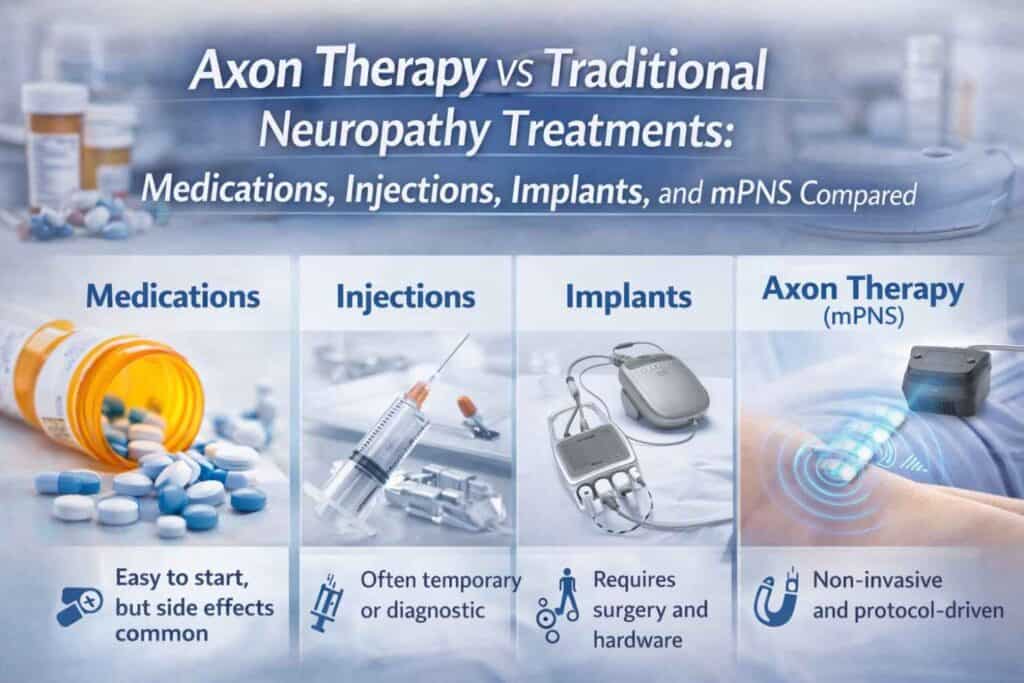
Neuropathy treatment is not one-size-fits-all. Medications are often the first step because they are guideline-supported and easy to start. Injections can help in select cases, but they are usually temporary or diagnostic rather than a true long-term plan. Implants such as spinal cord stimulators are more invasive and are usually reserved for harder, refractory cases. Axon Therapy — a form of magnetic peripheral nerve stimulation (mPNS) — sits in the middle: more advanced than simply taking a pill, but without the surgical commitment of an implanted device. The FDA clearance for the Axon system covers stimulation of peripheral nerves for relief of chronic intractable pain, post-traumatic pain, post-surgical pain, and chronic painful diabetic peripheral neuropathy in the lower extremities in adults.
For ActiveMed, this is the right way to present the therapy. Your site already positions Axon for post-traumatic nerve pain and diabetic neuropathy, and you already have related educational content on who responds best to Axon Therapy for neuropathy and Axon Therapy safety, side effects, and screening. This article should act as the comparison hub that helps patients understand where Axon fits in the neuropathy care ladder.
Where medications fit in the neuropathy treatment ladder
For many patients, especially those with painful diabetic neuropathy, medications are still the first rung of care. The American Academy of Neurology recommends offering one of four medication classes to reduce neuropathic pain: tricyclic antidepressants (TCAs), serotonin-norepinephrine reuptake inhibitors (SNRIs), gabapentinoids, and sodium channel blockers. That means any honest neuropathy comparison article has to start here, because oral medication remains the most common first move.
The strength of medications is obvious: they are familiar, accessible, and guideline-backed. The weakness is just as obvious: many people get only partial relief, and side effects can become the main story. Mayo notes common problems such as drowsiness, dizziness, and swelling with some anti-seizure medications used for diabetic neuropathy, and similar tradeoffs show up across other neuropathic pain drug classes.
This is the first place where Axon Therapy becomes clinically interesting. If a patient is not doing well with medications, does not want to keep escalating medication burden, or wants to reduce dependence on them, a non-invasive option can become more attractive. That does not mean Axon replaces medication in every case. It means it gives patients another rung on the ladder before they move toward more invasive care.
Where injections fit
Injections are often misunderstood in neuropathy care. A nerve block is an injection placed near a targeted nerve that can provide temporary pain relief and can also help confirm whether that nerve is actually the source of symptoms. Cleveland Clinic describes nerve blocks as both a treatment and a diagnostic tool, which is important because it means they often serve a more selective role than patients assume.
That makes injections very different from a structured therapy like Axon. A nerve block may be useful for focal nerve pain, for short-term symptom control, or for answering “Is this the nerve that is driving the pain?” It is usually not the same thing as a long-term treatment plan for diffuse neuropathy. For generalized painful diabetic neuropathy, mainstream guidance focuses much more on medications and neuromodulation than on routine nerve blocks.
So the clean comparison is this: injections are often targeted and temporary. Axon Therapy is non-invasive and protocol-driven. If the patient’s neuropathy is focal and the immediate goal is short-term relief or diagnostic clarity, injections may make sense. If the goal is a more structured non-implant treatment path, Axon may fit better.
Where implants fit
At the more invasive end of the ladder is spinal cord stimulation (SCS). This involves a procedure to implant leads and a pulse generator. The FDA has approved Abbott’s spinal cord stimulation systems for diabetic peripheral neuropathy of the lower extremities, which confirms that implantable neuromodulation is now part of the formal neuropathy treatment pathway.
But implants come with a different commitment level. Johns Hopkins lists risks such as infection, bleeding or hematoma, lead migration, device malfunction, and dural puncture-related headache. None of that means spinal cord stimulation is a bad option. It means it is usually a later-stage option for patients with more refractory symptoms who are ready to accept procedural and device-related risks in exchange for a stronger intervention.
This is where Axon Therapy has a strong strategic position for ActiveMed. It offers patients something more advanced than medication alone, but less invasive than an implant. That middle-ground story is one of the strongest reasons to publish this article.
Where Axon Therapy fits
The best way to position Axon is not “better than everything else.” It is “the right next step for certain patients.” In the SEAT study for chronic post-traumatic and post-surgical neuropathic pain, Axon Therapy plus conventional medical management outperformed conventional care alone, and the published safety paper reported no adverse device effects, no adverse-event withdrawals, and no serious adverse events in the Axon group through day 90. That gives ActiveMed a solid evidence-backed message for the post-traumatic and post-surgical neuropathy population.
For painful diabetic neuropathy, the newer mPNS literature reports pain relief without the side effects associated with interventional approaches, which strengthens the case for a non-implant option between medication and surgery-based neuromodulation. ActiveMed’s own Axon page now specifically highlights diabetic neuropathy as one of the treatment targets.
Put plainly, Axon Therapy is often most compelling for patients who:
- have post-traumatic or post-surgical neuropathic pain
- have painful diabetic neuropathy
- want to move beyond medications without jumping straight to an implant
- prefer a non-invasive treatment series
- are willing to complete a structured protocol and fit the clinic’s screening criteria
If the patient is asking, “Is there something between pills and surgery?” this is where Axon belongs.
How to tell which option may fit best
| Treatment type | Best fit | Main upside | Main downside |
| Medications | First-line neuropathic pain, especially painful diabetic neuropathy | Easy to start, guideline-backed | Side effects and incomplete relief are common |
| Injections / nerve blocks | Focal nerve pain, temporary relief, diagnostic use | Targeted and often fast | Usually temporary and less useful as a long-term answer for diffuse neuropathy |
| Implants / spinal cord stimulation | Refractory painful diabetic neuropathy or severe chronic neuropathic pain ready for procedural escalation | Stronger intervention for selected patients | Surgery, infection/device risks, and maintenance |
| Axon Therapy / mPNS | Patients who want to escalate beyond medications without moving to an implant, especially post-traumatic/post-surgical pain or PDN | Non-invasive, FDA-cleared, protocol-driven | Requires multiple visits and proper screening |
This table is the simplest way to explain the care ladder. Medications often start the journey. Injections may solve a focused or temporary problem. Implants are later-stage procedural options. Axon Therapy sits between them as the non-invasive escalation path.
At ActiveMed, the question is not “Axon or everything else?” It is “Where does Axon fit in your full neuropathy plan?”
That lets you naturally explain that Axon may be used alongside physical therapy for gait, balance, and function, or alongside functional medicine when blood sugar, inflammation, nutrient status, or broader metabolic issues are part of the case. ActiveMed’s site already presents care in exactly that integrative way.
FAQs
Is Axon Therapy more invasive than a nerve block?
- No. A nerve block is an injection, while Axon Therapy is non-invasive magnetic peripheral nerve stimulation delivered externally. That makes Axon less invasive than both injections and implants.
Are medications still the first treatment for painful diabetic neuropathy?
- Often, yes. The AAN recommends medication classes such as TCAs, SNRIs, gabapentinoids, and sodium channel blockers for painful diabetic neuropathy. Axon is better viewed as a next-step option when patients want more than medication alone or cannot tolerate medication well.
Are injections a long-term solution for neuropathy?
- Usually not. Nerve blocks are generally temporary and can also be diagnostic. They are more selective than a broad long-term treatment plan for generalized neuropathy.
Is spinal cord stimulation stronger than Axon Therapy?
- It is more invasive, not automatically “better.” Spinal cord stimulation may be the right move for refractory patients ready for an implant, but it also involves surgical and hardware-related risks that Axon avoids.
Who is the best fit for Axon Therapy?
- The best fit is often a patient with post-traumatic neuropathic pain, post-surgical neuropathic pain, or painful diabetic peripheral neuropathy who wants to move beyond medication without jumping straight to an implant. ActiveMed’s own eligibility section also emphasizes diagnosis clarity, symptom duration, and ability to complete the protocol.