
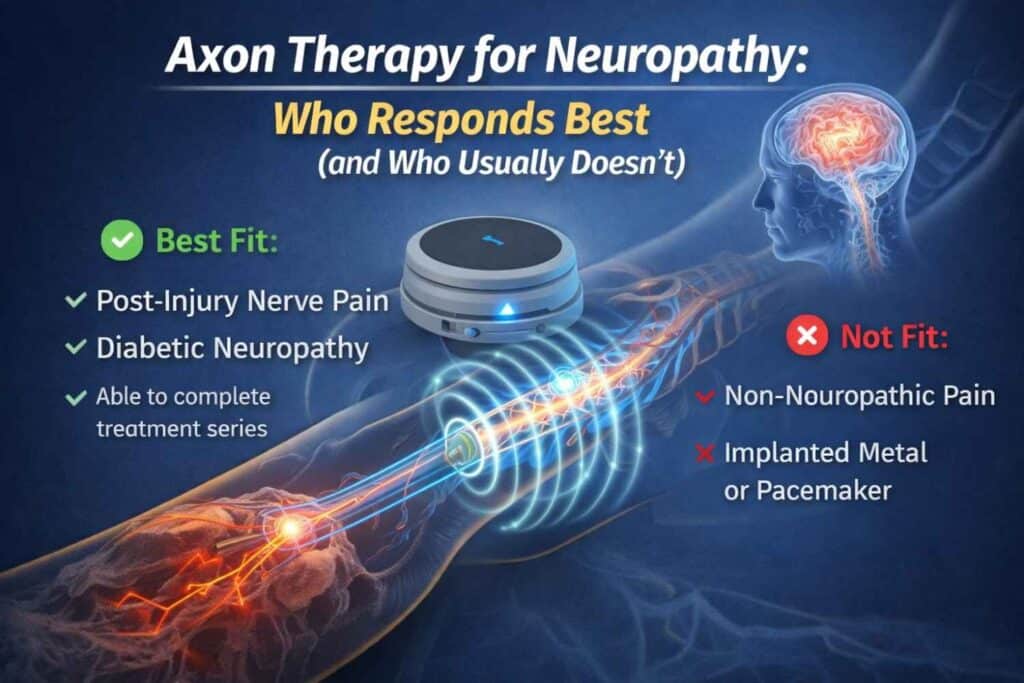
If you’re dealing with nerve pain, Axon Therapy can sound like a miracle. The reality is more specific — and that’s good news if you actually match the profile.
Who tends to respond best
- People with chronic post-traumatic or post-surgical neuropathic pain (nerve pain after an injury or surgery) lasting 3+ months.
- People with painful diabetic neuropathy in the feet and legs who still have significant pain despite standard care.
- Patients who can commit to a multi-week Axon protocol (multiple sessions in the first weeks, then spaced boosters) and have no major contraindications such as pacemakers, certain metal implants, or seizure history.
Who usually doesn’t respond as well
- People whose pain is not neuropathic (mostly muscle, joint, or widespread central pain).
- Patients who cannot complete the series of treatments (only show up for one or two sessions).
- People with formal safety exclusions for Axon Therapy (for example, certain implanted devices or pregnancy).
What the research shows
- In a randomized trial of chronic post-traumatic/post-surgical neuropathy, about 71% of patients receiving Axon Therapy (mPNS) plus conventional care reached at least 50% pain reduction at 90 days, compared with 13% on conventional care alone.
- In a trial for painful diabetic neuropathy, around 70–80% of patients treated with magnetic peripheral nerve stimulation plus medications improved, compared with minimal response in the sham group.
At ActiveMed Integrative Health Center in Encinitas, Axon Therapy is used as one part of a neuropathy plan, alongside physical therapy, acupuncture, medications, and metabolic care — not as a standalone cure.
Important: This article is informational and not medical advice. Only a qualified clinician who knows your history can tell you whether Axon Therapy is appropriate for you.
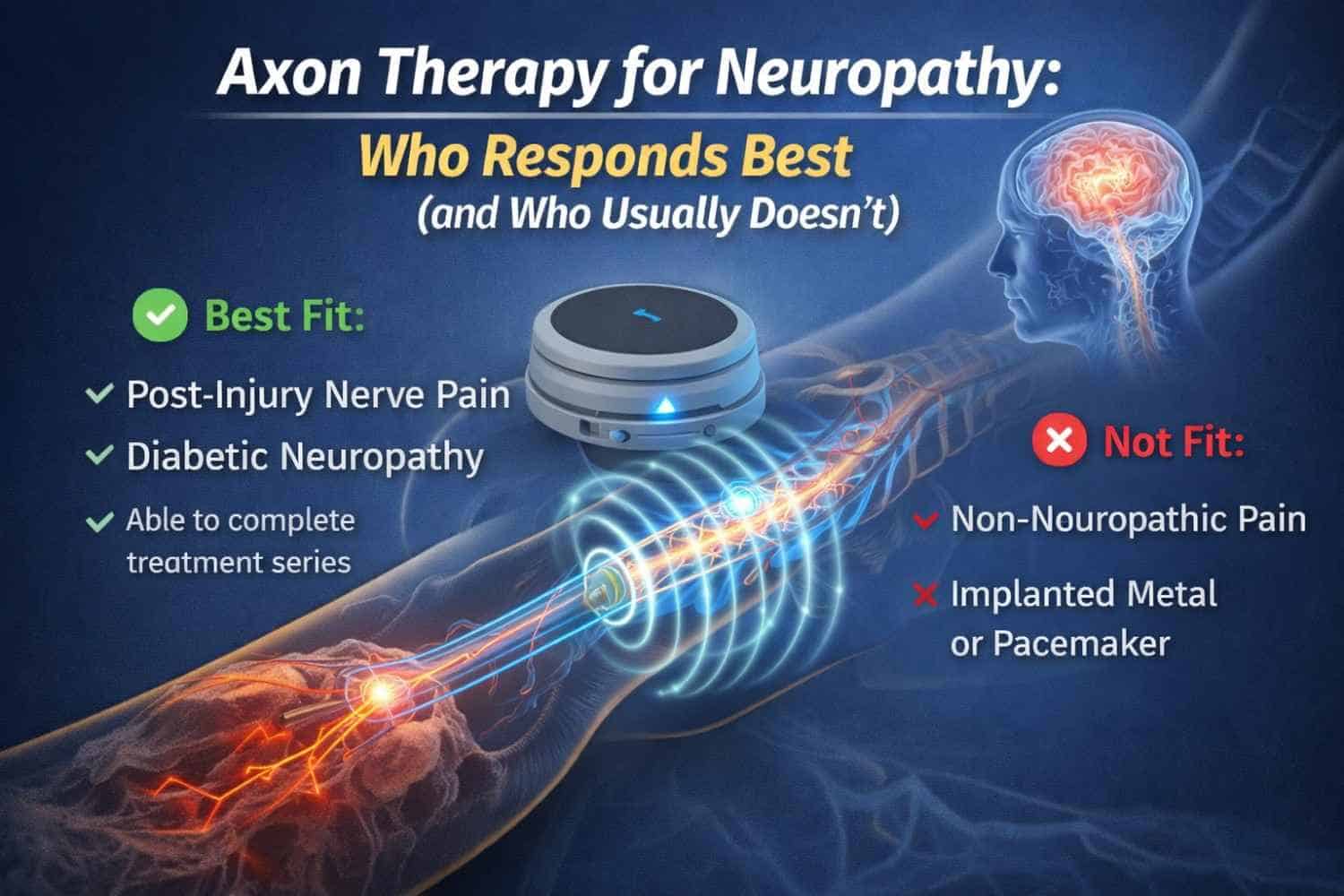
What exactly is Axon Therapy for neuropathy?
Axon Therapy® is a branded form of magnetic peripheral nerve stimulation (mPNS) — a non-invasive treatment that uses focused, low-frequency magnetic pulses over a painful nerve. Those pulses create small electrical fields inside the nerve, without needles or surgery, and modulate how that nerve sends pain signals.
In 2021, Axon Therapy received FDA 510(k) clearance as an electromagnetic stimulator intended to relieve chronic, intractable pain from post-traumatic, post-surgical, and other neuropathic conditions in adults.
At ActiveMed Integrative Health Center, Axon Therapy is offered specifically for:
- Post-traumatic and post-surgical peripheral nerve pain, and
- Diabetic neuropathy of the feet and legs.
Sessions are done in-clinic and typically involve gentle magnetic pulses over the nerve region; the device never breaks the skin.
Read more: Empower Yourself with Axonic Therapy for Mental Wellness
How does Axon Therapy work for nerve pain?
From a neurophysiology point of view, Axon Therapy:
- Delivers low-frequency magnetic pulses (around 0.5 Hz) over the affected nerve.
- Those pulses induce electrical currents in the nerve, preferentially activating large sensory fibers that modulate pain pathways.
- Repeated sessions appear to “retrain” how the nerve behaves, reducing spontaneous pain signaling and improving sensory function over time.
In trials, Axon Therapy is almost always used on top of conventional medical management (CMM) — meaning patients continue medications, diabetes care, and other therapies. The combination of Axon + CMM has repeatedly outperformed CMM alone in neuropathic pain studies.
At ActiveMed, the protocol for a neuropathy case typically looks like:
- Initial evaluation to confirm that your pain is neuropathic and to rule out safety issues.
- Intensive phase (often multiple sessions in the first week).
- Consolidation phase (weekly sessions for several weeks).
- Maintenance phase with monthly boosters if you respond.
The exact schedule is individualized, but the research is based on a series, not a single visit.
Read more: Can Axonic Therapy Improve Your Quality of Life?
What does the research say about Axon Therapy for neuropathy?
Post-traumatic and post-surgical neuropathy (SEAT study)
The SEAT (Safety and Efficacy of Axon Therapy) trial was a multicenter randomized study of adults with chronic post-traumatic or post-surgical neuropathic pain that had lasted at least three months and remained severe despite standard care.
Key findings:
- Patients were randomized to Axon Therapy + CMM vs CMM alone.
- At 90 days, 71% of Axon patients achieved at least 50% pain reduction, compared with 13% in the CMM-only group.
- Pain scores dropped on average by nearly 4 points (on a 0–10 scale) with Axon Therapy vs less than 1 point in the control group.
- Quality-of-life and patient global impression scores improved significantly more in the Axon group.
A follow-up analysis showed that with monthly re-dosing, these improvements remained durable at 6–12 months, with continued high satisfaction.
Read more: How Does Axotics Therapy Work
Painful diabetic neuropathy (PDN)
A separate randomized, sham-controlled trial evaluated magnetic peripheral nerve stimulation for painful diabetic neuropathy of the lower extremities.
In that study:
- Patients received either mPNS + CMM or sham stimulation + CMM.
- At around 30 days, roughly 70%+ of mPNS patients were “responders” (≥50% pain reduction), versus 0% in the sham group.
- Improvements in pain, sensation, and quality of life persisted through 90 days.
Other studies of related transcutaneous magnetic stimulation approaches in diabetic neuropathy have also shown clinically meaningful pain reductions, supporting the broader concept of magnetic neuromodulation for neuropathic pain.
Read more: Discover the Benefits of Acupuncture Poway for Pain Relief
What this means in practice
The data are strong enough that recent consensus guidelines on peripheral nerve stimulation acknowledge Axon Therapy (mPNS) as a promising non-invasive option for localized neuropathic pain, especially where other treatments have not worked well.
At the same time, some insurers still classify transcutaneous magnetic stimulation for chronic pain as investigational, which affects coverage decisions even with FDA clearance.
Read more: Exploring Back Pain Relief with Acupuncture Encinitas
Who responds best to Axon Therapy for neuropathy?
This is the core question: “Am I actually the type of patient this works for?”
From trial data and real-world use, responders tend to fall into a few clear groups.
1. People with clearly diagnosed, localized neuropathic pain
Best responses are seen in patients who have:
- A known nerve injury (after trauma or surgery).
- Pain that has lasted 3 months or longer.
- Symptoms in a specific nerve distribution (for example, along the peroneal nerve after knee surgery).
- Pain that feels burning, electric, shooting, tingling, or hypersensitive to light touch (classic neuropathic descriptors).
If your pain is more like deep joint ache, muscle soreness, or widespread body pain, you might not be in this sweet spot.
2. Patients with painful diabetic neuropathy in the feet and legs
The PDN trial suggests Axon-like mPNS is especially promising for:
- People with type 1 or type 2 diabetes.
- Distal, symmetric burning, tingling, or stabbing pain in the feet/lower legs.
- Persistent symptoms despite medications and good glycemic control.
These patients in studies not only had less pain, but also improved sensation and quality of life, which matters for fall risk and daily function.
3. People who can complete the full Axon protocol
Responder profiles tend to share another trait: adherence.
In both post-traumatic and diabetic neuropathy studies, patients received a series of sessions (often multiple in the first month, then tapering).
At ActiveMed, a typical pathway might include:
- An initial intensive week with several treatments.
- Weekly sessions over a few additional weeks.
- Monthly maintenance visits if you respond well.
If your schedule or transportation makes it impossible to attend regularly, your chance of benefit drops.
4. Patients without major contraindications
Finally, strong candidates pass a safety screen. Based on Axon labeling, research protocols, and ActiveMed’s own criteria, caution or exclusion often applies if you have:
- A pacemaker or similar implanted neuromodulation device.
- Ferromagnetic metal close to the treatment area.
- A history of seizures.
- Pregnancy (in many protocols, this is an exclusion).
- Severe, unstable medical conditions that make clinic visits risky.
Screening isn’t about gatekeeping; it’s about using Axon where the risk–benefit balance actually favors you.
Read more: Managing Chronic Conditions with Acupuncture Poway Care
Who usually doesn’t respond well (or may not be a good candidate)?
Not everyone with “neuropathy” in their chart will benefit the same way.
Non-neuropathic or poorly defined pain
If your pain is primarily:
- Deep joint pain (arthritis),
- Muscular strain, or
- Widespread central pain (e.g., some fibromyalgia-like patterns),
then a peripheral nerve-targeted treatment like Axon is less likely to deliver major benefit because the pain generator isn’t a single peripheral nerve.
Mixed, diffuse, or central pain syndromes
Axon Therapy is best understood as a peripheral neuromodulation tool. For people whose dominant issue is central sensitization or non-dermatomal pain, the evidence is very limited so far.
That doesn’t mean it can’t ever help, but expectations should be conservative and the decision should be individualized.
Patients who cannot complete the series
Because the clinical trials and real-world protocols all use repeated sessions, someone who:
- Cancels often,
- Can’t travel reliably, or
- Can’t tolerate the schedule
is less likely to see the kind of durable relief reported in the SEAT and PDN studies.
People who fail the safety screen
If you have implanted devices, unstable medical conditions, or other contraindications, Axon Therapy may be off-label or unsafe. In those cases, your team at ActiveMed would likely shift focus to other neuropathy tools (medications, physical therapy, acupuncture, metabolic optimization) instead.
How does Axon Therapy fit into a full neuropathy treatment plan?
Even in the best studies, Axon Therapy was never used in isolation.
In both the post-traumatic/surgical trial and the PDN trial, patients remained on conventional medical management — medications, disease-specific care, and lifestyle changes — and Axon was layered on top.
At ActiveMed, that usually looks like:
- Cause-focused medicine
- Diabetes management, B-vitamin status, autoimmune work-up when indicated.
- Physical therapy and rehab
- Gait training, balance work, strength and mobility to reduce fall risk and improve function.
- Acupuncture and manual therapies for pain modulation and mobility.
- Axon Therapy
- Targeting the actual nerve path that matches your symptoms, using mPNS to recondition the pain signaling.
The goal isn’t to swap your entire plan for Axon Therapy, but to add a non-drug, non-surgical option that can make everything else work better by reducing pain and improving function.
What does an Axon Therapy neuropathy session look like at ActiveMed?
While each clinic visit is tailored, a typical neuropathy-focused Axon session at ActiveMed includes:
- Check-in and brief reassessment
- Quick review of how your pain, sleep, and activity have been since the last session.
- Confirmation of any changes in medications or health status.
- Positioning and coil placement
- You sit or lie comfortably.
- The Axon device’s magnetic coil is positioned over the nerve path related to your pain (for example, along the peroneal nerve or tibial nerve).
- Stimulation
- You feel a series of tapping or pulsing sensations in the area.
- No needles, no incisions; the device does not touch bare skin.
- Each nerve region is typically treated for about 14–15 minutes.
- Post-session
- Most people go back to normal activities immediately.
- A series of sessions is scheduled according to your protocol.
Throughout, your team is watching for pain reduction trends, function changes, and any side effects, adjusting the plan as needed.
FAQs about Axon Therapy for neuropathy
Does Axon Therapy work for all types of neuropathy?
- No. Axon Therapy appears to work best for localized peripheral neuropathic pain, especially post-traumatic/post-surgical neuropathy and painful diabetic neuropathy of the feet and legs. Other neuropathies or central pain syndromes may not respond as well, and evidence there is limited.
How long do Axon Therapy results usually last?
- In the SEAT study, patients who responded to Axon Therapy and continued with monthly maintenance sessions maintained significant pain relief and quality-of-life gains out to at least 6–12 months. Individual responses vary, and some people may need periodic boosters.
Can Axon Therapy help if medications haven’t worked for my neuropathy?
- Yes — many trial participants had long-standing, treatment-resistant neuropathic pain before entering the studies, and Axon Therapy still produced meaningful pain reductions when added to their existing care. That said, not everyone responds, and careful screening is essential.
Is Axon Therapy safe if I have diabetes, heart disease, or other chronic conditions?
- In PDN and post-traumatic neuropathy studies, patients often had multiple chronic conditions and still tolerated mPNS well, with mostly mild and transient side effects. The bigger issues are implanted devices, seizure history, and other specific contraindications, which your ActiveMed provider will screen for.
Will I need Axon Therapy forever, or can I taper?
- Most protocols involve an intensive start, then spacing out to monthly once you’re stable. Some patients can gradually extend intervals or stop if improvements hold; others choose ongoing maintenance. This is decided case by case based on your pain, function, and goals.
Can I try Axon Therapy if I already have a pacemaker or spinal cord stimulator?
- Magnetic peripheral nerve stimulation is generally not recommended over or near certain implanted devices, and many protocols exclude these patients for safety reasons. If you have a pacemaker, spinal cord stimulator, or other implant, your provider will review the specifics and likely prioritize other options.
Is Axon Therapy covered by insurance for neuropathy?
- Coverage varies widely. Some policies still classify transcutaneous magnetic stimulation for chronic pain as unproven or investigational, even though Axon has FDA 510(k) clearance, so many patients pay out of pocket. Your ActiveMed team can help you check your plan’s stance and provide documentation if you want to ask for coverage or reimbursement.
Final thoughts: Is Axon Therapy worth exploring for your neuropathy?
If your neuropathy looks like the patients in the trials — chronic, localized post-traumatic/post-surgical pain or painful diabetic neuropathy in the feet and legs — Axon Therapy is a serious option to discuss, not just a gadget.
At ActiveMed Integrative Health Center, Axon Therapy is:
- Used within a full neuropathy plan (not in isolation),
- Tailored to your diagnosis, safety profile, and life constraints, and
- Monitored carefully so you and your clinicians can see whether it’s actually moving the needle for your pain and function.
If you recognize yourself in the “who responds best” sections above, the next step is straightforward: book a neuropathy evaluation, bring your history, and ask specifically whether Axon Therapy fits your pattern of nerve pain.