
Aesthetics
Aesthetic Treatments in Encinitas, Poway, and San Diego, California
Our three convenient locations offer a variety of holistic aesthetic procedures. Cosmetic acupuncture, PRP micro-needling facials, and PRP hair restoration are three aesthetic treatments that are becoming increasingly popular and are readily available in our offices.
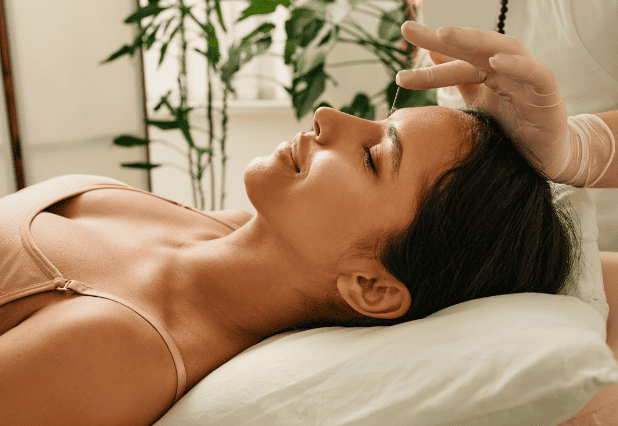
Cosmetic acupuncture involves the use of fine needles inserted into specific points on the face, which stimulates collagen production and improves circulation to the treated area. This can help reduce the appearance of fine lines and wrinkles, improve skin texture, and promote a more youthful appearance.
The PRP (platelet-rich plasma) micro-needling facial involves the use of a micro needling device to create tiny punctures in the skin, followed by the application of platelet rich plasma derived from the patient’s own blood. This treatment stimulates collagen production, improves skin texture and tone, and promotes healing and rejuvenation of the skin.
PRP hair restoration involves the injection of platelet rich plasma into the scalp to stimulate hair growth and reduce hair loss. The growth factors in the PRP promote the growth of hair follicles and increase blood flow to the scalp, resulting in thicker, fuller hair.
FAQs About Aesthetic Treatments
- We define aesthetic treatments as non-surgical procedures that support appearance goals like skin texture, fine lines, and hair density. Our core aesthetic treatments include cosmetic acupuncture, PRP microneedling facials, and PRP hair restoration.
- We match cosmetic acupuncture and PRP microneedling facials to skin goals (texture, tone, fine lines), and we match PRP hair restoration to scalp/hair density goals. We select based on the target area and the type of change we want over time.
- We use cosmetic acupuncture as facial acupuncture with fine needles placed at specific points to support circulation and collagen-related skin changes. We position it as a gradual, series-based aesthetic treatment—not an instant “procedure-day” transformation.
- We expect subtle, gradual changes rather than dramatic “filler-like” effects. A randomized controlled trial of facial/body acupuncture reported measurable improvement in frown lines after a twice-weekly, 6-week course, with minor bleeding/bruising rates reported as low.
- We usually plan a series. In published clinical research on facial lines, treatment was delivered 2× per week for 6 weeks; in practice, we adjusted frequency and maintenance to goals and response.
- We treat safety as highly dependent on sterile, single-use needles and proper technique. National Center for Complementary and Integrative Health notes complications are uncommon but can occur with nonsterile needles or improper delivery, and FDA rules require sterile, single-use needles.
- We define a PRP microneedling facial as microneedling followed by PRP application (often called a “PRP facial”). PRP is created by drawing blood, centrifuging it to concentrate platelets, and then applying or delivering it to the skin.
- We use microneedling to support improvement in acne scars, dark spots, large pores, uneven texture/tone, and fine lines as collagen builds over time. We treat it as a texture-and-quality treatment, not a replacement for lifting or volume procedures.
- We present PRP as an optional enhancer, not a guarantee. American Academy of Dermatology notes PRP for younger-looking skin has high demand but limited evidence overall, and a randomized clinical trial found no clear facial-aging improvement from injectable PRP compared with saline in its study population.
- We usually plan multiple sessions. Guidance commonly describes treatments spaced about 3–8 weeks apart, with results building gradually over 3–6 months, and some maintenance afterward.
- We expect minimal downtime, with redness and a “sunburn-like” feel that usually settles in a few days to a week. We typically hold makeup for about 24 hours and follow a simple, gentle aftercare plan while the skin calms.
- We avoid microneedling when there’s elevated risk—examples include active infection, poor healing, certain scar patterns (keloids), immunosuppression, recent isotretinoin use, or active inflammatory breakouts in the treatment area.
- We define PRP hair restoration as PRP prepared from our own blood and then injected into the scalp to support follicles and improve hair density goals over time. We position it as a “biology-support” treatment, not an overnight fix.
- We describe the evidence as moderate overall. A 2025 systematic review/meta-analysis reported PRP can improve hair density and reduce hair loss, with less consistent improvement in hair thickness, and it emphasizes variation across PRP preparation protocols.
- We usually plan a series delivered every 2–4 weeks for several sessions (common in published studies), then we reassess. We expect visible change to take time because hair growth cycles run in months, not days.