
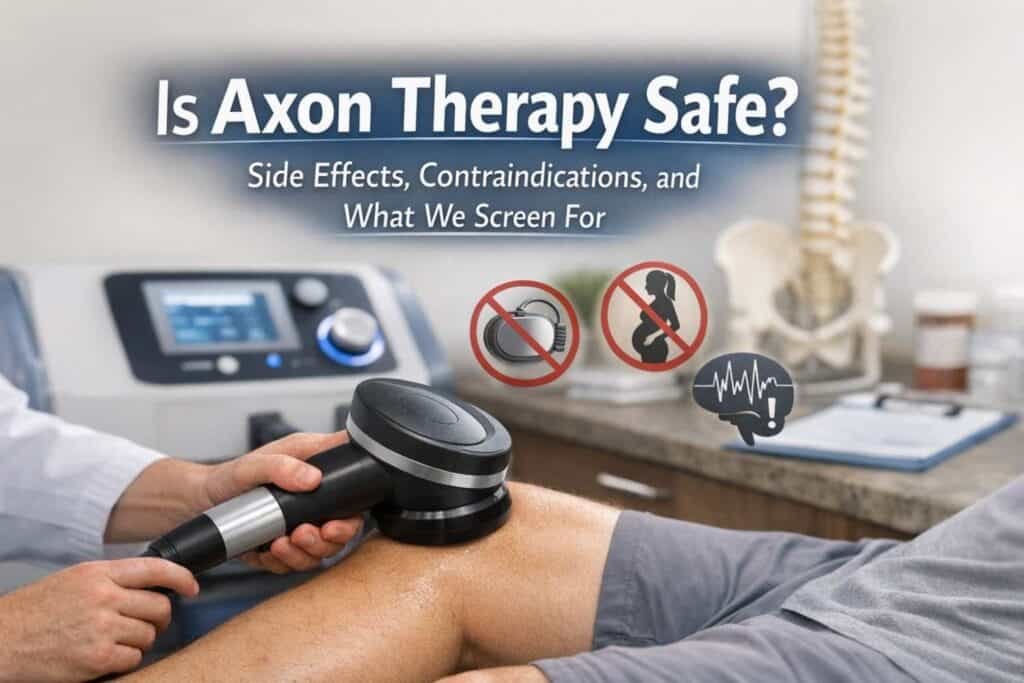
Axon Therapy appears to be generally well tolerated in appropriately selected adults, but the real safety question is not “Does this treatment have a long list of side effects?” It is “Is this the right patient for this treatment?” The FDA-cleared Axon Therapy system is intended to stimulate peripheral nerves for relief of chronic intractable pain, post-traumatic pain, post-surgical pain, and painful diabetic peripheral neuropathy in the lower extremities, for patients age 18 and older. In the published SEAT randomized trial for post-traumatic and post-surgical neuropathic pain, there were no adverse device effects, no adverse events leading to withdrawal, and no serious adverse events in the Axon group through day 90.
At ActiveMed Integrative Health Center, safety starts with screening. The clinic’s current Axon Therapy page says patients are screened for factors including pregnancy, pacemakers or similar modulatory implants, ferromagnetic material near the treatment area, seizure history, major psychiatric or life-threatening disease, and ability to understand and follow the treatment plan. That is the right frame for this therapy: not fear, not hype, just careful patient selection.
What Axon Therapy actually is
Axon Therapy is a non-invasive magnetic stimulator system that delivers brief, focused magnetic pulses to stimulate peripheral nerves. The FDA summary describes it as a clinic-based device used in settings such as pain management and physical therapy clinics, and states that it is intended for chronic intractable pain, post-traumatic pain, post-surgical pain, and chronic painful diabetic peripheral neuropathy in the lower extremities.
That matters because patients often hear “magnetic therapy” and assume it is either experimental or vague. It is neither. It is a defined peripheral nerve stimulation approach with an FDA-cleared indication and published clinical data, but it is still a treatment that should be matched to the right diagnosis and the right body, not used casually.
Read more: Empower Yourself with Axonic Therapy for Mental Wellness
The short answer: is Axon Therapy safe?
Based on the current published evidence, Axon Therapy is generally safe in the studied population when patients are screened appropriately. In the SEAT trial, adverse events were reported in 17.1% of patients receiving conventional medical management plus Axon Therapy and 13.3% of patients receiving conventional care alone, but the paper reported no adverse device effects, no adverse-event withdrawals, and no serious adverse events in the Axon arm. The only serious adverse event and death reported in that trial occurred in the conventional-care-only group, not in the Axon group.
That does not mean Axon Therapy is “safe for everyone.” It means the available evidence supports a good safety profile when you screen out the wrong candidates first. That is exactly why a clinic’s contraindication checklist matters more than marketing language.
Read more: Can Axonic Therapy Improve Your Quality of Life?
What side effects have actually been reported?
This is where you should stay honest. The current evidence does not support a long, dramatic list of common side effects. In the SEAT study, the authors reported no adverse device effects and no serious adverse events in the Axon group through day 90. Two treatment-related adverse events were recorded in the Axon arm, one ankle pain event and one shoulder pain event, and the study described both as unrelated to the Axon procedure itself.
ActiveMed’s own Axon Therapy page tells patients to expect that side effects are usually mild, listing mild soreness or numbness from muscle stimulation and, occasionally, skin irritation such as redness or pain. That is a reasonable way to frame the treatment: usually well tolerated, but not literally sensation-free.
A separate 2025 randomized PubMed-indexed trial in painful diabetic neuropathy also described noninvasive magnetic peripheral nerve stimulation as providing pain relief without the side effects associated with interventional approaches, which strengthens the overall safety story for the technology family in neuropathic pain.
Read more: How Does Axotics Therapy Work
What does Axon Therapy feel like during treatment?
Patients usually want this answered before anything else. ActiveMed’s Axon page says the treatment is not painful for most people, and notes that some patients describe the feeling as the gentle snapping of a rubber band. The clinic also states that the treatment typically lasts 14 minutes per site, and the FDA device description includes a thermal shutdown feature tied to session timing and coil temperature, which supports the idea that this is a structured clinical treatment, not a vague wellness gadget.
That sensory detail matters because “safe” is not just about serious adverse events. It is also about whether a patient can tolerate the experience well enough to complete the protocol. For a non-invasive therapy, that tolerance profile appears favorable.
Read more: Discover the Benefits of Acupuncture Poway for Pain Relief
The real safety issue: contraindications
The strongest version of this article is not “Axon has almost no side effects.” It is “Axon Therapy is safest when we are strict about who should not get it.”
ActiveMed currently lists the following exclusion criteria for Axon Therapy:
- Pregnancy
- Pacemaker or similar modulatory device implant
- Ferromagnetic material such as bullet fragments, shrapnel, or device implants near the site of injury
- History of dementia, major psychiatric disease, or life-threatening disease
- History of seizure
- Pending litigation
- Inability to understand the treatment protocol and communicate adequately in English
These are not random rules. They reflect the basic logic of safe magnetic stimulation: do not stimulate near incompatible implants or metal, do not use a protocol when neurologic or psychiatric stability is uncertain, and do not start a multi-visit treatment with someone who cannot safely understand or follow it.
Read more: Exploring Back Pain Relief with Acupuncture Encinitas
What we screen for before starting Axon Therapy
A good Axon consult is not just a painful conversation. It is a fit conversation.
At ActiveMed, the eligibility section on the Axon page says the clinic typically looks for:
- A clear diagnosis of traumatic nerve injury
- Nerve pain for more than 3 months
- Average daily nerve pain above 3/10
- Ability to attend the required protocol visits
- Patients with diabetic neuropathy as another candidate group
That tells you what the real screening model should look like:
1. Is this actually neuropathic pain?
If the pain is mostly muscular, arthritic, or diffuse, Axon may not be the right tool. The FDA indication and published trial evidence are specific to chronic neuropathic pain patterns, not every pain complaint.
2. Is the diagnosis clear enough?
The clinic’s own criteria emphasize a clear diagnosis and persistent symptoms. That is smart. A non-invasive neuromodulation therapy performs best when the problem is well defined, not guessed.
3. Are there implant, metal, or seizure concerns?
This is the section patients often underestimate. If someone has a pacemaker, another modulatory implant, ferromagnetic metal near the treatment site, or a seizure history, screening should be conservative. ActiveMed explicitly lists all of those categories.
4. Can the patient complete the treatment plan?
ActiveMed’s current protocol notes:
- 3 consecutive days in week 1
- Weekly treatments in weeks 2–5
- Bi-monthly treatments in month 2
- Monthly treatments in months 3–4
- Then maintenance as needed
That means safety is partly practical. If a patient cannot attend visits consistently, cannot communicate changes, or cannot tolerate the cadence, then the treatment may not be the right fit even if the device itself is low risk.
A simple safety table
| Question | Short answer |
| Is Axon Therapy generally well tolerated? | In the published SEAT trial, yes, in the studied population. |
| Are serious side effects common? | No serious adverse events were reported in the Axon arm through day 90 in the SEAT trial. |
| What common side effects should patients expect? | ActiveMed describes mostly mild, temporary soreness, numbness, or occasional skin irritation. |
| Biggest safety issue? | Contraindications and poor patient selection, not a long list of common side effects. |
| What does ActiveMed screen for? | Pregnancy, pacemaker/modulatory implant, ferromagnetic material near the site, seizure history, major illness, and ability to follow the protocol. |
How Axon compares with other neuropathy treatments on safety
This is one reason patients are interested in Axon in the first place. Standard neuropathic pain care often relies on medications that can bring sedation, dizziness, cognitive dulling, edema, or other burdens, while implanted neuromodulation brings procedural and hardware-related risks. The SEAT discussion specifically contrasts mPNS with more invasive modalities and notes that Axon’s non-invasive design may improve access to neuromodulation at lower risk and cost. The diabetic neuropathy trial also emphasizes relief without the side effects associated with interventional approaches.
That does not mean Axon replaces every medication or every procedure. It means the risk profile is part of the reason it deserves a look earlier, especially in carefully selected neuropathy patients.
Read more: Managing Chronic Conditions with Acupuncture Poway Care
FAQs
Is Axon Therapy safe for diabetic neuropathy?
- The current FDA clearance includes chronic painful diabetic peripheral neuropathy in the lower extremities for adults, and a 2025 randomized trial reported effective pain relief with mPNS plus conventional care, describing the approach as relieving pain without the side effects associated with interventional treatments. Safety still depends on individual screening.
Can I get Axon Therapy if I have a pacemaker?
- ActiveMed’s current exclusion list says no for a pacemaker or similar modulatory device implant. That is exactly the kind of issue that should be clarified before any treatment is scheduled.
Does Axon Therapy hurt?
- ActiveMed says Axon Therapy is not painful for most people and notes that some patients compare the sensation to a gentle rubber-band snap.
What side effects have been reported?
- The published SEAT trial reported no adverse device effects and no serious adverse events in the Axon arm through day 90. ActiveMed’s patient-facing guidance mentions mild temporary soreness, numbness, and occasional skin irritation.
Is Axon Therapy safe during pregnancy?
- ActiveMed lists pregnancy as an exclusion criterion, so pregnant patients should not be treated under the clinic’s current screening rules.
Can Axon Therapy be used if I have a seizure history?
- ActiveMed lists history of seizure as an exclusion criterion. That should be disclosed during the first screening conversation.
How long is a treatment session?
- ActiveMed states that Axon Therapy takes 14 minutes per site.
Conclusion
Axon Therapy appears to be a low-risk, non-invasive option for the right neuropathy patient, but that is only half the story. The stronger and more honest conclusion is this: Axon Therapy is safest when a clinic is disciplined about screening. The evidence supports a favorable safety profile in the studied population, and ActiveMed already has a usable framework for deciding who should move forward and who should be screened out.