
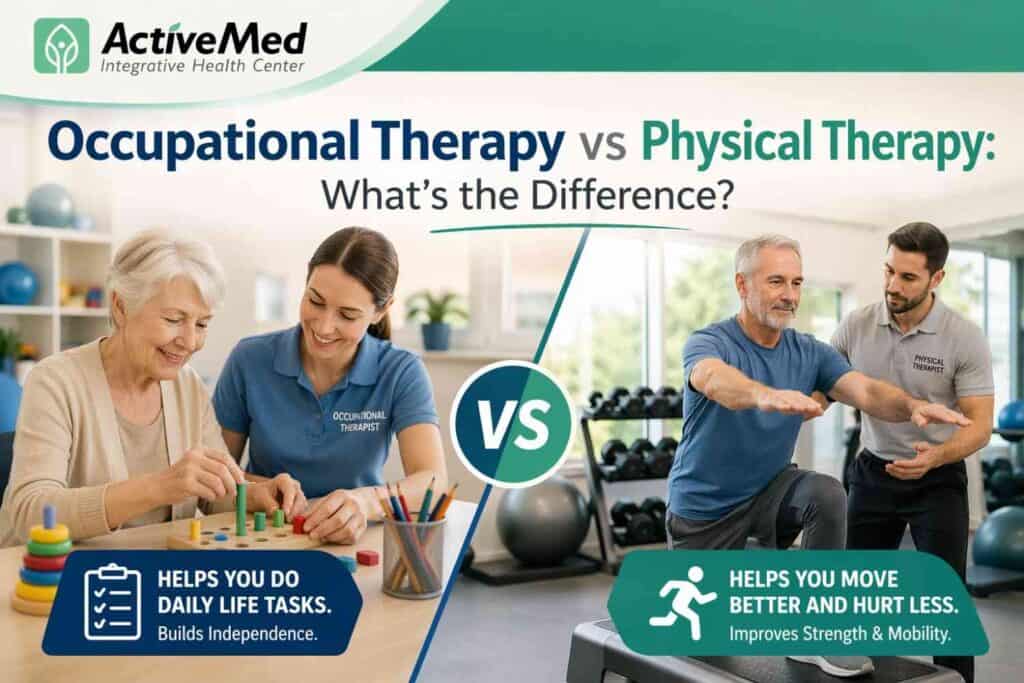
Occupational therapy and physical therapy both help people function better, but they do not do the same job. According to the American Occupational Therapy Association (AOTA), occupational therapy helps people participate in the everyday activities they need and want to do, including self-care, work, school, and home life. According to the American Physical Therapy Association (APTA) and MedlinePlus, physical therapy focuses more on restoring movement, improving strength, mobility, balance, and physical function, and helping people manage pain or recover from injury. In simple terms, occupational therapy helps people do daily life tasks more independently; physical therapy helps people move better and hurt less.
At ActiveMed, this distinction matters because we clearly offer Physical Therapy and related rehab content, while occupational therapy does not appear to be a dedicated core service page on the site. That means this article should help readers understand the difference honestly, then guide the right patients toward our physical therapy and integrative care resources.
What occupational therapy actually does
According to AOTA, occupational therapy uses everyday life activities — called “occupations” — to support health, well-being, and participation in life roles. That includes activities of daily living such as dressing, bathing, feeding, grooming, household tasks, school participation, work demands, health management, and social participation. In other words, occupational therapy is centered on independence in real life, not just on isolated body parts or exercises.
A person may be referred to occupational therapy when the main problem is not simply pain or weakness, but difficulty doing day-to-day tasks safely and effectively. That could include someone recovering from a stroke who needs help dressing and bathing again, someone with hand injuries who struggles to write or grip objects, or a person who needs adaptive strategies to function more independently at home or work. MedlinePlus’ stroke rehabilitation overview explains that occupational therapy helps improve daily living skills such as eating, drinking, bathing, and dressing.
What physical therapy actually does
Physical therapy is more focused on movement, mobility, strength, pain reduction, balance, and physical function. According to ChoosePT, APTA’s consumer site, physical therapists are movement experts who improve quality of life through hands-on care, patient education, and prescribed movement. MedlinePlus similarly says physical therapy helps with strength, mobility, and fitness.
That definition fits ActiveMed’s own Physical Therapy page, which describes PT as a specialty focused on the diagnosis, treatment, and prevention of musculoskeletal and movement-related disorders. On our site, that PT focus is reinforced by supporting posts like How Physical Therapy Can Improve Your Quality of Life and From Injury to Recovery: The Role of Physical Therapy in Encinitas, which both frame PT around pain reduction, mobility, strength, recovery, and function.
The simplest way to explain the difference
Occupational therapy usually focuses on daily life tasks and independence. Physical therapy usually focuses on movement, mobility, balance, strength, and pain.
That distinction is consistent across AOTA, ChoosePT/APTA, and MedlinePlus: OT is about helping people function in everyday occupations, while PT is about helping people move, recover, strengthen, and physically perform.
Occupational therapy vs physical therapy: comparison table
| Question | Occupational Therapy | Physical Therapy |
| Main focus | Daily activities and independence | Movement, mobility, strength, balance, pain, and physical function |
| Typical goals | Dressing, bathing, cooking, writing, work/school tasks | Walking, lifting, balance, flexibility, strength, pain reduction |
| Common fit | Hand function, self-care, home tasks, adaptive strategies | Injury rehab, post-op recovery, back/neck/joint pain, mobility problems |
| End goal | Function in everyday life | Better physical movement and function |
| Can they overlap? | Yes | Yes |
This side-by-side comparison reflects the role descriptions from AOTA, ChoosePT/APTA, and MedlinePlus.
When someone may need occupational therapy instead of physical therapy
Occupational therapy may be the better fit when the biggest problem is doing daily tasks, not just moving. That can include difficulty with bathing, dressing, meal prep, writing, hand use, work tasks, school tasks, or managing life safely after a neurologic event or disability. AOTA’s occupational framework specifically includes activities of daily living, instrumental activities of daily living, education, work, health management, and social participation as core OT domains.
So if someone says, “I can walk, but I can’t button my shirt, prepare meals, or handle my normal tasks safely,” that leans more toward OT than PT. Likewise, after stroke rehab, MedlinePlus clearly distinguishes OT as the discipline helping restore day-to-day self-care activities.
When someone may need physical therapy instead of occupational therapy
Physical therapy is often the better fit when the main challenge is pain, weakness, stiffness, limited range of motion, poor balance, walking difficulty, or reduced physical function after injury or surgery. That includes many cases of back pain, neck pain, knee pain, shoulder pain, sports injuries, gait issues, balance issues, and post-surgical rehab. ChoosePT/APTA and MedlinePlus both support that broader movement-and-function role for PT.
That is exactly where ActiveMed’s PT content sits. If a reader’s main complaint is pain, stiffness, loss of mobility, or recovery after injury, the more relevant next step on our site is usually Physical Therapy, especially alongside supporting resources like How Physical Therapy Can Improve Your Quality of Life and From Injury to Recovery: The Role of Physical Therapy in Encinitas.
When someone may need both
In real rehabilitation, the answer is often both. After stroke, major injury, surgery, neurologic disease, or developmental issues, PT and OT often work side by side. MedlinePlus explains this clearly: physical therapy helps people relearn movement, coordination, strength, and stretching, while occupational therapy helps improve daily living skills such as eating, bathing, and dressing.
That overlap is also useful to mention in pediatric contexts. On ActiveMed, the article Pediatric Physical Therapy Services Enhance Child Development discusses developmental support and references occupational therapy in the broader rehab picture, even though our clearly defined service page is PT. So if a family is trying to understand whether a child needs help with movement, coordination, daily tasks, or all of the above, it is reasonable to think in terms of overlapping roles rather than strict silos.
FAQs
Is occupational therapy the same as physical therapy?
- No. They overlap, but they are not the same. Occupational therapy is centered on independence in daily activities, while physical therapy is centered more on movement, mobility, strength, balance, and pain-related physical function..
Which one helps more with pain and walking?
- Physical therapy is usually the better fit when the main issue is pain, walking, balance, range of motion, or movement recovery after injury or surgery. That is why readers with those problems should usually start with Physical Therapy at ActiveMed.
Which one helps more with dressing, bathing, and everyday tasks?
- Occupational therapy is usually the better fit when the goal is improving self-care, hand use, home tasks, work tasks, or daily independence.
Can someone need both occupational therapy and physical therapy?
- Yes. Stroke recovery, major injuries, neurologic conditions, and some pediatric developmental situations often involve both PT and OT because movement and daily-function goals overlap.