
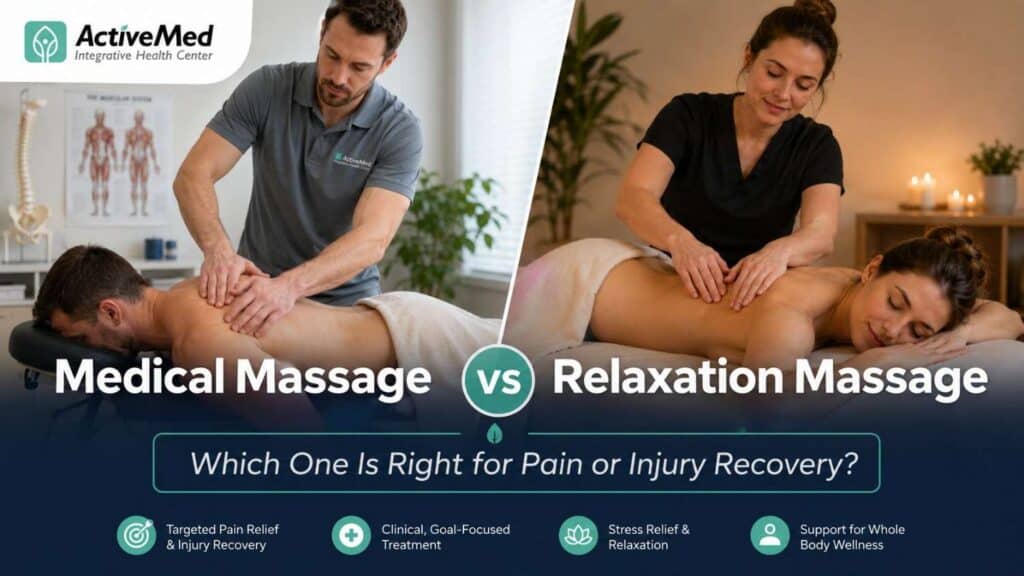
Medical massage and relaxation massage both use hands-on soft-tissue techniques, but they are designed for different goals. Relaxation massage is usually focused on stress reduction, general muscle tension, and wellness. Medical massage is more goal-specific and may be used for pain, muscle spasm, limited mobility, or injury recovery support as part of a broader care plan. If pain follows a serious injury or includes swelling, numbness, weakness, fever, suspected clot symptoms, or rapidly worsening function, get evaluated before choosing massage.
At ActiveMed Health, patients in Encinitas, Poway, and San Diego can explore Massage Therapy for soft-tissue tension, relaxation, and selected pain concerns.
Massage can be helpful for many people, but it should not be treated as one-size-fits-all care. A person looking for stress relief after a difficult week may need something very different from someone recovering from a sports strain, car accident, surgery, or persistent back, neck, shoulder, or hip pain.
The key question is not simply, “Which massage is better?” The better question is: What is the goal of care, and does massage fit the problem safely?
Medical Massage vs Relaxation Massage: Quick Comparison
| Question | Medical Massage | Relaxation Massage |
| Main goal | Support a specific pain, mobility, muscle tension, or recovery-related goal | Reduce stress, promote relaxation, and ease general tension |
| Best fit | Pain, muscle spasm, injury recovery support, limited movement, work or sport strain | Stress, general wellness, mild muscle tension, relaxation |
| Session focus | More targeted and symptom-informed | More whole-body or comfort-focused |
| Pressure style | Varies by condition, tissue sensitivity, and healing stage | Usually comfortable, calming, and not overly intense |
| Documentation | May include goals, symptoms, affected area, progress notes, and care coordination | Usually simpler wellness notes |
| Works alone? | Often best as part of a broader plan when injury or function is involved | Often suitable as standalone wellness care |
| Should it hurt? | No. Therapeutic does not mean painful. Pressure should be tolerable and appropriate. | No. It should generally feel calming and comfortable. |
| When to get evaluated first | Severe pain, swelling, numbness, weakness, trauma, suspected clot, fever, infection signs, unexplained weight loss, or rapidly worsening symptoms | The same warning signs apply before any massage |
According to Mayo Clinic, massage therapy involves rubbing and kneading soft tissues, including muscles, connective tissue, tendons, ligaments, and skin. Mayo Clinic also notes that massage may help reduce stress, lessen pain and muscle tightness, and increase relaxation.
What Is Relaxation Massage?
Relaxation massage is usually focused on comfort, calmness, stress reduction, and general muscle tension. It may use light to moderate pressure, slower pacing, and broader full-body techniques depending on the patient’s preferences.
Relaxation massage may be a good fit when the main goal is not injury rehabilitation or treatment of a specific functional limitation. Instead, the patient may want to unwind, reduce stress, ease everyday tightness, or support a wellness routine.
| Goal | Why Relaxation Massage May Fit |
| Stress reduction | Massage may promote relaxation and help the body settle |
| General muscle tension | Gentle or moderate pressure may help ease everyday tightness |
| Sleep support | Relaxation may help some people wind down |
| Wellness routine | Useful when there is no specific injury or medical concern |
| Mild soreness from daily life | May help with comfort and body awareness |
| Mental reset | A calm session may support stress management and relaxation |
Relaxation massage should not be dismissed as “just pampering.” Stress reduction and nervous-system calming can be meaningful wellness goals. The limitation is that relaxation massage may not be enough when pain is tied to injury, weakness, mobility loss, nerve symptoms, or functional limitation.
What Is Medical Massage?
Medical massage is a more goal-specific form of massage therapy used to support a defined concern, such as pain, muscle spasm, soft-tissue sensitivity, limited mobility, or injury recovery support. It should be guided by the patient’s symptoms, history, goals, risk factors, and, when appropriate, coordination with a healthcare provider or physical therapist.
Medical massage is not simply “harder massage.” That is the wrong frame.
A better definition is:
Medical massage is targeted massage with a specific clinical or functional goal. The pressure, technique, and treatment area should be selected based on the person’s symptoms, tissue sensitivity, healing stage, and safety factors.
According to NCCIH, massage therapy includes many techniques, including Swedish or classical massage, sports massage, and clinical massage used for specific goals such as releasing muscle spasms. NCCIH also notes that massage therapy has been studied for several pain conditions, but the evidence is often not strong and benefits may be short-term.
| Concern | How Medical Massage May Be Used |
| Muscle spasm | Gentle or targeted soft-tissue techniques may help reduce guarding |
| Localized muscle tension | Treatment may focus on specific regions rather than full-body relaxation |
| Injury recovery support | May be used after appropriate evaluation and when soft-tissue work fits the healing stage |
| Neck, shoulder, or back discomfort | May help short-term comfort for selected patients |
| Sports or work-related strain | May support recovery alongside mobility and strengthening |
| Postural tension | May support symptom relief while movement habits are addressed |
| Stress-related muscle guarding | May help relaxation and body awareness |
Medical massage should not be described as a cure. It may support comfort and soft-tissue symptoms, but injury recovery often requires more than hands-on treatment.
Medical Massage vs Relaxation Massage: Main Differences
| Category | Medical Massage | Relaxation Massage |
| Primary purpose | Specific symptom, pain, mobility, or recovery goal | Stress reduction and general wellness |
| Treatment plan | Usually targeted to a complaint or body region | Often full-body or comfort-focused |
| Pressure | Adjusted to condition and tolerance | Usually calming and comfortable |
| Best for | Pain, tension, spasm, injury support, movement-related discomfort | Stress, general tension, wellbeing |
| Communication | More detailed symptom updates and progress tracking | Preference-based comfort feedback |
| Outcome tracking | Pain, range of motion, function, sleep, activity tolerance | Relaxation, stress level, comfort, general tension |
| Clinical coordination | May coordinate with PT, pain management, or medical care | Less likely unless symptoms require it |
| Not appropriate when | Red flags or urgent symptoms are present | Same red flags apply |
| Biggest mistake | Assuming deeper pressure is always better | Dismissing it as “only pampering” |
Both types can be useful. The right option depends on the patient’s goal.
If the goal is stress relief, relaxation massage may be appropriate. If the goal is pain or injury recovery support, medical massage may be more relevant—but only after safety screening and only as part of the right care plan.
Which One Is Right for Pain?
Pain does not automatically require medical massage. The type of massage that fits depends on the pain pattern, severity, history, and whether function is affected.
| Pain Situation | Better Starting Point |
| Mild general tension after stress or desk work | Relaxation massage may be enough |
| Localized muscle tightness or spasm | Medical massage may be more appropriate |
| Pain after a new injury | Evaluation first, then massage only if appropriate |
| Pain with weakness, numbness, swelling, redness, fever, or major trauma | Medical evaluation first |
| Pain that limits walking, lifting, work, or exercise | Physical Therapy may be needed |
| Persistent or complex pain | Pain Management may be appropriate after evaluation |
| Chronic low-back pain | Massage may help some people, but evidence is weak and often short-term |
NCCIH states that massage therapy may help relieve several kinds of pain, but in most cases the evidence is not strong and massage may provide only short-term relief. NCCIH also notes that massage may provide short-term benefits for neck or shoulder pain.
If pain is tied to movement, strength, mobility, or injury recovery, Physical Therapy may be a more appropriate primary pathway than massage alone.
Which One Is Right for Injury Recovery?
For injury recovery, massage may support comfort, muscle guarding, and soft-tissue symptoms. But massage should not replace rehabilitation when strength, mobility, joint motion, balance, or return-to-function goals need to be restored.
This is the strategic distinction:
Massage may support recovery. Physical therapy is usually more directly focused on restoring movement, strength, function, and safe return to activity.
According to ChoosePT, physical therapists and physical therapist assistants help people maximize movement, manage pain, participate in recovery, and recover from and prevent injury.
| Injury-Recovery Situation | Massage May Help With | Physical Therapy May Be Needed For |
| Muscle soreness after activity | Comfort and soft-tissue relaxation | Graded return to training if recurring |
| Muscle spasm after strain | Short-term guarding and tension support | Strength, mobility, and loading progression |
| Neck or back tightness after overuse | Symptom relief | Movement assessment and exercise plan |
| Postural or desk-related pain | Tension relief | Ergonomics, posture tolerance, strength, mobility |
| Sports injury recovery | Soft-tissue comfort | Return-to-sport progression and reinjury prevention |
| Post-surgical recovery | Only with clearance and appropriate timing | Structured rehabilitation and function restoration |
| Swelling, bruising, severe pain, instability, or numbness | Not first-line without evaluation | Medical or PT evaluation first |
Medical massage should not be framed as complete injury rehabilitation. Rehabilitation means restoring function. That usually requires assessment, progressive movement, strengthening, and measurable goals.
When Massage Should Not Be the First Step
Massage is not appropriate for every symptom. Some signs require medical evaluation before massage therapy, relaxation work, deep tissue treatment, or self-care.
| Symptom or Situation | Why Evaluation Comes First |
| Severe pain after trauma | Fracture, tear, or serious injury may need evaluation |
| New numbness, tingling, or weakness | May indicate nerve involvement |
| Sudden swelling, redness, warmth, or calf pain | Possible clot or infection concern |
| Fever or feeling very unwell | Could signal infection or systemic illness |
| Open wound, burn, or skin infection | Massage may worsen irritation or spread infection |
| Recent surgery without clearance | Tissue healing and medical restrictions matter |
| Known blood clot or clot risk | Massage could be unsafe without clearance |
| Severe osteoporosis or fracture risk | Deep pressure may be unsafe |
| Cancer history with unexplained pain | Medical evaluation is needed |
| Rapidly worsening pain or unexplained weight loss | Needs medical assessment |
| Shortness of breath or chest pain with pain symptoms | Needs urgent medical evaluation |
NCCIH advises patients not to use massage therapy to postpone seeing a healthcare provider about a medical problem. NCCIH also reports rare serious side effects from massage, including blood clot, nerve injury, or bone fracture.
Cleveland Clinic also lists safety cautions for massage, including people who take blood thinners, have blood clots in the leg, or have osteoporosis or a spine disorder that increases fracture risk.
Does Medical Massage Need to Be Deep Tissue?
No. Medical massage does not automatically mean deep tissue massage.
This is one of the biggest patient misconceptions. Deep pressure is not always better. In some cases, aggressive pressure can increase soreness, guarding, bruising, or irritation.
| Myth | Better Explanation |
| “Medical massage must be deep.” | Pressure should match the person’s condition and tolerance. |
| “More pain means better results.” | Painful pressure can increase guarding or irritation. |
| “Deep tissue breaks up scar tissue.” | Tissue change is complex and should not be oversold. |
| “Relaxation massage is not therapeutic.” | Stress reduction and relaxation can be meaningful. |
| “Medical massage fixes the root cause.” | It may support symptoms; function and injury recovery may require PT or medical care. |
Therapeutic does not mean aggressive. The right pressure is the pressure that supports the treatment goal without creating unnecessary irritation or risk.
What to Expect During a Medical Massage Visit
A medical massage visit should begin with a clear conversation about symptoms, goals, and safety.
A visit may include:
- Symptom history
- Pain location and duration
- Review of injury, surgery, medical conditions, and medications
- Screening for red flags
- Discussion of pressure tolerance
- Targeted soft-tissue treatment
- Comfort and response monitoring during the session
- Recommendations for follow-up or referral if symptoms suggest more evaluation is needed
For pain or injury recovery support, progress should be tracked. The goal is not simply to “feel worked on.” The goal is to know whether the session is helping the patient move, function, sleep, or participate in daily activities more comfortably.
| What to Track | Why It Matters |
| Pain intensity | Shows whether symptoms are changing |
| Muscle tightness | Helps assess short-term response |
| Range of motion | Useful for neck, shoulder, back, hip, or limb concerns |
| Sleep quality | Pain and tension often affect sleep |
| Work tolerance | Important for desk or physically demanding jobs |
| Activity tolerance | Shows whether massage is supporting daily function |
| Need for pain medication | Can be tracked if medically appropriate |
| Recurrence pattern | Shows whether massage alone is enough |
If symptoms keep returning without meaningful functional improvement, the plan should be reassessed.
Medical Massage vs Physical Therapy: When You Need More Than Massage
Massage and physical therapy can overlap in some goals, but they are not the same.
Massage is usually soft-tissue focused. Physical therapy is more movement- and function-focused. If a patient has weakness, limited joint motion, balance problems, gait changes, nerve symptoms, or return-to-activity goals, massage alone is unlikely to be enough.
| If This Is the Main Issue… | Massage May Be Enough | Physical Therapy May Be Better |
| Stress and general tension | Yes, often reasonable | Not always needed |
| Mild soreness without function loss | Yes, may be reasonable | If recurring or worsening |
| Loss of strength | No | Yes |
| Limited joint motion | Sometimes supportive | Often yes |
| Pain with walking, lifting, stairs, reaching, or work tasks | Supportive only | Usually better fit |
| Injury recovery | Supportive care only | Often primary pathway |
| Balance or movement confidence | No | Yes |
| Post-surgical return to function | Only with clearance | Usually yes |
| Nerve symptoms | Not first-line | Evaluation needed |
ActiveMed’s Physical Therapy service may be more appropriate when pain is tied to movement, weakness, mobility limits, balance, or injury recovery goals.
How ActiveMed Supports Pain, Tension, and Recovery Goals
ActiveMed’s care pathway should be based on the patient’s goal and symptom pattern.
A practical pathway may look like this:
| Patient Need | ActiveMed Care Pathway |
| Stress, general tension, or wellness support | Massage Therapy |
| Pain tied to muscle tension or soft-tissue discomfort | Massage Therapy, with reassessment if symptoms persist |
| Pain tied to movement, weakness, mobility, or function | Physical Therapy |
| Persistent, complex, or non-improving pain | Pain Management after evaluation |
| Back pain, neck pain, or integrative symptom support | Acupuncture may be discussed |
| Trigger-point or myofascial pain patterns | Dry Needling may be discussed after evaluation |
At ActiveMed Health, Massage Therapy may support soft-tissue tension, relaxation, and selected pain concerns. When symptoms involve injury recovery, strength, mobility, walking, lifting, or persistent pain, Physical Therapy or Pain Management may also be discussed after evaluation.
Patients can schedule a visit or verify insurance benefits before beginning care.
Related Reading From ActiveMed
Continue learning about pain, recovery, and integrative care options:
- Physical Therapy for Lower Back Pain
- Shoulder Pain When Reaching Overhead
- Sciatica Treatment Options
- Dry Needling vs Acupuncture
- Acupuncture
Frequently Asked Questions About Medical Massage vs Relaxation Massage
What is the difference between a medical massage and relaxation massage?
- Medical massage is more goal-specific and may focus on pain, muscle spasm, injury recovery support, or movement-related discomfort. Relaxation massage is usually focused on stress reduction, general tension relief, comfort, and wellness.
Is medical massage better than relaxation massage?
- Not automatically. Medical massage may be better for a specific pain or recovery goal, while relaxation massage may be better for stress, general muscle tension, and wellness. The right choice depends on symptoms and goals.
Can massage help with pain?
- Massage may help some people with pain, but benefits are often short-term and evidence varies by condition. It should not be described as a guaranteed treatment or cure.
Can massage help with injury recovery?
- Massage may support comfort, muscle tension, and soft-tissue symptoms during injury recovery, but it usually should not replace physical therapy when strength, mobility, joint motion, balance, or function need to be restored.
Should medical massage hurt?
- No. Therapeutic does not mean painful. Pressure should be adjusted to the patient’s condition, comfort, tissue sensitivity, and healing stage.
Is deep tissue massage the same as medical massage?
- No. Deep tissue refers more to pressure and technique style. Medical massage refers to a goal-specific session for a specific concern. A medical massage does not always need deep pressure.
When should I avoid massage and get evaluated first?
- Get evaluated first for severe pain after trauma, new numbness or weakness, sudden swelling, redness, warmth, fever, open wounds, suspected blood clot symptoms, recent surgery without clearance, cancer history with unexplained pain, unexplained weight loss, infection signs, or rapidly worsening symptoms.
Is relaxation massage useful if I have stress-related tension?
- Yes. Relaxation massage may be useful for stress reduction, general muscle tension, comfort, and wellness. Stress reduction can be a valid goal.
When should I choose physical therapy instead of massage?
- Choose physical therapy when pain affects movement, strength, walking, lifting, balance, return to exercise, work tasks, or injury recovery. Massage may support symptoms, but PT is more focused on function.
Where can I schedule massage therapy in Encinitas, Poway, or San Diego?
- ActiveMed Health offers integrative care options for patients in Encinitas, Poway, and San Diego. Patients can schedule a visit to discuss massage therapy, physical therapy, or other care options.
Conclusion
Medical massage and relaxation massage can both be valuable, but they are not designed for the same purpose. Relaxation massage is often the better fit for stress reduction, general tension, and wellness. Medical massage is more targeted and may support pain, muscle spasm, limited mobility, or injury recovery goals.
The key is not to assume that deeper pressure is better or that massage alone can rehabilitate an injury. When symptoms involve weakness, numbness, swelling, trauma, loss of function, or persistent pain, evaluation matters first. When strength, mobility, balance, joint motion, or return-to-activity goals are involved, physical therapy may be the better primary pathway.
To discuss your next step, explore Massage Therapy, Physical Therapy, or Pain Management at ActiveMed Health. You can also schedule a visit or verify insurance benefits before beginning care.