
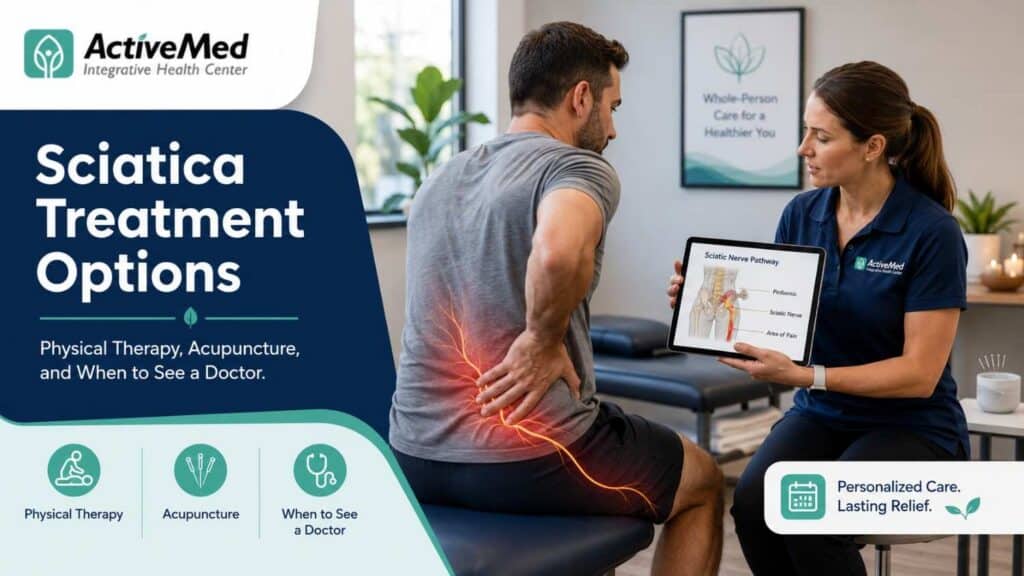
Sciatica treatment options may include staying active, guided exercise, Physical Therapy, Acupuncture, pain-management support, or specialist evaluation depending on the cause and severity of symptoms. Sciatica usually causes pain, tingling, numbness, or weakness that travels from the lower back or buttock into one leg. Seek urgent medical care for severe or worsening weakness, bilateral symptoms, saddle numbness, or bowel or bladder changes.
At ActiveMed Health, patients in Encinitas, Poway, and San Diego can begin with Physical Therapy or discuss Acupuncture after an appropriate evaluation.
Sciatica can be frustrating because it often affects more than the lower back. It may make sitting, standing, walking, driving, sleeping, working, or exercising difficult. Some people feel sharp pain down one leg. Others feel burning, tingling, numbness, or weakness.
The right next step depends on what is irritating the nerve, how severe symptoms are, how long symptoms have been present, and whether any warning signs are present.
Quick Answer: Sciatica Treatment Options
| Question | Evidence-Based Answer |
| What is sciatica? | Sciatica is a symptom pattern involving pain, weakness, numbness, or tingling in the leg caused by injury to or pressure on the sciatic nerve. |
| What does sciatica feel like? | It may feel sharp, burning, electric, tingling, numb, or weak and often travels from the lower back or buttock into one leg. |
| What helps many non-urgent cases? | Staying active as tolerated, gentle movement, physical therapy, and avoiding prolonged bed rest may help. |
| Can physical therapy help sciatica? | Physical therapy may help with movement, strength, walking tolerance, sitting tolerance, activity modification, and symptom management. |
| Can acupuncture help sciatica? | Acupuncture may help selected patients, especially chronic sciatica from herniated disk, but results vary and guidelines differ. |
| Do I need imaging right away? | Not always. Imaging is usually considered when serious pathology is suspected or when results would change management. |
| When is sciatica urgent? | Bilateral sciatica, severe or worsening weakness or numbness, saddle numbness, or bowel/bladder changes require urgent evaluation. |
According to the NHS, immediate emergency care is needed for sciatica on both sides, severe or worsening weakness or numbness in both legs, numbness around the genitals or anus, difficulty urinating, loss of bladder control, or bowel-control changes.
What Is Sciatica?
Sciatica is not a complete diagnosis by itself. It is a symptom pattern that usually involves irritation, pressure, or injury affecting the sciatic nerve or related nerve roots.
According to MedlinePlus, sciatica refers to pain, weakness, numbness, or tingling in the leg caused by injury to or pressure on the sciatic nerve. MedlinePlus also notes that sciatica is a symptom of a medical problem, not a medical condition by itself.
The sciatic nerve is the largest nerve in the body. It travels from the lower back through the buttock and down the leg. When this nerve pathway is irritated, symptoms may travel into the buttock, thigh, calf, foot, or toes.
Common causes may include:
| Possible Cause | Simple Explanation |
| Herniated or slipped disc | Disc material may irritate or press on a nerve |
| Spinal stenosis | Narrowing in the spine may affect nerve space |
| Spondylolisthesis | One vertebra slips forward over another |
| Bone spurs or arthritic changes | Extra bone growth may narrow nerve space |
| Piriformis-related irritation | A deep hip muscle may contribute to sciatic-type symptoms in some cases |
| Back, pelvic, or nerve injury | Trauma or injury may affect nerve function |
The NHS identifies slipped disc, spinal stenosis, spondylolisthesis, and back injury as possible causes of sciatica.
What Does Sciatica Feel Like?
Sciatica symptoms usually follow a nerve-like pattern. They may affect the lower back, buttock, back of the thigh, calf, foot, or toes.
| Symptom | What Patients May Notice |
| Sharp leg pain | Pain may travel down the back of one leg |
| Burning pain | Some patients describe heat, burning, or electric pain |
| Tingling or pins and needles | Sensation may travel into the leg, foot, or toes |
| Numbness | Part of the leg or foot may feel reduced sensation |
| Weakness | Walking, stairs, standing, or lifting the foot may feel harder |
| Pain with sitting | Sitting may increase nerve irritation for some people |
| Pain with coughing or sneezing | Symptoms may increase with pressure changes in the spine |
| Back pain plus leg pain | Leg pain may be more noticeable than back pain |
According to the Mayo Clinic, sciatica pain often travels from the low back to the buttock and down the back of the thigh and calf. Mayo Clinic notes that it may feel sharp, burning, or like an electric shock and may worsen with coughing, sneezing, or sitting for a long time.
Sciatica symptoms commonly affect one side. Symptoms on both sides, especially with numbness, weakness, or bowel/bladder changes, require urgent evaluation.
When Sciatica Needs Medical Help
This section is critical. Sciatica can be managed conservatively in many cases, but some symptoms may indicate serious nerve compression or another medical problem.
| Warning Sign | Why It Matters | Recommended Action |
| Sciatica on both sides | May indicate a more serious nerve problem | Seek urgent medical evaluation |
| Severe or worsening weakness in both legs | May indicate serious nerve involvement | Seek urgent medical evaluation |
| Severe or worsening numbness in both legs | May indicate serious nerve involvement | Seek urgent medical evaluation |
| Numbness around the genitals, groin, anus, or saddle area | Possible cauda equina-type warning sign | Emergency evaluation |
| Trouble starting urination or inability to urinate | Possible serious nerve compression | Emergency evaluation |
| New loss of bladder control | Possible serious nerve compression | Emergency evaluation |
| Loss of bowel control or not noticing the need to have a bowel movement | Possible serious nerve compression | Emergency evaluation |
| Fever, chills, or feeling very unwell | May suggest infection or systemic illness | Medical evaluation |
| Back or leg pain after major trauma | Fracture or significant injury should be ruled out | Medical evaluation |
| History of cancer with new sciatica symptoms | Requires medical evaluation | |
| Unexplained weight loss with back or leg pain | May signal an underlying medical cause | Medical evaluation |
| Rapidly worsening pain or neurologic symptoms | Needs assessment before conservative care | Medical evaluation |
| Pain not improving after a few weeks or stopping normal activities | Needs care planning | Schedule evaluation |
According to the NHS, people should see a GP if sciatica has not improved after trying home treatments for a few weeks, is getting worse, or is stopping normal activities. NHS also recommends emergency care for bilateral sciatica, severe or worsening weakness or numbness in both legs, saddle-area numbness, or bowel/bladder changes.
If these symptoms are present, do not rely on exercises, stretching, acupuncture, massage, or online advice alone. Get evaluated.
What Can You Do First for Non-Urgent Sciatica?
When urgent warning signs are not present, conservative care may be appropriate. The right plan still depends on symptoms, function, and clinical evaluation.
| Conservative Step | Why It May Help |
| Stay active as tolerated | Prolonged rest may delay recovery |
| Gentle movement | Helps maintain mobility without forcing painful motion |
| Avoid long periods of sitting or lying down | Sitting can worsen symptoms for some people |
| Modify aggravating activities | Reduces nerve irritation while symptoms calm |
| Use heat packs if helpful | May reduce local discomfort for some patients |
| Track symptoms | Helps identify whether pain, numbness, or weakness is improving |
| Seek physical therapy when function is limited | Helps guide safe movement, strength, and activity progression |
According to the NHS, people with sciatica should carry on normal activities as much as possible, start gentle exercise as soon as possible, avoid sitting or lying down for long periods, and use heat packs if helpful.
This does not mean every person should do the same exercise. Sciatica symptoms can be sensitive, and the wrong movement may aggravate some patients. A guided plan is safer when symptoms are persistent, limiting, or associated with weakness, numbness, or repeated flare-ups.
Physical Therapy for Sciatica: When It May Help
Physical therapy may help many patients with sciatica-related movement limitations, especially when symptoms affect walking, sitting, standing, lifting, sleeping, driving, work, or exercise.
A physical therapy plan for sciatica may focus on:
- Symptom behavior and nerve-symptom monitoring
- Walking tolerance
- Sitting and standing tolerance
- Strength and mobility
- Safe movement strategies
- Gradual return to daily activity
- Work, lifting, driving, and sleep modifications
- Flare-up planning
- Education about what symptoms should be monitored
- Identifying symptoms that need further medical evaluation
The goal is not to “push through” nerve pain. The goal is to understand what is limiting movement, reduce unnecessary fear, avoid prolonged inactivity, and build a plan that supports function.
According to the Academy of Orthopaedic Physical Therapy / APTA low back pain clinical practice guideline, low back pain care should include examination, classification, education, evidence-informed interventions, and monitoring of progress. The guideline supports physical therapist management of acute and chronic low back pain and related movement limitations.
At ActiveMed Health, Physical Therapy may help patients with sciatica-related movement limits, walking difficulty, weakness, and activity concerns build a safer, more individualized plan.
What Might Physical Therapy Include?
Physical therapy for sciatica should be individualized. It is not a universal exercise sheet.
| PT Focus Area | Why It May Matter for Sciatica |
| Symptom assessment | Helps identify what movements and positions aggravate or ease symptoms |
| Movement testing | Clarifies how bending, walking, sitting, or standing affects leg symptoms |
| Strength assessment | Helps identify weakness affecting walking, stairs, or daily function |
| Mobility work | May help when stiffness limits safe movement |
| Nerve-symptom monitoring | Tracks whether pain, numbness, tingling, or weakness is changing |
| Walking and activity progression | Helps patients return to normal movement safely |
| Education | Helps patients understand what symptoms are expected vs concerning |
| Home plan | Supports progress between visits |
| Referral if needed | Red flags or worsening neurologic signs require medical evaluation |
Manual therapy may sometimes be used, but it should not replace active care. According to NICE NG59, manual therapy for low back pain with or without sciatica should only be considered as part of a treatment package that includes exercise, with or without psychological therapy.
Acupuncture for Sciatica: What the Evidence Says
Acupuncture may be discussed for selected patients with sciatica, especially when symptoms are chronic and no urgent warning signs are present. But the evidence must be presented carefully.
The correct position is not “acupuncture cures sciatica.” It is:
Acupuncture may help some selected patients with sciatica symptoms, but results vary, and guideline recommendations differ.
| Evidence Source | What It Suggests | How to Frame It |
| NCCIH low-back-pain summary | Acupuncture may help chronic low back pain; evidence quality varies | Supports acupuncture as a possible non-drug option for chronic back-related pain |
| 2024 JAMA Internal Medicine trial | Acupuncture improved leg pain and function compared with sham acupuncture in chronic sciatica from herniated disk | Strong recent evidence for a specific subgroup |
| NICE NG59 | Recommends not offering acupuncture for low back pain with or without sciatica | Must be disclosed; guidelines differ |
| Clinical reality | Sciatica has different causes and severities | Acupuncture should not replace evaluation or rehab when weakness, numbness, or functional loss is present |
According to NCCIH, low- or moderate-quality evidence suggests that acupuncture and several other mind and body approaches may be helpful for chronic low back pain. NCCIH also notes that the American College of Physicians guideline recommends nondrug treatments as first-line therapy for chronic low back pain.
A 2024 randomized clinical trial in JAMA Internal Medicine found that acupuncture resulted in less leg pain and better function than sham acupuncture in patients with chronic sciatica from herniated disk at week 4, with benefits persisting through week 52. The trial included 216 patients and involved 10 sessions over 4 weeks.
However, NICE NG59 recommends not offering acupuncture for managing low back pain with or without sciatica. This means the article should be transparent: professional guidance differs.
ActiveMed’s Acupuncture service may be discussed for selected patients with back pain, leg symptoms, or chronic pain patterns after appropriate screening. Patients may also review location-specific acupuncture services, including acupuncture in Encinitas, acupuncture in Poway, and acupuncture in San Diego.
Physical Therapy vs Acupuncture for Sciatica
Physical therapy and acupuncture are not interchangeable. One may be more relevant than the other depending on the pain pattern, function, and evaluation findings.
| Option | May Fit When… | Limitation |
| Physical Therapy | Sciatica affects walking, sitting, strength, daily movement, work, exercise, or function | Requires active participation and follow-through |
| Acupuncture | Patient wants a non-drug symptom-support option and has no urgent red flags | Does not directly rebuild strength, mobility, or activity tolerance |
| Pain Management | Symptoms are persistent, severe, complex, or not improving | Should not be reduced to one procedure or passive treatment |
| Medical or specialist evaluation | Weakness, numbness, bowel/bladder changes, bilateral symptoms, trauma, fever, or severe worsening symptoms occur | Comes before conservative treatment when red flags are present |
For many patients, physical therapy is the stronger function-focused starting point because it addresses movement, walking tolerance, strength, posture, and activity confidence. Acupuncture may be considered as symptom support for selected patients, especially when symptoms are chronic and properly screened.
If sciatica symptoms are persistent, severe, complex, or not improving, ActiveMed’s Pain Management services may be discussed after evaluation.
Do You Need Imaging for Sciatica?
Not everyone with sciatica needs immediate imaging.
In many non-urgent cases, a healthcare provider can begin with history, symptom review, physical examination, and conservative care. Imaging becomes more relevant when serious underlying pathology is suspected, neurologic symptoms are severe or worsening, or results would change treatment decisions.
According to NICE NG59, imaging should not be routinely offered in a non-specialist setting for people with low back pain with or without sciatica. NICE recommends imaging in specialist settings only if the result is likely to change management.
| Imaging May Not Be First Step When… | Imaging May Matter More When… |
| Symptoms are mild or improving | Severe or worsening neurologic symptoms are present |
| No red flags are present | Bowel/bladder changes or saddle numbness occur |
| Conservative care is appropriate | Trauma, cancer history, fever, or infection signs exist |
| Function is improving | Symptoms are not improving despite appropriate care |
| Imaging would not change the plan | Injections or surgery are being considered |
| Symptoms are consistent and stable | Symptoms are rapidly worsening or unusual |
Imaging is a tool, not a treatment. The question is whether imaging will change the next step.
When Injections or Surgery May Be Discussed
Injections or surgery are not first-line choices for every person with sciatica. They may be discussed when symptoms are severe, persistent, function-limiting, and supported by evaluation findings.
According to the NHS, severe sciatica that has not improved may lead to referral for specialist options such as painkilling injections, procedures to seal off nerves, or surgery to relieve pressure on nerves.
NICE also states that spinal decompression may be considered for people with sciatica when nonsurgical treatment has not improved pain or function and radiological findings are consistent with sciatic symptoms.
| Situation | Why Further Discussion May Be Needed |
| Severe leg pain persists despite appropriate nonsurgical care | Pain may require additional evaluation |
| Weakness or numbness is worsening | Neurologic status needs medical assessment |
| Function remains significantly limited | Treatment plan may need escalation |
| Imaging findings match persistent symptoms | Specialist options may be considered |
| Bowel/bladder or saddle numbness symptoms occur | This is urgent, not routine treatment planning |
Physical therapy or acupuncture should not delay urgent care when red flags are present.
What Happens During an ActiveMed Sciatica Evaluation?
A sciatica evaluation should begin by understanding the symptom pattern and screening for warning signs.
An evaluation may include:
- Where symptoms start and where they travel
- Whether pain is sharp, burning, electric, tingling, numb, or weak
- Whether symptoms affect one leg or both legs
- Whether sitting, standing, walking, coughing, sneezing, or bending changes symptoms
- Whether there is weakness, numbness, saddle numbness, or bowel/bladder change
- Medical history, prior injury, prior imaging, and previous treatment
- Walking, mobility, strength, and movement assessment
- Discussion of work, driving, sleep, lifting, exercise, and daily activity limits
- Whether Physical Therapy is appropriate
- Whether Acupuncture may be discussed after screening
- Whether Pain Management, imaging, or specialist evaluation may be appropriate
The first goal is not to choose a treatment quickly. The first goal is to determine whether symptoms are safe for conservative care, what function is limited, and what plan should be tried and reassessed.
At ActiveMed Health, patients can begin with Physical Therapy, discuss Acupuncture when appropriate, or schedule a visit to review symptoms and next steps.
Patients who plan to use insurance can also verify insurance benefits before beginning care.
Related Reading From ActiveMed
Continue learning about back pain, acupuncture, and physical therapy options:
- Back pain relief with acupuncture in Encinitas
- Acupuncture for Chronic Low Back Pain: What the Evidence Shows
- Physical Therapy for Lower Back Pain: What Helps, What Doesn’t, and When to Get Evaluated
- Physical Therapy
- Acupuncture
Frequently Asked Questions About Sciatica Treatment Options
What is sciatica?
- Sciatica is a symptom pattern involving pain, weakness, numbness, or tingling in the leg caused by irritation, pressure, or injury affecting the sciatic nerve or related nerve roots. It is a symptom of an underlying problem, not a standalone diagnosis.
What does sciatica feel like?
- Sciatica may feel like sharp, burning, electric, tingling, or shooting pain that travels from the lower back or buttock down the back of the leg. Some people also have numbness, weakness, or symptoms that reach the foot or toes.
Can physical therapy help sciatica?
- Physical therapy may help many patients with sciatica improve movement, strength, walking tolerance, sitting tolerance, activity confidence, and symptom management. The plan should be individualized based on symptoms and evaluation findings.
Can acupuncture help sciatica?
- Acupuncture may help selected patients, especially chronic sciatica from herniated disk, but results vary. A 2024 randomized trial found benefit compared with sham acupuncture, while NICE recommends against acupuncture for low back pain with or without sciatica.
Should I rest with sciatica?
- Short-term activity modification may help, but prolonged sitting or lying down is usually not the goal. NHS advises staying active as much as possible and starting gentle movement as soon as possible.
When should I see a doctor for sciatica?
- See a healthcare provider if pain is getting worse, has not improved after a few weeks of home care, or is stopping normal activities. Seek urgent care for bilateral symptoms, severe or worsening weakness or numbness, saddle numbness, or bowel/bladder changes.
Do I need an MRI for sciatica?
- Not always. Imaging is usually considered when serious underlying pathology is suspected, symptoms are severe or worsening, or imaging would change treatment decisions.
Can sciatica go away without surgery?
- Many cases improve with conservative care, and surgery is not needed in most cases. However, severe weakness, bowel/bladder changes, saddle numbness, or persistent function-limiting symptoms may require specialist evaluation.
Is acupuncture better than physical therapy for sciatica?
- Neither is automatically better. Physical therapy is more focused on movement, strength, and function. Acupuncture may provide symptom support for selected patients. The right approach depends on the cause, severity, symptoms, and goals.
Where can I get sciatica treatment in Encinitas, Poway, or San Diego?
- ActiveMed Health offers physical therapy, acupuncture, and pain-care services for patients in Encinitas, Poway, and San Diego. Patients can schedule a visit to discuss symptoms and appropriate next steps.
Conclusion
Sciatica treatment options should be chosen carefully because sciatica is a symptom pattern, not a single diagnosis. The right plan depends on what is irritating the nerve, how severe symptoms are, whether function is affected, and whether warning signs are present.
For many non-urgent cases, staying active, gentle movement, and physical therapy may help improve movement, strength, walking tolerance, and daily function. Acupuncture may be discussed for selected patients, especially chronic sciatica, but results vary and guideline recommendations differ. Persistent, severe, or neurologic symptoms may require pain-management support or specialist evaluation.
If sciatica is affecting walking, sitting, sleep, work, or daily life, explore Physical Therapy, discuss Acupuncture, or schedule a visit with ActiveMed Health. Patients planning to use insurance can also verify insurance benefits before beginning care.