
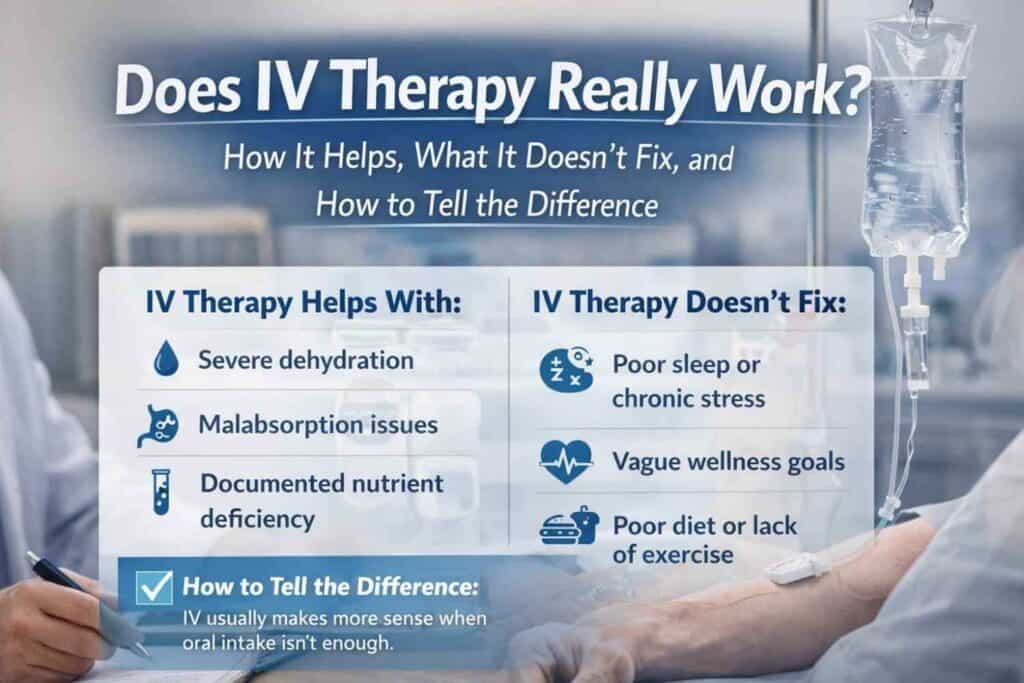
IV therapy can absolutely work — but only when the reason for using it makes sense. Intravenous therapy delivers fluids, electrolytes, medications, or nutrients directly into the bloodstream, which can be useful when someone is dehydrated, cannot keep fluids down, has absorption problems, or needs rapid, controlled treatment. Where the evidence gets weaker is the “wellness drip” world: for generally healthy, well-nourished adults, major medical sources say there is limited proof that IV vitamin therapy delivers benefits beyond what food, fluids, sleep, and oral supplements can already do.
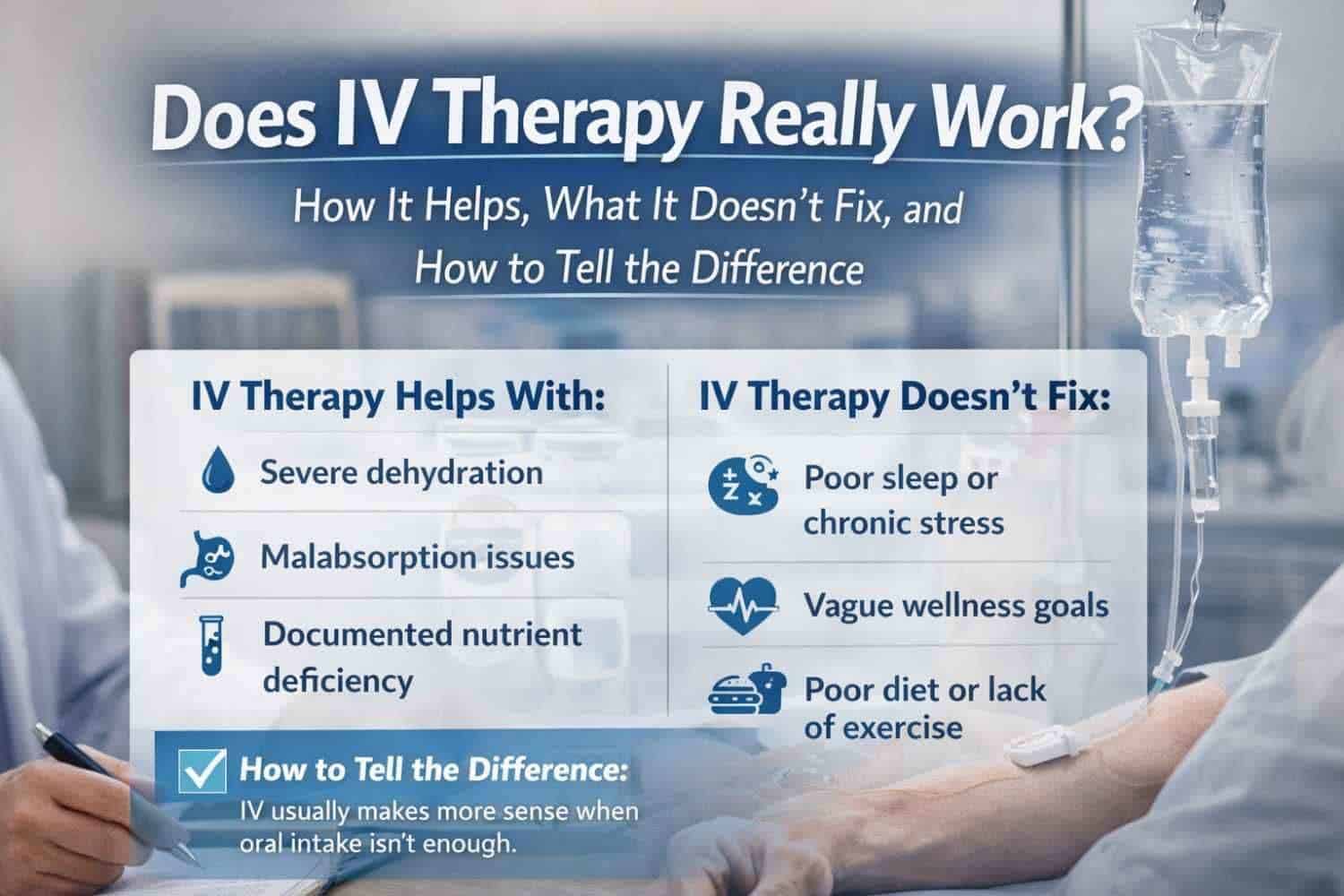
At ActiveMed Integrative Health Center, IV therapy is presented as a targeted clinical tool, not a magic shortcut. The clinic’s IV pages describe physician-guided evaluation, in-clinic monitoring, and specific options such as Nourish, Immunity, Detox, and NAD formulas, which is a much stronger positioning than vague “boost” language.
Read more: Vitamin IV Therapy Boosts Wellness
What IV therapy actually is
IV therapy, or intravenous therapy, means delivering fluid or ingredients through a vein so they enter circulation without first passing through the digestive tract. That route is fundamental in mainstream medicine because it allows faster, more predictable delivery when oral intake is not enough or not possible. In hospitals and urgent care, that often means dehydration treatment, medications, antibiotics, chemo, or nutrition support. In integrative clinics, the same route is used for hydration and nutrient formulas.
That distinction matters. Medical IV therapy has clear, established uses. Wellness IV therapy borrows the same route but often expands the claims far beyond what the evidence supports. The Merck Manual notes that IV vitamin therapies such as Myers’ Cocktail are widely promoted for energy, immune support, and wellness, but the evidence behind many of those claims is limited.
What IV therapy can help with
IV therapy tends to make the most sense when the digestive tract cannot do the job well enough, or when speed and control matter.
Severe dehydration or inability to keep fluids down
If someone is vomiting repeatedly, has severe diarrhea, or is too dehydrated to catch up by mouth, IV therapy can be the right tool. CDC guidance on rehydration makes clear that oral rehydration is preferred for many mild to moderate cases because it is safer and more physiologic, but IV therapy becomes necessary in more severe dehydration or shock states.
Malabsorption or GI issues
This is one of the strongest reasons IV therapy may outperform oral supplements. Reviews of IV vitamin therapy note that its clearest clinical role is in patients with documented deficiencies, malabsorption syndromes, or gastrointestinal conditions that impair normal uptake of nutrients. If the gut cannot reliably absorb what you swallow, oral supplementation may be too weak or too slow.
Medical need for rapid or controlled dosing
One reason IV therapy has existed in medicine for so long is control. When clinicians need a fast, predictable response — rehydration, electrolytes, antibiotics, chemotherapy, or hospital nutrition support — IV delivery is often the correct route. That does not automatically mean every wellness goal deserves an IV, but it does explain why IV therapy can be clearly effective in the right context.
Targeted nutrient support when oral options have failed
There are select patients whose diets are decent and who have already tried oral supplements, but still show low levels or poor response. In those cases, IV therapy may be used more strategically. The key is that this should be lab-guided and diagnosis-guided, not based on guesswork. That approach lines up with ActiveMed’s stated model of medical consultation first, followed by a customized IV plan.
Read more: IV Therapy Side Effects To Know
What IV therapy does not fix
This is the section most clinics avoid, but it is exactly what makes the article stronger.
IV therapy does not fix poor sleep, chronic stress, alcohol overuse, poor diet, lack of movement, or an undiagnosed medical problem by itself. Mayo Clinic Press says there is limited evidence that IV vitamins provide benefits to people who already have normal nutritional intake and levels, and it specifically notes that broad claims about immunity, stress relief, and general health improvement often rest on weak or poorly designed studies.
That means an IV drip is not a substitute for the basics. If someone is sleeping five hours a night, eating poorly, chronically overworked, and using IV therapy as a weekly “reset,” the drip may feel helpful in the short term while leaving the real problem untouched. That is not a knock on IV therapy — it is a warning against using the wrong tool for the wrong job.
Does IV therapy really work?
The honest answer is: yes, for some things; maybe, for others; and no, not in the sweeping way it is often marketed.
It clearly works when it is solving a real hydration, absorption, or delivery problem. It may also be reasonable in some integrative settings where symptoms, labs, and tolerance to oral therapies point toward a supervised IV plan. But for general “feel better,” “detox,” “anti-aging,” or “immune boost” claims in otherwise healthy adults, the evidence is limited and much less convincing than the marketing.
That is why the right question is not “Does IV therapy work?” in the abstract. The better question is: “Work for what, in whom, and compared with what?” If the comparison is severe vomiting vs oral intake, IV often wins. If the comparison is mild dehydration vs water and electrolytes, oral hydration usually wins. If the comparison is normal nutrition vs a pricey vitamin drip, the evidence often does not justify the IV.
Read more: What Is IV Therapy? (And When It’s Better Than Just Drinking Water and Taking Supplements)
What about NAD IV therapy?
NAD is where patients get especially curious. ActiveMed’s IV Nutrient Therapy product page includes multi-visit NAD packages, so this article should address that directly.
The right framing is cautious: NAD has biologic logic, but broad clinical claims are still ahead of the evidence. NAD-related therapies are being explored for metabolism, cellular energy, and aging pathways, but current reviews do not support overselling NAD IV as a proven anti-aging or high-performance fix for healthy adults. That does not mean it has no value; it means the evidence is still evolving, and clinics should present it as a selective option rather than a guaranteed breakthrough.
How to tell the difference: when IV makes sense vs when it’s overkill
Here is the simplest way to explain it to patients:
| Situation | IV therapy may make sense | Oral hydration / supplements are usually enough |
| Severe dehydration, vomiting, or inability to keep fluids down | Yes | No |
| Malabsorption, gut disease, or documented deficiency not responding to oral treatment | Yes | Sometimes not enough |
| Mild dehydration after travel, exercise, or a busy week | Usually not necessary | Usually yes |
| Normal labs, normal digestion, vague “wellness boost” goals | Usually not the first step | Usually yes |
This table is consistent with CDC guidance favoring oral rehydration when appropriate, plus Mayo and Merck’s caution that IV vitamin therapy is not well supported for generally healthy people without deficiency.
A practical rule patients can understand:
- IV is more justified when the gut cannot keep up.
- Oral is usually smarter when the body can absorb normally.
Risks and side effects patients should know about
Even when IV therapy is used for reasonable indications, it is not risk-free. Mayo Clinic Press and the 2025 review on IV vitamin therapy both highlight risks including infection, vein irritation, bruising, infiltration, electrolyte problems, fluid overload, and dosing concerns, especially when therapy is performed casually or without careful medical oversight.
The Merck Manual specifically advises caution or avoidance in pregnant or breastfeeding women and in people with kidney disease, high blood pressure, or heart conditions when it comes to high-dose IV vitamin therapies such as Myers’ Cocktail. That is one reason a proper consultation matters more than the menu name of the drip.
This is also where ActiveMed can differentiate itself from “drip bar” marketing: the clinic already describes IV therapy as something that begins with a consultation with a Naturopathic Medical Doctor, followed by IV placement, monitoring, and follow-up. That clinical framing is exactly what reduces risk and builds trust.
How ActiveMed should position IV therapy
For ActiveMed, the strongest positioning is:
IV therapy is a medically guided support tool, not a miracle.
That means the service page and blog should consistently say:
- IV therapy can help in targeted scenarios
- formulas should match symptoms, history, and labs
- the clinic offers specific options like Nourish, Immunity, Detox, and NAD
- IVs work best as part of a broader plan that may include functional medicine, physical therapy, acupuncture, or other treatments, not as a stand-alone fix.
This is especially important because ActiveMed already has multiple IV-related pages. The smartest content strategy is to make this article the decision-making hub, then link outward to:
- the main IV Therapy service page
- the IV Nutrient Therapy product page
- the existing What Is IV Therapy? article
- any related drip / nutrient / functional medicine pages.
FAQs
Does IV therapy really work?
- Yes — when it is used for the right reason. IV therapy is clearly useful for dehydration, poor oral tolerance, malabsorption, and some targeted medical/nutrient situations. The evidence is much weaker for broad wellness claims in otherwise healthy adults.
When is IV therapy better than drinking water?
- It is more likely to be better when someone is significantly dehydrated, vomiting, or unable to absorb or tolerate oral intake. For mild dehydration, oral fluids and electrolytes are usually safer and sufficient.
Does IV vitamin therapy help if my labs are normal?
- Maybe not much. Major medical sources say there is limited evidence that IV vitamin therapy benefits people who already have normal intake and normal nutrient levels.
What does IV therapy not fix?
- It does not reliably fix poor sleep, chronic stress, weak nutrition habits, alcohol overuse, or undiagnosed medical problems. Those issues usually need a broader plan, not just a drip.
Is NAD IV therapy proven for anti-aging?
- Not in the way many ads suggest. NAD has scientific interest and early data, but broad anti-aging and general wellness claims are still ahead of the current evidence.
Who should be cautious with IV therapy?
- People with kidney disease, heart conditions, high blood pressure, pregnancy, breastfeeding, or complex medical issues should be screened carefully before high-dose IV vitamin therapy.