
Clinician-guided PEMF treatment and at-home PEMF mats both use pulsed electromagnetic fields, but they are not automatically equivalent. The diagnosis, device design, intended use, settings and supporting evidence all matter. Clinical care may add evaluation and monitoring, while a home mat may offer convenience. Neither can guarantee pain relief, structural change or functional recovery.
What Is PEMF Therapy?
Pulsed electromagnetic field therapy uses a device that produces time-varying electromagnetic pulses near the body. Unlike static magnets, the field changes over time. PEMF also differs from electrical stimulation, which applies current through electrodes, and transcranial magnetic stimulation, which targets brain regions. Learn more about PEMF therapy at ActiveMed.
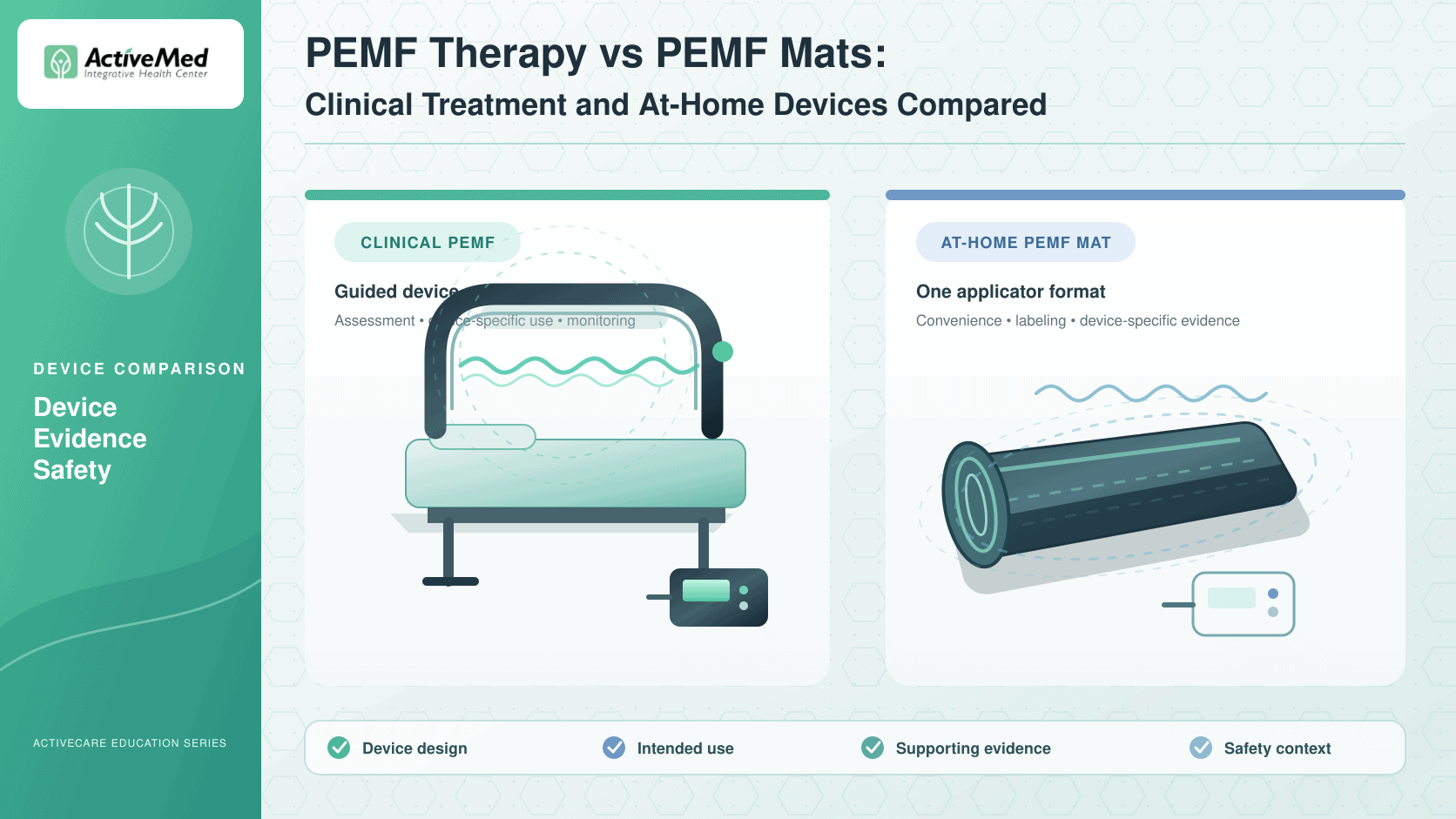
What Is a PEMF Mat?
A PEMF mat is one applicator format that distributes pulsed electromagnetic fields across a broad surface. Some products are intended for medical use; others are marketed for wellness. Whole-body coverage does not establish greater effectiveness. ActiveMed’s guide to PEMF mat therapy provides additional background.
How Are Clinical PEMF Treatment and At-Home Mats Different?
The main difference is the context in which the device is selected and used. Clinician-guided care may include assessment, safety screening, defined goals and follow-up. Home mats provide easier access, but users may have to evaluate device claims and relevance without professional guidance.
| Comparison factor | Clinician-guided PEMF | At-home PEMF mat |
| Evaluation | May include assessment | Often purchased without assessment |
| Device selection | Selected clinically | Selected by the consumer |
| Intended use | Defined clinical goal | May be marketed for pain or wellness |
| Settings | Within labeling and judgment | Preset or user-controlled programs |
| Monitoring | Symptoms may be reassessed | Usually depends on the user |
| Evidence | Device- and condition-specific | Research on another device may not transfer |
| Rehabilitation | May coordinate with care | Does not provide rehabilitation assessment |
| Convenience | Requires a clinical visit | Available for home use |
| Cost considerations | May involve visit-related costs | Requires purchase, rental or subscription decisions |
| Limitations | Clinical use does not prove superiority | Marketing may exceed device evidence |
Are All PEMF Devices Equivalent?
No. Devices can differ in frequency, field intensity, waveform, pulse duration, coil design, applicator placement, treatment area, calibration and intended use. Even studies of nonspecific low-back pain have used markedly different frequencies, intensities and schedules, limiting straightforward comparisons between devices or protocols.
“Evidence from one PEMF device or condition should not be generalized to every PEMF mat.”
What Does the Evidence Say About PEMF?
PEMF evidence is condition-specific and difficult to generalize because studies use different devices, parameters, comparison groups and outcomes. Some reviews report improvements in pain or function, but other conditions show limited or inconsistent findings. Explore non-surgical joint-pain treatment options when comparing PEMF with other approaches.
| Condition or use | What research suggests | Responsible interpretation |
| Knee osteoarthritis | Reviews report possible pain and function improvements, with variable protocols. | One system’s results should not be applied to every mat. |
| Nonspecific low-back pain | Five of nine randomized trials reported favorable outcomes, but settings varied. | Evidence does not establish one best device. |
| Shoulder or rotator-cuff pain | NCCIH reports that limited evidence did not consistently show additional benefit. | Knee or back findings should not be transferred to shoulder conditions. |
| Fibromyalgia | Evidence is limited and mixed; a larger study did not find pain reduction. | PEMF is not a proven fibromyalgia treatment. |
| Bone-healing devices | The FDA has approved particular devices for defined indications. | Approval does not transfer to consumer mats or other conditions. |
| General wellness, sleep or performance | Broad marketing claims extend beyond the strongest condition-specific evidence. | Do not promise better sleep, energy, immunity, recovery or performance. |
Does FDA Clearance Apply to Every PEMF Mat?
No. FDA registration, listing, clearance and approval have different meanings, and status applies to a specific device and intended use. Registration or listing does not establish FDA approval, clearance or authorization. Consumers can search FDA databases for specific products.
Approval of a PEMF bone-growth stimulator does not mean consumer mats are approved for arthritis, back pain or wellness. Check the exact manufacturer, model and labeled indication.
What May a Clinical Evaluation Add?
A clinical evaluation may clarify the diagnosis and symptom pattern, review medical history and implants, assess functional limitations, identify findings requiring imaging or referral, and establish goals. Follow-up may monitor response and coordinate rehabilitation. It may also determine whether PEMF is relevant or another approach should take priority. ActiveMed offers pain-management support.
What Should You Check Before Buying a PEMF Mat?
Before buying a mat, examine the exact product rather than relying on general PEMF research. Look for transparent labeling, realistic claims and technical information that can be compared with research. This helps distinguish device-specific evidence from general marketing.
- Manufacturer and exact model
- Labeled intended use
- Verifiable FDA status when medical claims are made
- Frequency, intensity, waveform and applicator information
- Warnings and contraindications
- Evidence involving that device or reasonably comparable parameters
- Warranty, return policy and customer support
- Claims involving cures, regeneration or guaranteed outcomes
- Whether your medical history warrants clinician review
Do not choose settings or schedules from a general article; follow labeling and seek individualized guidance when appropriate.
Who Should Seek Medical Guidance Before Using PEMF?
People with pacemakers, insulin pumps or other implanted electronic devices should obtain device-specific medical guidance before exposure. An FDA recall cited potential interference with pacemakers and insulin pumps, illustrating why screening matters. Pregnant people and those with serious or unexplained symptoms should review relevant labeling and clinical context.
Warnings vary, so this is not a complete contraindication list. Medication and implanted-device decisions must come from the treating clinician or relevant specialist.
Can PEMF Replace Physical Therapy or Medical Evaluation?
No. PEMF cannot diagnose pain or replace progressive strengthening, mobility work, movement retraining, load management or neurological and orthopedic assessment. When rehabilitation is appropriate, physical therapy and rehabilitation can address the functional factors that a passive device cannot assess or retrain. PEMF should not delay indicated imaging, conventional treatment, specialist referral or urgent assessment.
What Can Neither Clinical PEMF Nor a Home Mat Promise?
Neither clinical PEMF nor a home mat can guarantee a specific biological or functional outcome. Symptom improvement does not prove structural repair, and convenience or price does not change that limitation. Neither option can promise:
- A cure
- Guaranteed pain relief
- Tissue regeneration
- Cartilage regrowth
- Tendon repair
- Faster recovery
- Improved athletic performance
- Stronger immunity
- Permanent results
- Avoidance of surgery
- Replacement of necessary rehabilitation
When Does Pain Need Prompt Medical Evaluation?
Pain needs prompt assessment when it may reflect a serious injury, infection, neurological problem or cardiopulmonary emergency. Do not use a PEMF device to delay evaluation of severe, new or rapidly worsening symptoms. Seek urgent or emergency care for:
- Severe pain after trauma
- Inability to bear weight or use a limb
- Visible deformity
- Sudden weakness or progressive numbness
- Loss of bladder or bowel control
- Fever with a hot, red or rapidly swollen joint
- Chest pain or difficulty breathing
- Rapidly worsening symptoms
ActiveMed is not an emergency-care provider.
How May ActiveMed Help?
ActiveMed offers PEMF mat therapy, physical therapy, pain-management support and an integrative medicine approach. An evaluation may determine whether PEMF, rehabilitation, conventional medical care, imaging or an outside referral should be considered. ActiveMed does not claim that PEMF is appropriate for every person or pain condition.
Frequently Asked Questions
These answers provide general decision support rather than personal device instructions. Diagnosis, product labeling, medical history, goals and evidence should guide a PEMF discussion. They cannot determine whether a specific device is appropriate for you.
Is clinical PEMF therapy better than an at-home PEMF mat?
Not automatically. We consider the diagnosis, device, intended use, evidence, safety screening and goals. Clinical care may add examination, monitoring and coordination with rehabilitation, but the clinic setting alone does not make a device more effective. A home mat may be convenient, but that does not establish suitability or equivalence to a studied system.
Do at-home PEMF mats work for pain?
They may help some people, but the answer depends on the pain condition and device. We do not generalize findings from one PEMF protocol to every consumer mat. Research is more supportive for certain musculoskeletal conditions than for broad wellness claims, and even favorable studies use different parameters. Some users may experience no meaningful improvement; no home device guarantees benefit.
Is every PEMF mat FDA-cleared?
No. Check the exact manufacturer and model in FDA databases when a seller makes medical claims. Registration or listing is not the same as clearance or approval. Regulatory status also applies to an intended use; a device authorized for a defined bone-healing indication does not establish that another mat treats arthritis or generalized pain.
Is PEMF the same as static magnet therapy?
No. PEMF devices generate electromagnetic fields that change over time, while static magnets produce a constant field. We also distinguish PEMF from electrical stimulation and transcranial magnetic stimulation. Do not group them when interpreting research. Evidence about a static magnet product cannot establish PEMF effectiveness, and evidence about PEMF cannot validate every magnetic wellness product.
Can you use a PEMF mat with a pacemaker or implanted device?
Do not assume that you can. We advise people with pacemakers, insulin pumps or other implanted electronic devices to consult the treating specialist and review the specific device labeling before exposure. Electromagnetic fields may interfere with certain equipment. Do not stop, reprogram or otherwise change management of an implanted device based on general online guidance.
Can PEMF regenerate cartilage or repair a tendon?
PEMF should not be presented as proven cartilage regeneration or tendon repair. We separate symptom or functional improvement from structural change. Reduced pain does not demonstrate cartilage regrowth or tendon repair. If a tear, progressive weakness or significant joint damage is suspected, examination, indicated imaging and conventional or orthopedic evaluation may be more important.
Can PEMF replace physical therapy?
No. We do not use a passive modality as a substitute for clinically appropriate rehabilitation. Physical therapy may address strength, mobility, movement patterns, load tolerance and gradual return to activity. PEMF may be discussed as an adjunct in selected situations, but it cannot perform a movement assessment or replace an individualized exercise and functional progression plan.
What should you check before buying a PEMF mat?
Check the exact model, labeled intended use, verifiable regulatory status, technical specifications, contraindications, warranty and evidence. We also recommend looking for exaggerated promises involving cures, regeneration, immunity or universal pain relief. If you have implanted electronics, pregnancy, unexplained symptoms or a significant medical condition, seek appropriate professional guidance before purchasing or using a particular device.