
PRP and cortisone injections work differently, and neither is best for every tendon or joint problem. Cortisone reduces inflammatory activity and may offer short-term symptom relief in selected conditions. PRP uses a preparation made from the patient’s blood, but evidence varies by diagnosis. Neither can guarantee tissue regeneration, lasting relief, functional recovery or avoidance of surgery.
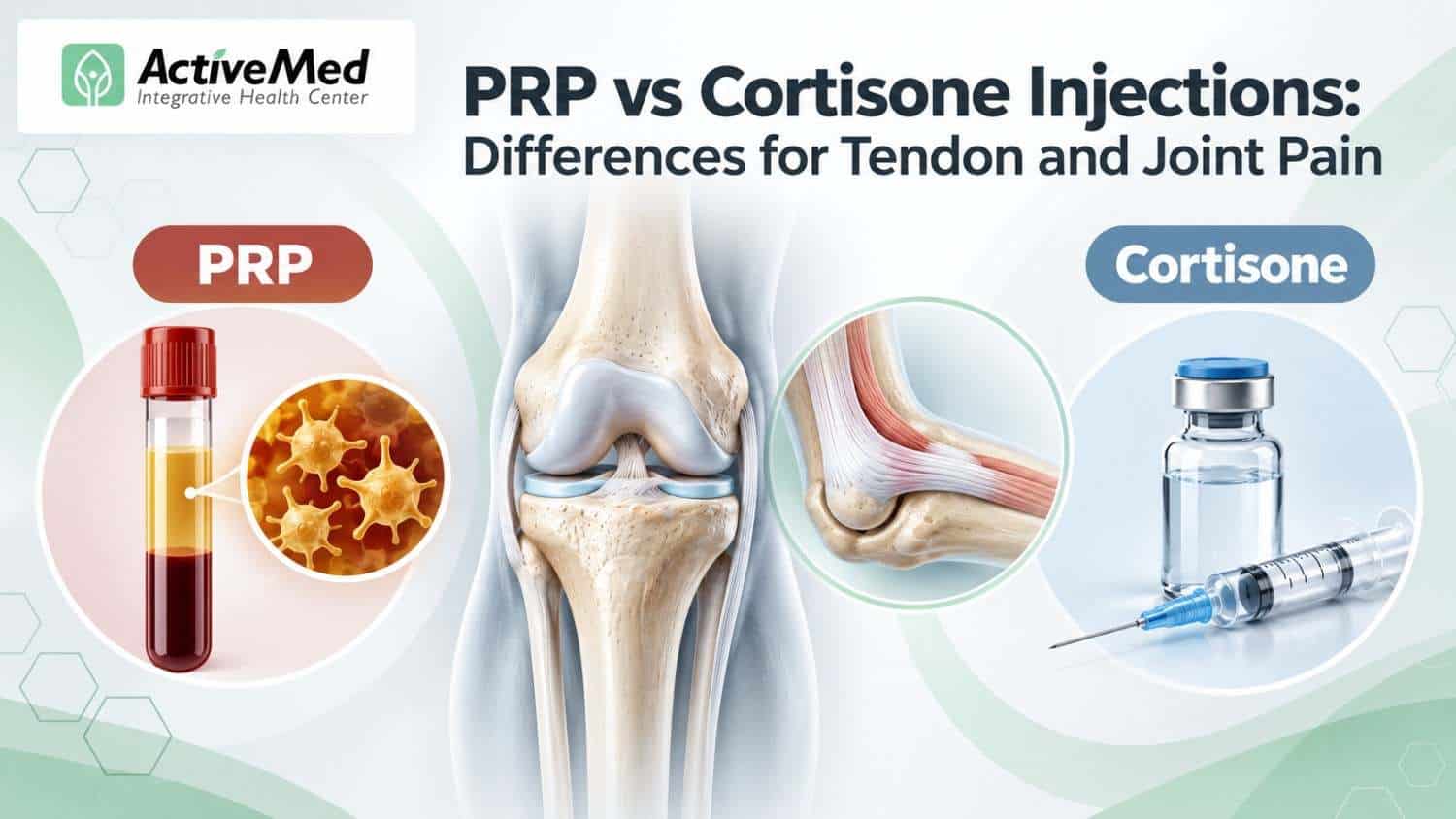
How Are PRP and Cortisone Injections Different?
PRP and cortisone differ in material, intended effect and supporting evidence. Cortisone is an anti-inflammatory medication. PRP is a blood-derived preparation studied for selected musculoskeletal conditions. The appropriate discussion depends on the diagnosis—not simply whether the painful area is a tendon or joint.
| Feature | PRP | Cortisone |
| Material | Platelet-rich preparation from the patient’s blood | Corticosteroid medication, sometimes with local anesthetic |
| Primary purpose | Investigated for pain and functional improvement in selected conditions | Reduces inflammatory activity and related symptoms |
| Typical clinical goal | Improve function or pain in a specifically diagnosed condition | Provide symptom relief, often over a shorter-term window |
| Evidence | Mixed and condition-specific | More established for short-term relief in selected joint conditions; unsuitable for some tendon problems |
| Onset | Variable; no universal timeline applies | May provide earlier symptom relief, but response varies |
| Main limitation | Cannot promise tissue regeneration | Does not repair tissue or cure the condition |
| Rehabilitation | Does not replace appropriate rehabilitation | Does not replace appropriate rehabilitation |
Why Does the Diagnosis Matter Before Choosing an Injection?
Tendon or joint pain is a symptom, not a complete diagnosis. Pain may arise from tendinitis, persistent tendinopathy, a partial or complete tear, osteoarthritis, inflammatory arthritis, bursitis, infection, nerve irritation or a referred source. History, examination and imaging when it would change management help prevent a misdirected injection and delayed care.
What Is a Cortisone Injection?
A cortisone injection places corticosteroid medication into or around a selected structure to reduce inflammatory activity and symptoms. It may improve pain and function, but relief does not cure the cause or prove structural improvement. Repeat exposure may add tissue-specific concerns. AAOS explains cortisone’s uses and limitations.
What Is PRP?
PRP is produced by collecting and processing a patient’s blood into a platelet-rich preparation for injection into a selected area. Platelet concentrations, white-blood-cell content and protocols vary, limiting comparisons across studies. Review PRP therapy at ActiveMed and the AAOS evidence overview.
“PRP is not stem-cell therapy.”
PRP vs Cortisone for Tendon Pain
Evidence changes by tendon. Some lateral-elbow research favors cortisone earlier and PRP later, while placebo-controlled Achilles research has not shown reliable PRP benefit. Cortisone also requires caution around certain tendons. See our guide to PRP for persistent tendon pain.
Lateral elbow tendinopathy: A randomized study favored corticosteroid earlier and PRP at one year, but it does not establish universal PRP superiority. Review the trial.
Achilles tendinopathy: With exercise, PRP produced no greater improvement than saline in a placebo-controlled trial. Review the trial. AAOS cautions against cortisone for tendinitis because of rupture concerns.
Patellar tendinopathy: Evidence remains limited and protocol-dependent; corticosteroid-related rupture concerns require diagnosis-specific procedural judgment.
Rotator-cuff tendinopathy or partial tears: AAOS does not support routine PRP and warns that multiple steroid injections may compromise cuff integrity. Read the guideline. Pain when reaching overhead has several possible causes.
Complete tendon rupture: This is not chronic tendinopathy and may require prompt orthopedic assessment.
PRP vs Cortisone for Joint Pain
For joint pain, the clearest comparison concerns knee osteoarthritis—but major guidelines disagree. Knee evidence should not be generalized to every painful knee or other joints. Our non-surgical joint-pain treatment comparison places injections alongside rehabilitation and other options.
AAOS says intra-articular corticosteroids may provide short-term relief and gives PRP only limited support because results are inconsistent. Read the AAOS knee guideline.
The 2026 ACR summary strongly recommends intra-articular glucocorticoids for knee and hip osteoarthritis and strongly recommends against PRP; both positions use low-certainty evidence. Read the ACR summary.
The disagreement reflects different evidence grading. Knee pain when walking still requires diagnosis before an injection is considered.
Which Injection Works Faster or Lasts Longer?
Cortisone often has an earlier symptom-control goal, while PRP studies sometimes assess later outcomes. Neither pattern creates a dependable individual timeline. “Faster” does not mean “better,” and pain can change without structural restoration. Progress should include functional goals such as walking, gripping, lifting or reaching—not pain scores alone.
What Can Neither Injection Promise?
Neither treatment can guarantee a biological or clinical result. A proposed mechanism, study or testimonial cannot predict an individual outcome; either procedure may produce temporary, limited or no meaningful improvement. No injection can ensure return to work, exercise or sport.
Neither treatment can promise:
- A cure
- Complete tendon or cartilage regeneration
- Guaranteed pain relief
- A specific recovery date
- Return to work, exercise or sport
- Prevention of surgery
- Permanent results
- Success after one injection
- Replacement of necessary rehabilitation
What Are the Risks and Limitations?
Both procedures carry risks determined by the target, technique, medical history and treatment. PRP’s use of the patient’s blood does not make it risk-free, while cortisone’s familiarity does not make every injection appropriate or harmless.
| Consideration | PRP | Cortisone |
| Pain or flare | Injection-site soreness or temporary flare | Temporary post-injection flare |
| Procedure | Bleeding, bruising, infection, lightheadedness or nearby-structure injury | The same procedural risks apply |
| Systemic issues | Medical history and medications require review | Blood glucose may rise temporarily, particularly with diabetes |
| Tissue concerns | Structural restoration is not guaranteed | Skin, soft-tissue, tendon or cartilage concerns may apply |
| Evidence | Preparations and protocols vary | Benefits and risks vary by diagnosis and exposure |
| Practical limits | Cost or insurance may limit access | Coverage and access vary |
| Outcome | No meaningful improvement is possible | No meaningful improvement is possible |
Decisions about anticoagulants, antiplatelet drugs, NSAIDs and other medicines must come from the treating clinician; patients should not change medication independently.
Why Does Physical Therapy Still Matter?
Physical therapy may address strength, mobility, load tolerance, movement patterns and gradual return to activity. An injection may change symptoms without correcting reduced capacity. Clinically appropriate physical therapy and progressive rehabilitation remain central to many care plans.
“An injection does not replace necessary rehabilitation when rehabilitation is clinically appropriate.”
Exercises, loading and return-to-activity decisions must be individualized.
What Should Happen Before Choosing an Injection?
Before choosing PRP or discussing cortisone, a clinician should determine the likely pain source. Assessment may review onset, injury, pain location, swelling, strength, limitations, previous care, health conditions and medications. Imaging is considered when it could change management. A pain-management evaluation may identify when conventional care or referral is more appropriate.
When Does Tendon or Joint Pain Need Prompt Medical Evaluation?
Some patterns may indicate rupture, serious injury, infection or a neurological or vascular emergency. Seek urgent or emergency assessment for severe, sudden or rapidly worsening symptoms, especially when function, circulation, breathing or general health is affected.
Prompt evaluation is important for:
- A hot, red or rapidly swollen joint
- Fever with severe pain
- A sudden pop followed by immediate weakness
- Visible deformity
- Inability to use the limb or bear weight
- Progressive numbness or weakness
- A pale, cold or discolored limb or other signs of reduced circulation
- Calf swelling
- Chest pain or difficulty breathing
- Rapidly worsening symptoms
ActiveMed is not an emergency-care provider. Call emergency services or use an appropriate urgent or emergency facility when the situation may be serious.
How May ActiveMed Help?
ActiveMed offers PRP therapy, physical therapy and pain-management support for adults in Encinitas, Poway and San Diego. We do not state that ActiveMed administers cortisone. Evaluation may clarify whether rehabilitation, PRP, imaging, conventional care or orthopedic referral fits the diagnosis, evidence, medical history and functional goals.
Frequently Asked Questions
These answers cannot determine your treatment. We use the diagnosis, affected structure, risks, previous care and functional goals to guide individualized discussion. Evidence from one tendon or joint should not be applied automatically to another.
Is PRP better than cortisone for tendon pain?
Not universally. Some lateral-elbow comparisons favor cortisone earlier and PRP later, but Achilles and rotator-cuff findings differ. We would first identify whether symptoms reflect tendinopathy, a tear or another source. Cortisone poses risks around certain tendons, while PRP may provide no meaningful improvement. Your rehabilitation needs and measurable functional goals also belong in that decision.
Is PRP better than cortisone for knee arthritis?
No simple answer exists. AAOS gives PRP limited support for knee osteoarthritis and describes cortisone as a short-term option. The 2026 ACR guideline recommends glucocorticoid injections and recommends against PRP for knee and hip osteoarthritis, both with low-certainty evidence. We would discuss this uncertainty alongside appropriate exercise, risks, previous care and your specific clinical diagnosis.
Which works faster, PRP or cortisone?
Cortisone commonly has an earlier symptom-relief goal, but no response time is guaranteed. PRP studies sometimes examine later outcomes, yet patients may improve, flare temporarily or experience no benefit. We avoid promising timelines because results depend on the condition, technique, health factors and rehabilitation. Earlier relief also does not necessarily mean a better long-term clinical result.
Does PRP regenerate tendon or cartilage?
No. PRP cannot be said to regenerate tendon or cartilage in an individual. Laboratory rationale and improvement in pain or function do not prove structural restoration. We describe PRP as an option studied for selected conditions, not as guaranteed repair. Decisions should use diagnosis-specific clinical evidence rather than “regenerative” marketing or testimonials about individual outcomes.
Can a cortisone injection weaken a tendon?
Potentially, depending on tendon, placement and exposure. AAOS cautions against cortisone for tendinitis because of rupture concerns, particularly around the Achilles, patellar and biceps tendons. Its rotator-cuff guideline also warns about multiple injections. We recommend carefully discussing the exact target, diagnosis, alternatives, previous injections and procedural risks with the qualified clinician responsible for your care.
Can you have physical therapy after PRP or cortisone?
Yes, when clinically appropriate. Timing and progression should come from the treating team because they depend on the diagnosis, procedure and response. We use rehabilitation to address strength, mobility, load tolerance and function; an injection alone does not rebuild capacity or replace a necessary return-to-activity progression. The plan should change if symptoms or function worsen.
How long do PRP and cortisone injections last?
There is no universal duration. Results vary by diagnosis, target, preparation, technique and individual response. Cortisone may offer temporary relief in selected joint conditions; PRP studies use different follow-up periods and produce inconsistent outcomes. We would define functional goals, track meaningful activity changes and regularly reassess clinical progress instead of promising a set benefit period.
When should you see an orthopedic specialist?
An orthopedic assessment may be appropriate when rupture, major tear, fracture, dislocation or a surgical condition is possible, or function remains substantially limited despite care. Seek urgent help for severe trauma, deformity, inability to bear weight, progressive weakness or circulation changes. We may recommend timely outside referral when examination findings or treatment needs exceed ActiveMed’s scope.