
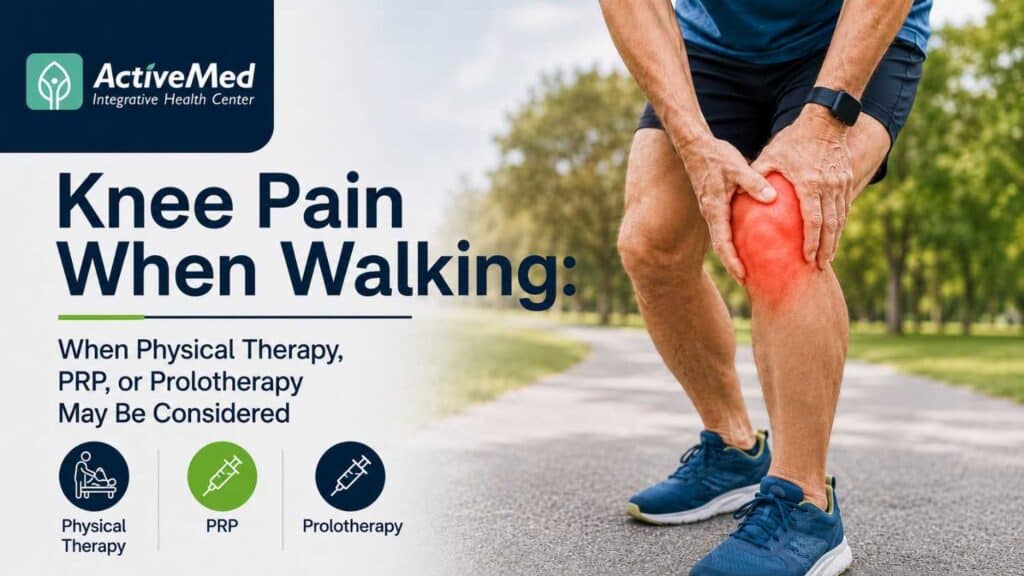
Knee pain when walking can come from osteoarthritis, a previous injury, tendon irritation, meniscus or ligament problems, inflammation, gout, infection, or another condition. The right treatment starts with understanding what is causing the pain and how it affects movement. Physical therapy is often considered when knee pain limits walking, stairs, strength, balance, or daily function. PRP or prolotherapy may be discussed for selected patients after evaluation, but they are not guaranteed solutions and professional guidelines differ on their use for knee osteoarthritis.
If your knee is severely painful, you cannot bear weight, it is badly swollen or deformed, it locks or gives way, or it is hot and red with fever or chills, seek prompt medical evaluation.
At ActiveMed Health, patients in Encinitas, Poway, and San Diego can begin with a physical therapy evaluation or schedule a visit to discuss knee pain, walking limitations, and appropriate next steps.
Physical Therapy vs PRP vs Prolotherapy for Knee Pain When Walking
| Treatment or Next Step | When It May Be Considered | What Patients Should Understand |
| Physical therapy | Knee pain limits walking, stairs, strength, balance, activity, or daily function; commonly considered with knee osteoarthritis | Focuses on movement, strengthening, function, confidence, and activity progression |
| PRP therapy | May be discussed for selected patients with diagnosed knee osteoarthritis or certain tendon problems after evaluation | Evidence is mixed; it should not be described as guaranteed cartilage repair or a guaranteed cure |
| Prolotherapy | May be discussed by a qualified provider for selected chronic musculoskeletal conditions after evaluation | Evidence for knee osteoarthritis remains limited; it is not established first-line care |
| Prompt medical evaluation | The knee cannot bear weight, is very swollen, deformed, hot/red with fever, locks, gives way, or symptoms followed serious injury | Diagnosis and safety come before selecting treatment |
| Specialist evaluation | Pain and reduced function remain severe despite appropriate nonsurgical management | Advanced arthritis or another significant condition may require additional options |
According to the National Institute for Health and Care Excellence (NICE), therapeutic exercise tailored to the individual should be offered for osteoarthritis, including local muscle strengthening and general aerobic fitness. NICE also advises that long-term adherence to exercise can reduce pain and improve function and quality of life.
Why Does Your Knee Hurt When You Walk?
Knee pain while walking is a symptom, not a diagnosis.
Walking places repeated load through the knee. When the joint, cartilage, muscles, tendons, ligaments, or surrounding tissues are irritated or injured, normal steps may become painful. Some people notice pain only after longer walks. Others feel discomfort during stairs, getting out of a chair, standing from a low surface, or taking the first few steps after sitting.
Common possibilities include:
| Symptom Pattern | Possible Cause to Discuss With a Provider |
| Gradual pain and stiffness, especially with activity or age | Osteoarthritis |
| Pain after overuse, running, jumping, or a change in activity | Tendon irritation or strain |
| Pain after twisting, falling, or a sudden movement | Ligament, tendon, meniscus, or cartilage injury |
| Knee giving way or locking | Mechanical or structural problem requiring evaluation |
| Hot, red, swollen knee with sudden severe pain | Gout, infection, or another inflammatory cause |
| Knee pain after a collision or fall | Fracture, dislocation, or significant injury |
According to the NHS, knee pain may be caused by osteoarthritis, tendonitis, ligament or meniscus injury, bursitis, gout, infection, or other conditions. Because different causes may require different treatment, patients should not choose physical therapy, PRP, or prolotherapy based on symptoms alone.
When Knee Pain While Walking Needs Prompt Evaluation
Many cases of knee pain are not emergencies. But some symptoms should be assessed promptly before beginning routine exercise or considering injection-based treatment.
| Warning Sign | Why It Matters | Recommended Next Step |
| You cannot move the knee or put weight on it | May indicate a significant injury or acute joint problem | Seek prompt medical evaluation |
| The knee is badly swollen or has changed shape | May indicate injury, bleeding, fracture, or dislocation | Seek prompt evaluation |
| The knee locks, gives way, or painfully clicks | May involve meniscus, ligament, cartilage, or mechanical injury | Get evaluated before starting treatment |
| The knee is hot, red, or swollen with fever or chills | May indicate infection or another urgent inflammatory problem | Seek urgent medical attention |
| Pain began after a significant fall, twist, or accident | May indicate internal knee injury or fracture | Seek evaluation |
| Pain is continuing for weeks or progressively worsening | May require diagnosis and a structured treatment plan | Schedule an evaluation |
According to the NHS, urgent medical advice is appropriate when a knee is very painful, cannot move or bear weight, is badly swollen or deformed, locks or gives way, or is hot and red with fever or chills.
If none of these warning signs are present but knee pain is limiting walking, stairs, exercise, work, or daily activities, an evaluation can help determine whether physical therapy is an appropriate starting point.
When Physical Therapy May Be Considered for Knee Pain When Walking
Physical therapy is often a practical first step when knee pain affects mobility and daily function, especially when symptoms are related to knee osteoarthritis, weakness, deconditioning, balance changes, or recovery after a non-urgent injury.
A physical therapist may assess:
- Where the knee hurts and when symptoms occur
- Whether pain is worse with walking, stairs, sitting, standing, or bending
- Swelling, instability, locking, stiffness, or reduced range of motion
- Strength in the thigh, hip, calf, and surrounding muscles
- Balance and walking mechanics
- Activity tolerance and daily limitations
- Goals such as walking farther, climbing stairs, returning to exercise, or moving with less fear
Physical therapy may help address:
| Walking Limitation | How Physical Therapy May Help |
| Knee stiffness when beginning to walk | Mobility work and graded movement |
| Pain with stairs or rising from a chair | Strengthening and functional retraining |
| Weakness around the knee | Quadriceps, hip, calf, and supporting muscle exercises |
| Reduced balance or confidence | Balance and gait training |
| Reduced walking distance | Gradual endurance and activity progression |
| Fear that activity will worsen the knee | Education and individualized pacing strategies |
| Ongoing symptoms related to osteoarthritis | Exercise-based symptom and function management |
According to NICE guidance for osteoarthritis, all people with osteoarthritis should be offered therapeutic exercise tailored to their needs, such as local muscle strengthening and general aerobic fitness. NICE also recommends considering supervised therapeutic exercise sessions.
NICE acknowledges that joint discomfort may initially increase when beginning therapeutic exercise. However, regular and consistent exercise can benefit the joints over time by reducing pain and improving function and quality of life.
At ActiveMed Health, physical therapy may help patients with knee pain improve walking tolerance, strength, mobility, balance, and confidence with daily movement.
For additional guidance on arthritis-related mobility limits, read Can Physical Therapy Help Arthritis?.
What Physical Therapy Can and Cannot Promise for Knee Pain
Physical therapy can be valuable, but it should be described honestly.
| Physical Therapy May Help With | Physical Therapy Should Not Promise |
| Improving strength around the knee | Regrowing knee cartilage |
| Improving walking and stair tolerance | Permanently eliminating pain |
| Increasing movement confidence | Avoiding surgery in every case |
| Supporting balance and daily function | Treating every cause of knee pain without diagnosis |
| Providing an exercise and activity plan | Replacing urgent evaluation for severe symptoms |
| Helping manage knee osteoarthritis symptoms | Guaranteeing that injections will never be needed |
The goal is not to convince every patient that physical therapy solves every knee problem. The goal is to determine whether movement-based care is appropriate, improve function where possible, and identify when further evaluation or additional treatment should be discussed.
What Does Not Work as a Standalone Plan for Knee Osteoarthritis?
For knee pain related to osteoarthritis, patients are often offered many passive or product-based approaches. Some may be used in selected circumstances, but they should not replace an active, individualized plan.
| Approach | Important Limitation |
| Resting indefinitely and avoiding activity | May lead to additional weakness, stiffness, and loss of function |
| Manual therapy without exercise | NICE states there is not enough evidence to support manual therapy alone for managing osteoarthritis |
| Routine imaging to guide nonsurgical care | NICE advises against routinely using imaging for follow-up or nonsurgical management of osteoarthritis |
| Electrotherapy treatments for knee osteoarthritis | NICE recommends against TENS, ultrasound, interferential therapy, laser therapy, pulsed short-wave therapy, and NMES for osteoarthritis because of insufficient evidence of benefit |
| Promises of cartilage regrowth from one injection | Patients should not be promised structural regeneration or predictable results |
| Choosing an injection before obtaining a diagnosis | Knee pain has multiple potential causes and should first be evaluated |
According to NICE, manual therapy may be considered for hip or knee osteoarthritis only alongside therapeutic exercise, and patients should be told there is not enough evidence to support manual therapy alone.
When PRP Therapy May Be Discussed for Knee Pain
Platelet-rich plasma, commonly called PRP, is prepared from a patient’s own blood. A blood sample is processed to concentrate platelets, and the preparation is injected into a targeted area.
PRP should not be the first assumption for knee pain when walking. Before discussing PRP, a provider should determine whether the pain is related to osteoarthritis, a tendon condition, an injury, an inflammatory problem, or another diagnosis.
PRP May Be Discussed When:
- Knee osteoarthritis has been diagnosed or is clinically suspected after assessment
- Symptoms continue to limit function despite an appropriate conservative plan
- The patient understands the evidence limits, potential risks, costs, and alternatives
- The decision is made through an individualized discussion rather than a guaranteed-results promise
Questions Patients Should Ask Before PRP
| Question | Why It Matters |
| What diagnosis is being treated? | PRP should target a clinically identified condition, not unexplained pain |
| What evidence supports PRP for my condition? | Evidence varies depending on diagnosis and severity |
| What results are realistic? | PRP should not be described as guaranteed cartilage repair or permanent pain relief |
| What are the alternatives? | Physical therapy and other nonsurgical options may still be relevant |
| Will I still need rehabilitation? | Function, strength, and walking capacity remain important even if an injection is considered |
| Is this covered by insurance? | Coverage for PRP is often limited and should be clarified beforehand |
According to the American Academy of Orthopaedic Surgeons (AAOS), increasing literature suggests PRP may benefit some patients with low- to moderate-grade knee osteoarthritis, while more scientific evidence is still needed to determine effectiveness across other conditions and treatment variations.
Professional guidance is not uniform. The American College of Rheumatology and Arthritis Foundation guideline strongly recommends against PRP treatment for knee or hip osteoarthritis because of uncertainty and variability in the available evidence and PRP preparations.
That disagreement matters. PRP should be discussed as a possible option for selected patients after evaluation—not marketed as proven regeneration, guaranteed cartilage repair, or an automatic next step.
Patients who want to learn about ActiveMed’s injection-based services after evaluation may review PRP Therapy and Regenerative Medicine.
When Prolotherapy May Be Discussed for Knee Pain
Prolotherapy generally involves injecting an irritant solution, often dextrose-based, into a painful joint, tendon, or ligament region. Some clinicians may discuss prolotherapy for selected chronic musculoskeletal conditions, but it requires cautious, transparent positioning.
For knee osteoarthritis, therapeutic exercise has stronger guideline support than prolotherapy.
Prolotherapy Should Not Be Presented As:
- A routine first treatment for knee pain when walking
- A guaranteed treatment for knee osteoarthritis
- A proven method for regrowing cartilage
- A replacement for diagnosis, physical therapy, or appropriate medical evaluation
Prolotherapy May Be Discussed Only After:
- The cause of knee pain has been evaluated
- Serious injury or urgent conditions have been excluded
- Conservative options and functional goals have been reviewed
- The patient understands evidence limitations, potential risks, costs, and alternatives
The American College of Rheumatology and Arthritis Foundation guideline conditionally recommends against prolotherapy for knee or hip osteoarthritis because evidence is limited and reported benefits are uncertain.
That does not mean no patient can ever ask about prolotherapy. It means the treatment should be discussed carefully, after evaluation, without promises that exceed the evidence.
Patients considering this option can review ActiveMed’s Prolotherapy service information and speak with a qualified provider about whether it is relevant to their diagnosis and goals.
Physical Therapy vs PRP vs Prolotherapy: Which Option May Fit Your Situation?
| Your Situation | Physical Therapy | PRP | Prolotherapy | Best Next Step |
| Knee pain with walking, stairs, weakness, or stiffness and no urgent warning signs | Often a reasonable starting point | Not usually the first step without diagnosis | Not usually the first step without diagnosis | Evaluation and function-focused plan |
| Suspected or diagnosed knee osteoarthritis | Strong guideline support for tailored exercise | May be discussed with evidence limitations | Evidence remains limited | Start with therapeutic exercise; discuss further options if needed |
| Knee pain after a major twist, fall, collision, or sudden injury | May be appropriate after assessment | Not appropriate before diagnosis | Not appropriate before diagnosis | Evaluate the injury first |
| Knee locking, giving way, major swelling, deformity, or inability to bear weight | Not routine PT-first care until assessed | Not appropriate before assessment | Not appropriate before assessment | Prompt medical evaluation |
| Ongoing symptoms after appropriate exercise-based care | PT may be modified or continued based on progress | May be discussed for selected diagnosed cases | May be discussed cautiously for selected cases | Shared decision-making with clear evidence review |
| Severe knee OA affecting quality of life despite nonsurgical care | PT may still support strength and function | May not solve advanced disease | May not solve advanced disease | Consider specialist evaluation |
A patient should not be pressured to select between physical therapy, PRP, or prolotherapy without first understanding what condition is actually being treated.
Do You Need Imaging for Knee Pain When Walking?
Not every person with knee pain needs immediate imaging.
For adults aged 45 or older who have activity-related joint pain and either no morning stiffness or morning stiffness lasting no longer than 30 minutes, NICE states that osteoarthritis can often be diagnosed clinically without imaging.
NICE also advises against routinely using imaging to diagnose osteoarthritis unless atypical features suggest another or additional diagnosis. These atypical features may include:
- Recent trauma
- Prolonged morning stiffness
- Rapid worsening of symptoms
- Deformity
- A hot swollen joint
- Concern for infection or malignancy
Imaging may be appropriate when a significant injury is suspected, symptoms are unusual, the knee is mechanically locking, or the result would change treatment decisions.
What Happens During an ActiveMed Evaluation for Knee Pain?
The first step should not be choosing an injection. It should be understanding the knee pain, walking limitations, and appropriate care pathway.
A knee pain evaluation may include discussion of:
- When symptoms began
- Whether pain followed an injury or developed gradually
- Whether walking, stairs, standing, sitting, bending, or exercise increase symptoms
- Swelling, warmth, redness, instability, locking, or clicking
- Whether the patient can safely bear weight
- Range of motion, strength, balance, and walking mechanics
- Previous treatment and current functional goals
- Whether physical therapy is appropriate
- Whether additional medical evaluation or imaging is needed
- Whether PRP or prolotherapy should be discussed only after diagnosis and conservative options are reviewed
At ActiveMed Health, patients experiencing knee pain while walking may begin by reviewing Physical Therapy or Pain Management. When clinically appropriate after evaluation, a provider may also discuss PRP Therapy or Prolotherapy with clear explanation of evidence, limitations, risks, costs, alternatives, and functional goals.
When Knee Pain May Require More Than Conservative Care
For people with knee osteoarthritis, nonsurgical care may include therapeutic exercise, information and support, weight management when appropriate, and selected pain-relief strategies.
However, some people continue to experience severe pain, stiffness, reduced function, or progressive deformity that substantially affects quality of life.
According to NICE, referral for joint replacement may be considered when hip, knee, or shoulder osteoarthritis symptoms substantially affect quality of life and nonsurgical management—such as therapeutic exercise, weight loss when appropriate, or pain relief—is ineffective or unsuitable.
PRP or prolotherapy should not be marketed as a way to delay necessary specialist evaluation when knee symptoms are severe or worsening.
Related Reading From ActiveMed
For additional guidance about mobility, arthritis, and treatment options, read:
- Can Physical Therapy Help Arthritis?
- Physical Therapy: Improve Your Quality of Life
- How Physical Therapy Supports Injury Recovery and Strength
- What to Expect During a PRP Therapy Session
Frequently Asked Questions About Knee Pain When Walking
Why does my knee hurt when I walk?
- Knee pain while walking can relate to osteoarthritis, overuse, tendon irritation, meniscus or ligament injury, bursitis, gout, infection, or another condition. Evaluation is especially important when pain persists, worsens, or includes swelling, locking, instability, or inability to bear weight.
Can physical therapy help knee pain when walking?
- Yes. Physical therapy may help many patients improve knee strength, mobility, balance, walking tolerance, and daily function, particularly when symptoms relate to osteoarthritis or movement limitations after urgent causes have been excluded.
Should physical therapy be considered before PRP?
- For knee osteoarthritis, therapeutic exercise has strong guideline support and is often an appropriate foundation of care. PRP may be discussed for selected patients after evaluation, but it is not an automatic or guaranteed next step.
Does PRP help knee pain?
- PRP may help some patients with low- to moderate-grade knee osteoarthritis, according to AAOS educational guidance, but evidence and professional recommendations are not uniform. Patients should discuss expected benefits, limitations, costs, alternatives, and rehabilitation needs before treatment.
Can PRP regrow knee cartilage?
- PRP should not be promoted as guaranteed cartilage regrowth. Patients should not be promised that PRP will reverse osteoarthritis, rebuild cartilage, or permanently remove knee pain.
Does prolotherapy help knee pain?
- Some clinicians may discuss prolotherapy for selected chronic musculoskeletal conditions. However, evidence for knee osteoarthritis is limited, and the American College of Rheumatology and Arthritis Foundation guideline conditionally recommends against prolotherapy for knee or hip osteoarthritis.
When is knee pain urgent?
- Seek prompt medical evaluation if the knee is very painful, cannot move or bear weight, becomes badly swollen or deformed, locks or gives way, or is hot and red with fever or chills.
Do I need imaging for knee pain when walking?
- Not everyone needs imaging immediately. When osteoarthritis is suspected, it can often be diagnosed clinically. Imaging may be appropriate when symptoms are atypical, follow serious injury, suggest another diagnosis, or would change treatment decisions.
Can exercise help knee osteoarthritis?
- Yes. According to NICE, therapeutic exercise tailored to the patient should be offered for osteoarthritis. Regular adherence can help reduce pain and improve function and quality of life over time.
Where can I get evaluated for knee pain in Encinitas, Poway, or San Diego?
- ActiveMed Health offers services for patients experiencing knee pain and movement limitations. You can schedule a visit to discuss symptoms, appropriate evaluation, and possible treatment options.
Conclusion
Knee pain when walking should not be treated as a one-size-fits-all problem. Pain may relate to osteoarthritis, injury, tendon irritation, inflammation, infection, or another condition, and the appropriate treatment depends on what is actually causing the symptoms.
For many patients with knee osteoarthritis or movement-related limitations, physical therapy and tailored exercise are appropriate evidence-supported starting points. PRP may be discussed for selected diagnosed cases, but evidence and professional guidance differ. Prolotherapy should be discussed even more cautiously because evidence for knee osteoarthritis remains limited.
If knee pain is limiting walking, stairs, work, exercise, or daily life, begin with an appropriate evaluation. Explore physical therapy at ActiveMed, review pain management, or schedule a visit to discuss your symptoms and next step.