

If you are asking whether you may need hormone replacement therapy, the most useful place to start is this: persistent, disruptive symptoms matter more than vague “hormone imbalance” language. For women, the clearest signs are usually hot flashes, night sweats, sleep disruption, vaginal dryness, painful sex, urinary symptoms, and major quality-of-life changes during perimenopause or menopause. For men, low-testosterone therapy is a different path and should only be considered when symptoms are present and blood testing repeatedly confirms low testosterone. According to the American College of Obstetricians and Gynecologists (ACOG), systemic estrogen therapy is the best treatment for hot flashes and night sweats, and both systemic and local estrogen can help with vaginal symptoms.

At ActiveMed, that is the right frame for this conversation. Instead of assuming every symptom means you “need HRT,” a stronger approach is to review symptoms, medical history, risks, goals, and — when relevant — labs before deciding whether hormone therapy fits. That aligns with the structure already on the site through Hormone Consulting / Testosterone Therapy, Hormone Replacement 101: What to Expect during Treatment, Hormone Replacement for Improved Quality of Life, Best Hormone Replacement Therapy, Women’s Health, and Lab Testing & Review.
What hormone replacement therapy actually treats
Hormone replacement therapy is not a one-size-fits-all answer for every symptom that appears in midlife. In women, it is most often used for menopausal hormone therapy — especially for vasomotor symptoms like hot flashes and night sweats, and for genitourinary symptoms like vaginal dryness, painful sex, and urinary discomfort. According to ACOG, systemic estrogen therapy with or without progestin is the most effective treatment for hot flashes and night sweats, while both systemic and local estrogen can relieve vaginal dryness. The Menopause Society also explains that low-dose vaginal estrogen is effective for GSM after menopause and that very little enters the bloodstream, so systemic risks are much lower.
In men, the conversation is different. What many people casually call “male HRT” is usually testosterone therapy for hypogonadism, and the diagnostic standard is stricter. According to the Endocrine Society testosterone guideline, testosterone treatment should be considered only in men who have symptoms and signs consistent with testosterone deficiency plus unequivocally and consistently low serum testosterone, confirmed by repeat testing.
The clearest signs you may need hormone replacement therapy
1. Hot flashes and night sweats that are disrupting daily life
This is the clearest sign that hormone therapy may be worth discussing. According to ACOG, systemic estrogen therapy is the best treatment for hot flashes and night sweats. The Menopause Society also describes hot flashes and night sweats as the most commonly reported symptoms of the menopause transition and notes that hormone therapy is FDA approved as a first-line therapy for relief of bothersome hot flashes. If vasomotor symptoms are frequent, intense, or interfering with work, sleep, exercise, or mood, that is one of the strongest evidence-based reasons to consider HRT.
2. Sleep problems that seem tied to hormonal change
According to the Office on Women’s Health, many women in perimenopause and menopause struggle to sleep through the night. Low progesterone can make it harder to fall and stay asleep, while low estrogen can contribute to hot flashes and night sweats that interrupt sleep. The same source also notes that urinary symptoms may wake some women repeatedly overnight. So if the sleep problem is not random insomnia but sleep disruption linked to night sweats, heat surges, or urinary changes, hormone-related treatment may be worth evaluating.
3. Vaginal dryness, painful sex, burning, or urinary symptoms
This is another high-value sign that often gets under-discussed. ACOG says both systemic and local estrogen therapy can help vaginal dryness, and the Menopause Society says low-dose vaginal estrogen is effective for GSM after menopause, helps rebuild tissue, and has very low systemic absorption. That means if your main issue is pain during sex, dryness, irritation, recurrent urinary discomfort, or GSM-like symptoms, you may not need broad systemic HRT at all — you may need a more targeted vaginal estrogen discussion.
4. Symptoms after early menopause, premature ovarian insufficiency, or surgical menopause
Hormone therapy often deserves a more serious discussion in women who experience menopause earlier than expected. According to the 2025 European Society of Endocrinology menopause guideline, management guidance differs for women going through menopause in middle age, those with premature ovarian insufficiency (POI), and those with early menopause. If menopause happens unusually early — whether naturally or after surgery — the threshold for discussing hormone therapy is often different than it is for an average-timing menopause transition.
5. Symptoms are consistently lowering your quality of life
Symptoms do not have to be “severe enough” by someone else’s standard to matter. If hot flashes, night sweats, vaginal symptoms, sleep disruption, or hormonal shifts are affecting mood, relationships, work, exercise, or your sense of normal daily function, that is a legitimate reason to seek evaluation. This quality-of-life framing also fits ActiveMed’s internal hormone content, including Hormone Replacement for Improved Quality of Life and Hormone Replacement 101: What to Expect during Treatment, both of which emphasize individualized treatment planning rather than generic HRT marketing.
6. For men: sexual symptoms plus repeatedly low testosterone
For men, the clearest signs are not just “low energy” or “brain fog.” According to the Endocrine Society patient information on hypogonadism, symptoms can include low libido, fewer spontaneous erections, erectile dysfunction, reduced energy, reduced muscle mass, and mood or concentration changes. But the same source says diagnosis requires at least two early-morning blood tests showing low testosterone in addition to symptoms. So if a man has persistent sexual symptoms or loss of vitality, the right next step is an evaluation through Hormone Consulting / Testosterone Therapy — not jumping straight to treatment because of a single symptom.
A practical comparison table
| Sign or situation | HRT may be worth discussing? | Why |
| Frequent hot flashes or night sweats | Yes | According to ACOG and the Menopause Society, hormone therapy is the most effective treatment for bothersome vasomotor symptoms. |
| Vaginal dryness, painful sex, or urinary discomfort | Often yes | Low-dose vaginal estrogen is effective for GSM and has very low systemic absorption. |
| Early menopause or POI | Often yes | Current endocrine guidance treats early menopause and POI as special clinical contexts. |
| Fatigue alone with no clear hormone pattern | Not by itself | Fatigue is too nonspecific and needs broader evaluation first. |
| Low libido and fewer morning erections in men | Maybe | Symptoms matter, but diagnosis also requires repeat low morning testosterone levels. |
| Men planning fertility soon | Usually not testosterone therapy | Endocrine guidance advises against starting testosterone in men planning fertility in the near term. |
This table is based on ACOG, the Menopause Society, the Endocrine Society, and current menopause guidance.
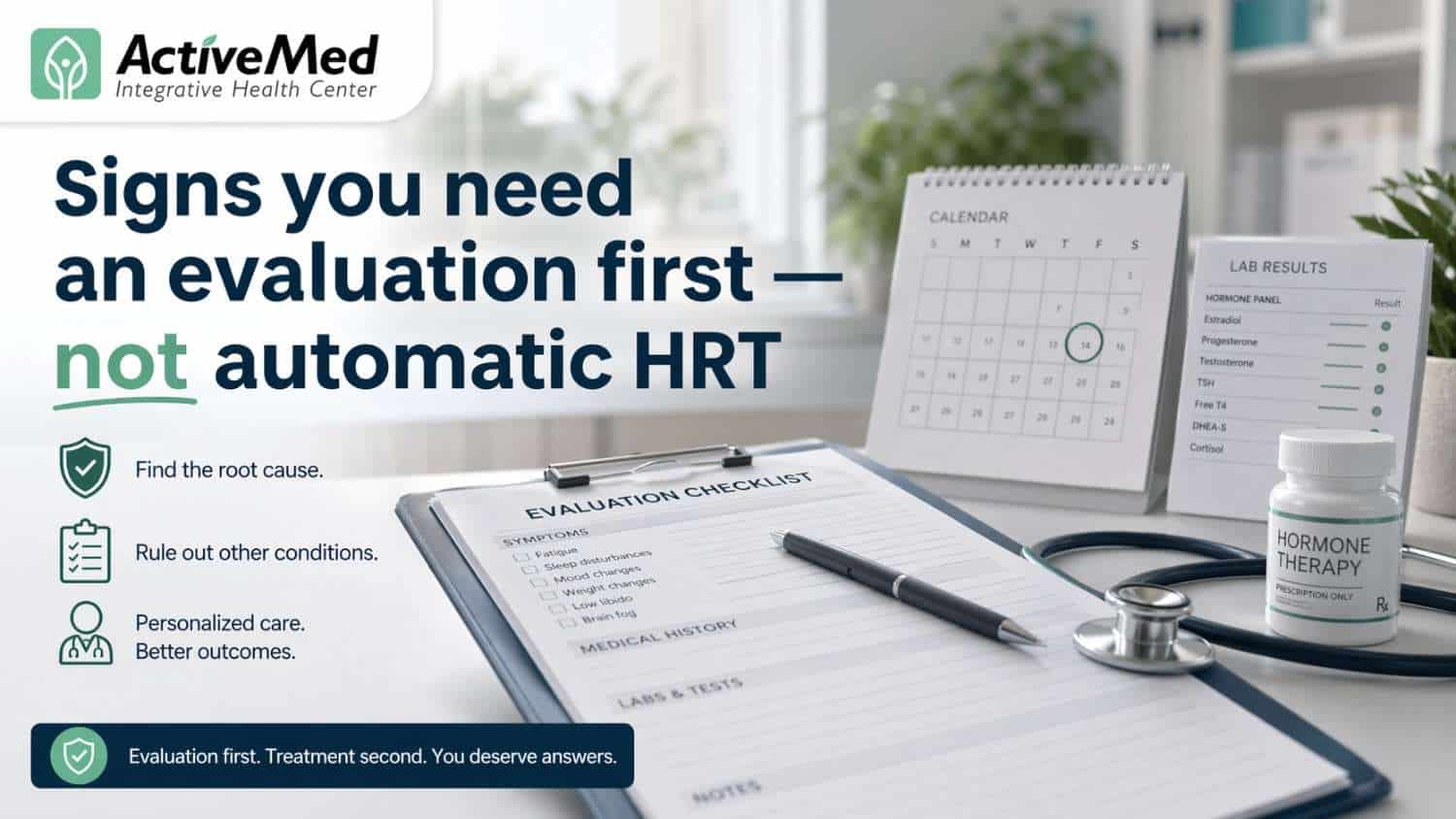
Signs you need an evaluation first — not automatic HRT
One of the biggest mistakes in hormone-content marketing is acting as if symptoms automatically equal treatment. In reality, some signs mean you should seek an evaluation first, not assume you “need HRT.” ActiveMed’s Hormone Replacement 101: What to Expect during Treatment already points out that hormone testing, medical history, cardiovascular health, bone health, and risk factors should be reviewed before starting treatment.
For women, red-flag or caution situations can include:
- abnormal or unexplained bleeding
- a significant personal or family risk history
- cardiovascular risk factors
- breast health concerns
- blood clot history
- medication interactions or other complex health issues
For men considering testosterone therapy, the Endocrine Society recommends against starting testosterone in men planning fertility in the near term or in those with conditions such as prostate or breast cancer, markedly elevated PSA without evaluation, elevated hematocrit, untreated severe sleep apnea, severe lower urinary tract symptoms, uncontrolled heart failure, recent MI or stroke, or thrombophilia. That is exactly why a real evaluation matters more than symptom checklists alone.
What HRT can and cannot realistically help
This is where a high-quality article becomes more trustworthy than a sales page.
What HRT can help
According to ACOG and the Menopause Society, hormone therapy can help with:
- hot flashes and night sweats
- vaginal dryness and GSM-related symptoms
- sleep disruption related to vasomotor symptoms
- bone protection in appropriate menopausal patients
- quality-of-life improvement when symptoms are clearly hormone-related and persistent
For men with true hypogonadism, testosterone therapy may help restore secondary sex characteristics and improve symptoms of testosterone deficiency when the diagnosis is properly established.
What HRT should not be assumed to fix
HRT should not be assumed to fix every case of:
- fatigue
- mood changes
- anxiety
- weight gain
- poor sleep
- low libido
For example, the Office on Women’s Health makes clear that menopause symptoms are varied and overlapping, while the Endocrine Society testosterone guideline advises against using testosterone therapy to improve glycemic control in men with diabetes. So while hormone therapy can be powerful, it is not a catch-all explanation or a shortcut for every midlife complaint.
What about the newer FDA message on menopausal hormone therapy?
This is worth mentioning because many readers still carry fear from older headlines. In February 2026, the FDA approved labeling changes for a first batch of menopausal hormone therapy products, following its broader move to revise older boxed-warning language. That does not mean hormone therapy is risk-free or right for everyone. It means the conversation has become more individualized and evidence-based, rather than being driven by one outdated blanket warning. That nuance actually helps ActiveMed: it supports a benefit-risk conversation tailored to the patient in front of you.
Frequently asked questions
What are the main signs you may need hormone replacement therapy?
- The clearest signs are usually hot flashes, night sweats, sleep disruption linked to menopause symptoms, vaginal dryness, painful sex, urinary symptoms, early menopause, or major hormone-related quality-of-life decline. In men, low libido and fewer spontaneous erections may be signs that a testosterone evaluation is needed, but diagnosis requires repeat blood testing.
Does every menopause symptom mean you need HRT?
- No. Some symptoms may improve with lifestyle measures, nonhormonal options, or targeted local therapies. For example, vaginal symptoms may sometimes be managed with low-dose vaginal estrogen rather than broad systemic hormone therapy.
What symptoms suggest low testosterone in men?
- According to the Endocrine Society, symptoms can include low sex drive, erectile dysfunction, fewer spontaneous erections, reduced energy, decreased muscle mass, and mood or concentration changes. But those symptoms alone are not enough; they must be paired with consistently low morning testosterone levels.
When should you not start hormone therapy without medical review?
- You should not assume HRT is appropriate if you have significant risk factors, abnormal bleeding, complex health history, fertility goals, or possible contraindications. Testosterone therapy in men, in particular, has several conditions that require caution or avoidance according to the Endocrine Society.
Where should I start at ActiveMed if I think hormones are part of the problem?
- The most relevant starting points are Hormone Consulting / Testosterone Therapy, Women’s Health, and Lab Testing & Review, depending on whether the main issue is menopause, testosterone-related symptoms, or broader hormone evaluation.
Conclusion
The signs you may need hormone replacement therapy are not just “feeling off.” The strongest signs are persistent, disruptive symptoms that clearly match a hormone transition or deficiency, especially hot flashes, night sweats, GSM symptoms, sleep disruption, early menopause, or — in men — sexual symptoms plus repeatedly confirmed low testosterone. According to ACOG, the Menopause Society, and the Endocrine Society, hormone therapy works best when the symptoms, the biology, and the patient’s risk profile all line up.