
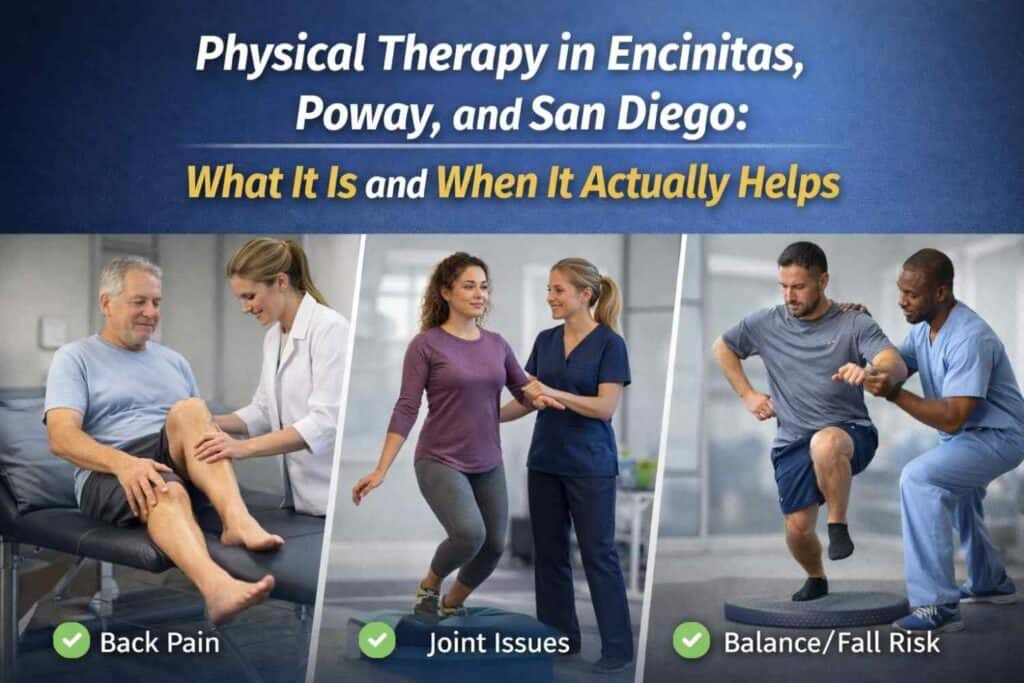
Physical therapy is medically guided movement, hands-on treatment, and education that helps you move better, hurt less, and do more of your normal life again. It works best when you have muscle, joint, nerve, or balance problems that last more than a few days—especially chronic low back pain, knee or hip arthritis, post-surgical recovery, and balance problems from neuropathy or aging.
Major clinical guidelines and reviews consistently recommend exercise-based physical therapy as a first-line treatment for chronic low back pain and many joint problems. For knee osteoarthritis, people who had structured physical therapy ended up with less pain and better function at one year than those who received a steroid injection alone.
At ActiveMed Integrative Health Center in Encinitas, Poway, and San Diego, physical therapy is part of an integrative care plan that can also include acupuncture, functional medicine, Axon Therapy for neuropathy, IV therapy, and more—not just a stack of generic exercises.
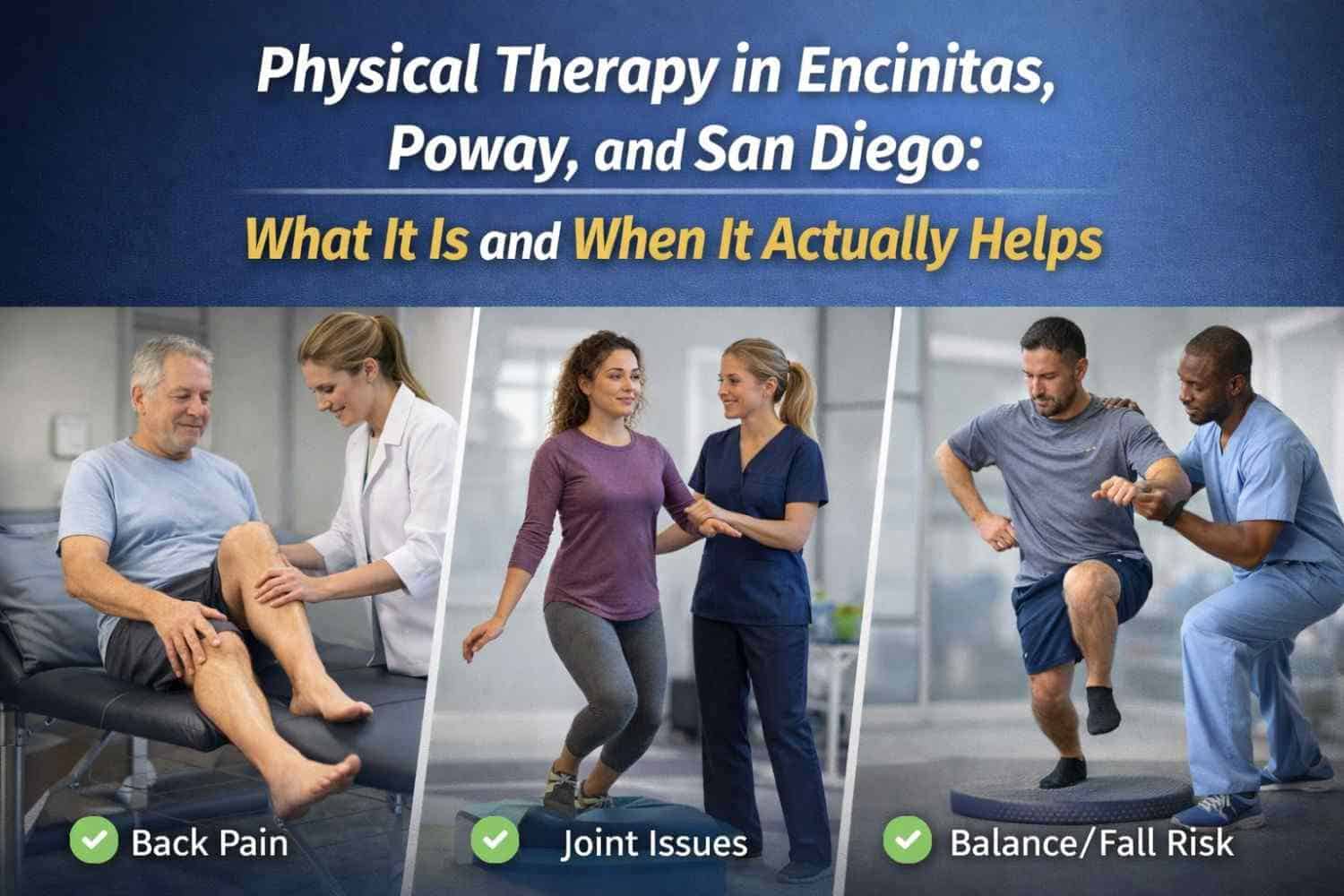
What is physical therapy, really?
Physical therapy (PT) is healthcare focused on movement. A physical therapist:
- Evaluates how you move, stand, walk, lift, and balance
- Identifies muscles, joints, and nerves that aren’t doing their jobs
- Designs a personalized treatment plan with exercise, hands-on work, and daily-life changes to reduce pain and restore function
At ActiveMed, PT is delivered inside an integrative clinic that also includes acupuncture, massage therapy, functional medicine, and Axon Therapy. That means your PT plan can be coordinated with the rest of your care instead of existing in a silo.
Common tools a PT will use:
- Exercise therapy – strengthening, stretching, motor-control work, balance and gait training
- Manual therapy – joint mobilization, soft-tissue work, sometimes manipulation
- Movement coaching – posture tweaks, lifting mechanics, pacing, return-to-sport plans
- Home program – a small set of exercises that progress over time, not a 30-exercise photocopy
The focus is not “fixing” you on the table—it’s making your body more capable so you rely less on quick fixes and passive treatments.
Read more: Empower Yourself with Axonic Therapy for Mental Wellness
When does physical therapy actually help?
Not every ache needs PT, but there are clear scenarios where it’s one of the highest-value, lowest-risk interventions you can choose.
1. Chronic low back pain
Chronic low back pain (pain lasting longer than 3 months) is one of the top causes of disability worldwide.
Multiple guidelines and reviews agree on a few things:
- Exercise-based PT (walking, general exercise, motor-control exercises)
- Education and self-management (“hurt ≠ harm”, staying active)
- Sometimes manual therapy and cognitive/behavioral strategies
…are recommended early, before escalating to injections or surgery.
In practice, a good PT program for chronic low back pain usually includes:
- Graded walking or aerobic activity
- Strength work for hips, legs, and trunk
- Targeted exercises for specific movement issues (e.g., directional preference, motor control)
- Advice on pacing, lifting, and sitting/standing strategies
Recent global analyses of non-surgical back-pain treatments found that exercise is one of the few interventions with consistent, though modest, benefit, while many passive treatments and injections offer minimal long-term gain.
2. Knee osteoarthritis and other joint arthritis
If you have knee osteoarthritis, you’ve probably been offered injections. There’s a key point you should know:
In a major randomized trial, patients with knee OA who did physical therapy had less pain and disability at one year than those who received a glucocorticoid injection.
What PT typically does for knee or hip arthritis:
- Strengthens muscles that support and unload the joint
- Improves joint mobility and gait mechanics
- Builds tolerance for walking, stairs, and daily tasks
- Reduces reliance on pain medications and injections over time
Is PT magic? No. But over months, consistent, progressive loading shifts you from “babying the joint” to “supporting the joint,” which almost always reduces pain and improves function.
3. Post-surgical and post-injury rehab
After orthopedic surgery (knee/hip replacement, rotator cuff repair, ACL surgery, etc.), PT is standard because it:
- Restores range of motion and strength
- Helps prevent stiffness and compensations
- Guides a phased return to work, sport, and daily life
The same logic applies after sprains, strains, fractures, and tendon injuries. The goal isn’t just “healed tissue.” It’s “I can walk my dog, surf, lift, and work again without fear.”
4. Neuropathy, balance problems, and fall risk
For people with diabetic peripheral neuropathy and age-related balance problems, PT is one of the few tools that consistently improves stability.
Systematic reviews show that strength and balance training can:
- Improve lower-extremity strength
- Improve balance and gait
- Reduce fall risk in older adults and people with neuropathy
A 2024 review of balance training for diabetic peripheral neuropathy found that programs involving intentional weight shifting, changing base of support, and challenging balance (e.g., tai chi, certain rehab protocols) produced the best improvements in balance and fall risk.
At ActiveMed, that often looks like:
- PT for strength, gait, and balance, plus
- Axon Therapy or other neuropathy treatments for pain, and
- Functional medicine to address blood sugar, inflammation, and overall health
Neuropathy is where integrative care matters—PT turns pain relief into real-world safety and independence.
5. Sports injuries and return to sport
PT is also crucial for:
- Ankle sprains
- Runner’s knee or hip pain
- Shoulder impingement or labral issues
- Tendinopathies (Achilles, patellar, lateral elbow, etc.)
The value isn’t just stretches and band work. It’s:
- Load management – how much, how often, and at what intensity you can safely train
- Technique adjustments – running form, jumping/landing mechanics, throwing mechanics
- A structured return-to-play progression so you don’t bounce between “injured” and “too much, too soon.”
Read more: Can Axonic Therapy Improve Your Quality of Life?
When is physical therapy not enough or not the first step?
Physical therapy is powerful, but it’s not the answer to everything—and you should hear that clearly.
Red-flag situations (see a doctor or ER first)
PT should not be your first call if you have:
- New severe back pain plus:
- Loss of bowel or bladder control
- Numbness in the groin/saddle area
- Rapidly worsening leg weakness
- Suspected fracture (major fall, trauma, deformity, inability to bear weight)
- Signs of infection (fever, chills, severe localized back or joint pain)
- Rapidly progressive weakness, numbness, or other neurologic deficits without evaluation
In those cases, you need urgent medical work-up. PT may come later, once serious causes are ruled out or treated.
Read more: Discover the Benefits of Acupuncture Poway for Pain Relief
Situations where PT must be part of a bigger plan
PT can still help, but not by itself, if you’re dealing with:
- Autoimmune or inflammatory disease (e.g., rheumatoid arthritis)
- Complex regional pain syndrome
- Severe depression/anxiety driving your pain experience
- Widespread central pain syndromes where the main problem isn’t one joint or region
Here, PT needs to be integrated with:
- Medical management (rheumatology, pain medicine)
- Psychology/behavioral health
- Sleep, stress, and lifestyle work
That’s exactly the type of cross-talk an integrative practice can handle more fluidly than a standalone PT shop.
Read more: Exploring Back Pain Relief with Acupuncture Encinitas
What does physical therapy at ActiveMed look like?
Integrated assessment
At ActiveMed’s physical therapy clinic in Encinitas (317 N El Camino Real) and at the Poway and San Diego locations, your first PT visit typically includes:
- A detailed history of your pain, injuries, and goals
- Movement assessment: posture, flexibility, strength, balance, walking or running mechanics
- Review of relevant imaging or labs (if available)
- Screening for red flags or issues that need medical referral
Plan of care that matches your bigger health plan
Because ActiveMed also offers acupuncture, massage therapy, functional medicine, Axon Therapy, IV therapy, and more, your PT plan can be built to line up with other treatments, not compete with them.
Examples:
- Chronic back pain: PT for graded activity and strength + acupuncture for pain modulation + functional medicine for sleep and inflammation.
- Neuropathy: Axon Therapy for nerve pain + PT for balance and gait + metabolic work for blood sugar.
- Post-surgery: PT plus manual therapy and targeted exercise while functional medicine addresses nutrition and healing.
What a typical session looks like
A standard PT session might include:
- Check-in and reassessment – what changed since last time, what flared up, what got easier
- Targeted manual therapy – when appropriate, to improve mobility or calm symptoms enough to move
- Progressive exercise – strength, control, balance, or power work based on your plan
- Home program coaching – small, focused assignments you can actually do, not a 2-page list
Every 4–6 visits, your PT should be re-testing key measures: range of motion, strength, walking speed, balance, pain with specific tasks, etc. If a program isn’t changing anything, it needs to be changed—not just repeated.
Read more: Managing Chronic Conditions with Acupuncture Poway Care
Physical therapy in Encinitas vs Poway vs San Diego: does location matter?
The clinical philosophy is the same across locations: integrative, evidence-driven, and individualized.
How to choose:
- Encinitas – convenient if you live along the coast or North County; mix of active adults, surfers, retirees.
- Poway – good for families and commuters in inland North County; often a hub for post-surgical rehab and chronic pain care.
- San Diego – ideal if you’re closer to central San Diego or work downtown and need PT near your weekday routine.
If you move or your schedule changes, you can ask about transitioning between locations while keeping the same overall plan.
What does a good PT program look like vs one that wastes your time?
You’ve probably seen both.
Signs of a good PT program
- Clear, functional goals
- “Walk 30 minutes without a flare.”
- “Lift my toddler without fear.”
- “Get back to surfing/running three days a week.”
- Mostly active treatment
- Exercise, balance work, gait/sport training, education.
- Progression over time
- Exercises get harder or more complex as you improve.
- You don’t do the same three band moves forever.
- Regular re-tests
- Range of motion, strength, balance, walking speed, pain scales.
This matches what multiple guidelines list as effective elements for chronic low back pain and many musculoskeletal conditions: exercise, education, and sometimes manual therapy—not passive modalities alone.
Red flags for low-value PT
- You spend most of your time lying on a table getting heat, ice, ultrasound, or “machines” with little exercise.
- Your home program is a generic photocopy you’ve seen before.
- Nobody explains why you’re doing a given exercise.
- Your goals are vague (“feel better”) instead of specific and testable.
If you see those patterns, it’s reasonable to ask for a plan that matches current evidence—or change providers.
FAQs about physical therapy in Encinitas, Poway, and San Diego
Do I need a referral for physical therapy at ActiveMed?
- That depends on your insurance plan. Some plans allow direct access to PT without a physician’s referral; others require one for coverage. The clinic can tell you what your plan requires when you schedule, and your PT will coordinate with your primary provider if needed.
How many PT sessions does the average person need?
- It varies with the problem and your goals. A simple sprain might take 3–6 visits; chronic low back pain or post-surgical rehab can take several months of tapered visits. Evidence suggests that consistent, progressive programs over weeks to months, not one-off visits, drive the best long-term outcomes.
Does insurance cover physical therapy at ActiveMed?
- Many insurance plans cover PT, but copays, visit limits, and in-network/out-of-network rules differ. ActiveMed’s team can help you verify benefits before you start, and you can always ask for a transparent plan of care so you know how many visits they’re recommending and why.
Can I combine physical therapy with acupuncture, Axon Therapy, or IV therapy?
- Yes. One advantage of an integrative clinic is the ability to sequence and combine treatments intelligently. For example, you might use Axon Therapy or acupuncture to calm pain enough that you can fully participate in PT, and IV nutrient therapy or functional medicine to address underlying health issues.
What should I wear and bring to my first PT appointment?
Wear comfortable clothing you can move in and that allows access to the area being treated (e.g., shorts for knee issues). Bring:
- Any relevant imaging or reports
- A list of medications
- A short list of activities you most want to get back to
That gives your PT real-world targets instead of generic goals.
Can I switch from Encinitas to Poway or San Diego if my schedule changes?
- In most cases, yes. Because your care is within the same organization, your plan and notes can be shared so another therapist can pick up where things left off. If you know your schedule is changing, let your therapist know so they can plan the transition.
When is PT at ActiveMed worth it?
Physical therapy is worth your time when:
- Your pain or limitation has lasted more than a few days
- It involves movement, joints, muscles, or nerves
- You want a non-surgical, low-risk option backed by guidelines
- You’re willing to work—not just lie on a table
At ActiveMed in Encinitas, Poway, and San Diego, PT isn’t a generic protocol. It’s an evidence-based movement plan plugged into a broader integrative strategy: acupuncture, functional medicine, Axon Therapy, IV therapy, and more if needed.
If you’re asking, “Will physical therapy actually help my situation?” the next step is straightforward:
schedule an evaluation, put your specific goals on the table, and make your PT program earn its keep.