
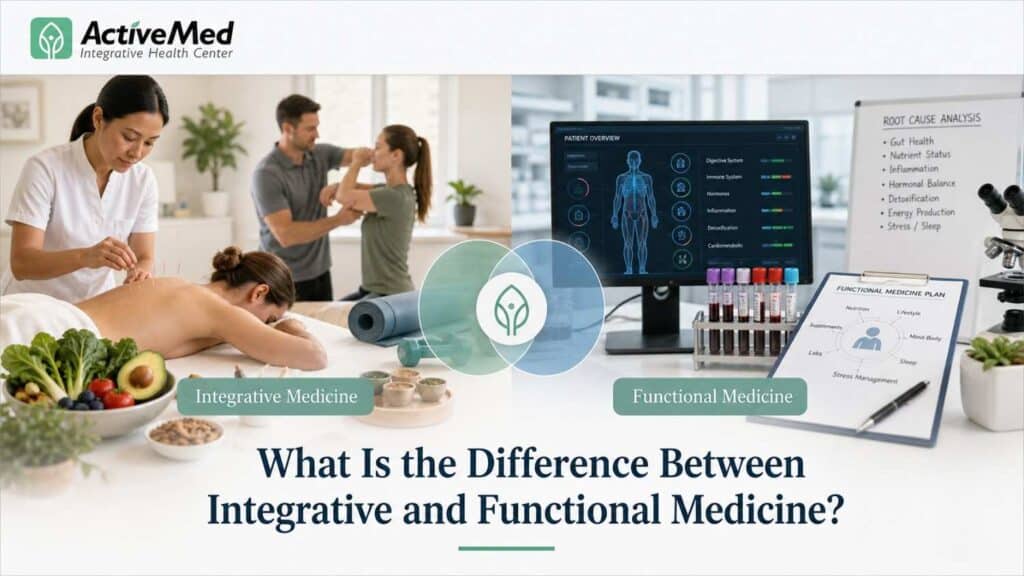
If we strip away the buzzwords, the difference is clearer than most health blogs make it sound. According to the National Center for Complementary and Integrative Health, integrative health brings conventional and complementary approaches together in a coordinated, whole-person way. According to the Institute for Functional Medicine, functional medicine is a root-cause, systems-based framework that tries to identify and address the underlying processes driving imbalance and disease. In simple terms, integrative medicine is the broader care model; functional medicine is a more specific investigative framework often used inside personalized care plans.
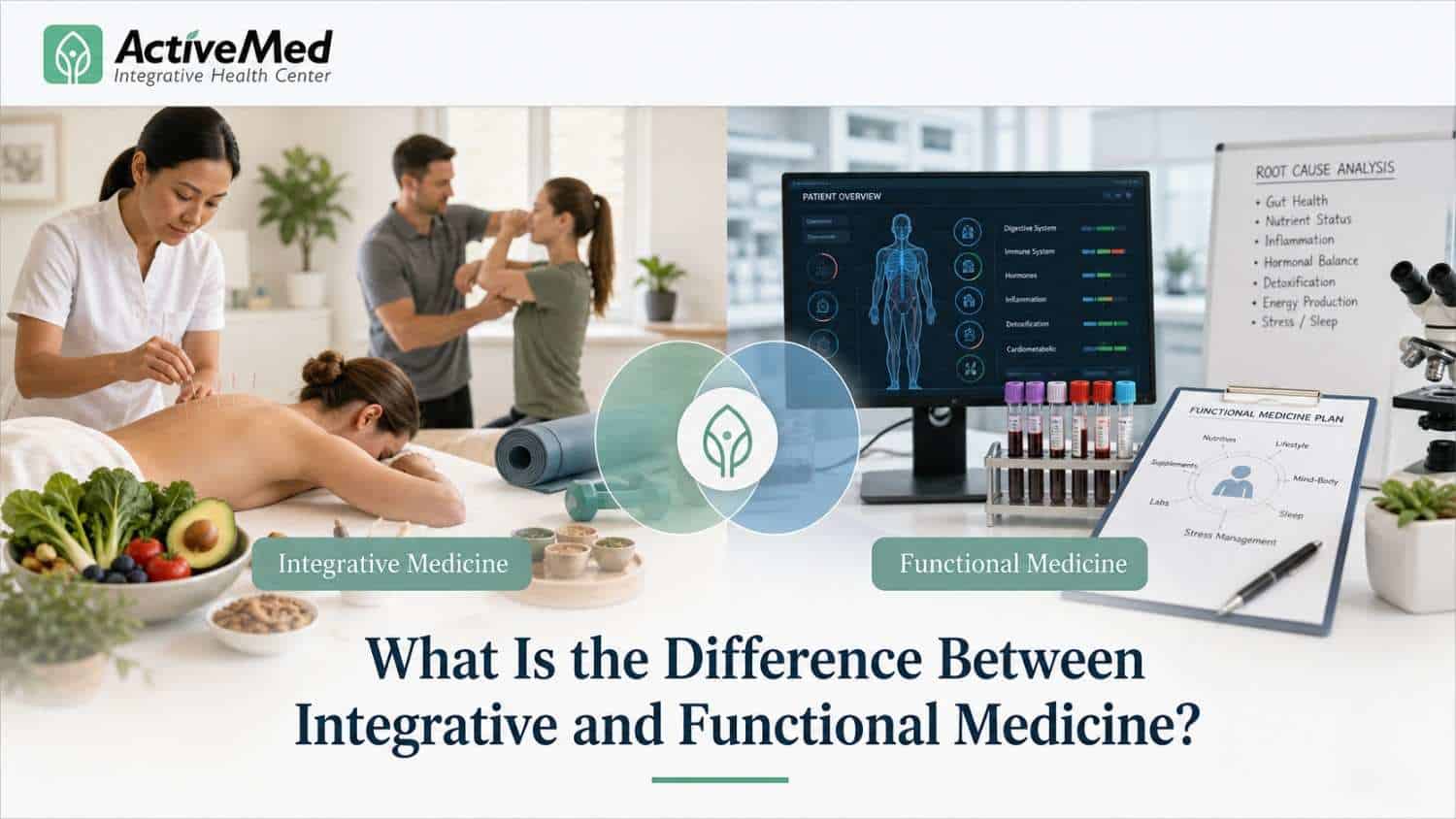
That distinction fits our clinic especially well. On the ActiveMed homepage, we describe ourselves as an integrative clinic with a collaborative team offering acupuncture, massage therapy, functional medicine, physical therapy, and Axon Therapy, and we explicitly say we believe in integrating eastern and western medicine. On our Functional Medicine page, we describe a deeper, patient-centered, root-cause approach that can include wellness visits, IV therapy, Lab Testing & Review, hormone therapy, Nutrition and Weight Loss, peptide therapy, and more. That gives us a very practical way to explain the difference: integrative medicine describes how we coordinate care; functional medicine describes one of the frameworks we may use to analyze and personalize that care.
What integrative medicine actually means
According to NCCIH, integrative health is not just “alternative medicine” with a nicer label. It is a coordinated model that combines conventional care and complementary approaches in a way that aims to treat the whole person, not just isolated symptoms. NCCIH also explains that complementary approaches can include nutritional approaches, psychological approaches, physical approaches, and combinations such as yoga, tai chi, acupuncture, and mindful eating.
The Osher Collaborative, which represents major academic integrative-health centers, frames integrative health as a mission-driven, whole-person, evidence-based approach that aims to improve health through clinical practice, education, research, and community engagement. Cleveland Clinic’s patient-facing explanation says integrative medicine uses a combination of therapies and lifestyle changes to treat and heal the whole person and uses an evidence-based approach, with the practitioner-patient relationship playing a central role.
What functional medicine actually means
According to IFM, functional medicine restores healthy function by treating the root causes of disease. IFM says the model allows clinicians to identify the underlying processes and dysfunctions causing imbalance and disease in each individual, using a patient’s genetic, environmental, and lifestyle influences to shape personalized interventions.
That means functional medicine is less about “adding more therapies” and more about asking why the symptoms are happening in the first place. Instead of stopping at a diagnostic label, the functional-medicine mindset tries to look for patterns, systems, drivers, and interactions. That is also how we describe it on our own Functional Medicine page, where we say we use functional medicine as a patient-centered, root-cause approach that looks at how systems interact — including lifestyle, environment, genetics, and physiology — to build a personalized plan instead of only labeling symptoms.
At ActiveMed, that root-cause emphasis is supported by the rest of the site. Our Lab Testing & Review page says our naturopathic doctors use unique lab tests to get a clearer picture of what is going on at a molecular level and to better understand the root cause of illness. Our functional medicine pages also consistently connect care to deeper visits, lab review, nutrition coaching, and targeted therapies, which is exactly the sort of structure readers need to see if they are trying to understand what “functional medicine” actually looks like in real practice.
The simplest way to explain the difference
A practical way to think about it is this:
- Integrative medicine is defined more by how care is organized.
- Functional medicine is defined more by how problems are analyzed.
That summary is an inference from the source definitions, but it is a strong one. NCCIH and Osher describe integrative health as coordinated, whole-person, multimodal care. IFM describes functional medicine as a root-cause, systems-oriented method for identifying underlying dysfunctions. Cleveland Clinic also makes the distinction directly, saying integrative medicine and functional medicine are similar, but integrative medicine seeks to understand the whole person and may use many different therapy types, while functional medicine seeks to identify and treat the underlying cause of the condition.
That is why the two overlap, but are not identical. A clinic can be integrative without making functional medicine its main analytic framework. A clinic can also market itself as functional medicine without offering the broader multidisciplinary, coordinated service range that people often associate with integrative care. At ActiveMed, we clearly sit in the overlap: our homepage reflects the integrative umbrella, while our Functional Medicine page shows the deeper root-cause framework inside it.
Integrative vs functional medicine: comparison table
| Question | Integrative Medicine | Functional Medicine |
| Core idea | Coordinates conventional and complementary care around the whole person | Looks for root causes and system-level dysfunctions behind symptoms |
| Main focus | Whole-person care, multimodal treatment, collaborative planning | Root-cause analysis, systems biology, personalized interventions |
| Typical tools | Conventional care, acupuncture, nutrition, rehab, mind-body approaches, supportive therapies | Deep history, lab review, nutrition, lifestyle assessment, targeted plans |
| Best way to think about it | A broad care model | A more specific clinical framework |
| Can they overlap? | Yes | Yes |
This table reflects the definitions from NCCIH, Osher, IFM, and Cleveland Clinic.
Where they overlap
The overlap is real, and readers should understand that. Both integrative medicine and functional medicine tend to care about the whole person, the role of lifestyle and environment, the practitioner-patient relationship, and care plans that go beyond symptom-only thinking. NCCIH and Osher both emphasize whole-person care, and IFM emphasizes individualized, patient-centered care shaped by genetics, environment, and lifestyle.
That means the difference is not “one is holistic and the other is not.” The stronger distinction is that the two systems approach whole-person care from slightly different angles. Integrative medicine asks, What therapies and disciplines should be coordinated? Functional medicine asks, What processes and dysfunctions are driving the symptoms? Both may lead to personalized plans, but they arrive there through different organizing logic.
Where they are actually different in practice
In real patient care, integrative medicine often feels broader and more multidisciplinary. A person might receive conventional evaluation plus acupuncture, physical therapy, nutrition guidance, stress-management work, or other supportive therapies based on the clinical picture. That model fits the way our homepage and Poway page present ActiveMed: a collaborative approach with multiple treatment types available under one roof.
Functional medicine, in contrast, often feels deeper and more investigative. The emphasis is usually on history, pattern recognition, lifestyle review, lab review, and looking for system-level contributors that may be missed in a shorter or more symptom-focused model. That is exactly how our Functional Medicine and Lab Testing & Review pages read. We describe plans that often combine deeper visits, lab review, nutrition coaching, and targeted therapies, and we explicitly say lab testing helps us get closer to root causes.
So if we simplify the practical distinction for patients, it looks like this:
- Integrative medicine says: “Let’s build the right mix of care.”
- Functional medicine says: “Let’s figure out what is driving this problem.”
That is not a contradiction. It is a difference in emphasis.
Is one more evidence-based than the other?
This is where weak articles usually become too promotional. The better answer is more disciplined.
Integrative medicine is explicitly presented by NCCIH, Osher, and Cleveland Clinic as evidence-informed or evidence-based whole-person care that combines appropriate conventional and complementary approaches. That does not mean every therapy used under an integrative umbrella is equally supported for every condition. It means the model itself is trying to coordinate care in a way that is patient-centered, whole-person, and evidence-aware.
Functional medicine also presents itself as patient-centered and science-based, but the evidence question is more complicated because the “functional medicine model” is not one uniform intervention. The evidence often depends on the specific test, the specific treatment, the specific condition, and the quality of the clinician’s reasoning. A 2021 BMJ Open study reported improved patient-reported outcomes and lower delivery costs in one functional medicine-based shared medical appointment model, but that does not prove that every functional medicine clinic, every testing approach, or every supplement-heavy protocol is equally evidence-based. It supports cautious optimism about one model, not blanket conclusions about the entire field.
That nuance is worth keeping in the article because it raises trust. Readers do not need a winner in a branding debate. They need to know that the quality of care depends on what is actually being done, not just on whether the clinic uses the word “integrative” or “functional.”
Which one sounds more like ActiveMed?
The honest answer is: both, but in different ways.
Our homepage and location pages clearly position ActiveMed as an integrative clinic. We talk about a collaborative team, integrating eastern and western medicine, and offering multiple therapies such as acupuncture, massage therapy, functional medicine, physical therapy, and Axon Therapy. That is classic integrative positioning because it describes a coordinated, whole-person service model.
Our Functional Medicine page, on the other hand, clearly positions functional medicine as a deeper framework. We describe it as root-cause, patient-centered, and system-aware, and we connect it to deeper visits, Lab Testing & Review, nutrition coaching, hormone therapy, IV therapy, peptide therapy, and more. That looks much more like functional-medicine positioning in the IFM sense.
That gives us a very usable internal message for this article:
At ActiveMed, integrative medicine describes how we coordinate care. Functional medicine describes one of the deeper frameworks we may use to investigate and personalize that care.
When functional medicine may make more sense
Functional medicine may make more sense when someone feels like the obvious symptom label is not enough, or when they want a deeper look at patterns involving lifestyle, stress, nutrition, sleep, hormones, labs, or chronic symptoms that seem interconnected. That is the logic behind related pages such as Weight Loss Strategies with Functional Medicine, which presents weight loss as more than calorie math and talks about stress, sleep, hormones, movement, and individualized care.
The same is true for our Lab Testing & Review page. It explicitly says lab testing is designed for people seeking answers and that the benefit is better understanding the body and getting to the root cause of ailments. So when the clinical question is, Why is this happening?, functional medicine often becomes the more relevant lens.
When integrative medicine may make more sense
Integrative medicine may make more sense when the patient already knows the general problem but needs a coordinated mix of care rather than a narrow one-track plan. That might mean combining pain care, rehab, acupuncture, lifestyle work, and supportive therapies rather than relying on a single type of intervention. That broader coordinated-care idea is visible on our homepage and our Poway presence, where we present multiple services as part of a collaborative approach rather than as isolated offerings.
For many patients, this is not an either-or decision. They may enter through an integrative-care need and then move into a functional-medicine workup when it becomes clear that the clinical picture needs more root-cause investigation. That is another reason this article works so well for ActiveMed: we do not need to force the two concepts apart unnaturally. We need to explain how they fit together.
What this means for patients choosing a clinic
If a patient is comparing clinics, the practical question is not “Which term sounds better?” It is:
- Does this clinic coordinate care well?
- Does it explain reasoning clearly?
- Does it personalize the plan?
- Does it use testing and interventions appropriately?
- Does it treat the whole person without turning every symptom into an expensive wellness package?
That concern is exactly why pages like Finding the Right Functional Medicine Practitioner in San Diego matter. That article emphasizes communication, listening, respect, and the ability to explain complex issues clearly. Those qualities are more useful predictors of a good patient experience than terminology alone.
Frequently asked questions
What is the difference between integrative and functional medicine?
- Integrative medicine is a coordinated, whole-person care model that combines conventional and complementary approaches. Functional medicine is a root-cause, systems-based framework used to identify and address underlying dysfunctions driving symptoms.
Is functional medicine part of integrative medicine?
- Sometimes, yes. Functional medicine can exist inside a broader integrative clinic model, but the two are not identical terms. At ActiveMed, that is a practical way to understand the relationship.
Is integrative medicine the same as alternative medicine?
- No. According to NCCIH, integrative health coordinates conventional and complementary approaches. That is different from using alternatives instead of conventional care.
Does functional medicine focus on root causes?
- Yes. According to IFM, functional medicine aims to restore healthy function by treating root causes and identifying underlying processes and dysfunctions causing imbalance and disease.
Which approach is more personalized?
- Both can be personalized, but functional medicine usually emphasizes individualized root-cause analysis more explicitly. Integrative medicine usually emphasizes coordinated whole-person care more explicitly.