
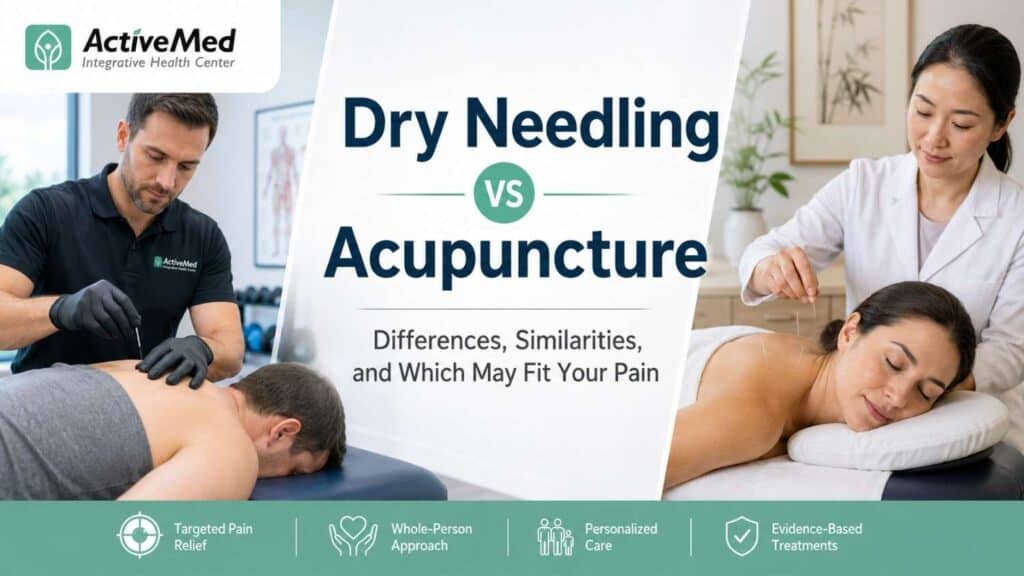
Dry needling and acupuncture both use thin, solid needles, but they are not the same treatment. Dry needling is often used for myofascial trigger points, muscle tension, pain, range-of-motion limits, and movement impairments. Acupuncture is rooted in traditional Chinese medicine and is also discussed in modern pain care for symptoms such as neck pain, back pain, headaches, and chronic pain. The right option depends on your symptoms, exam findings, provider qualifications, safety factors, and local regulations.
At ActiveMed Health, patients in Encinitas, Poway, and San Diego can explore Dry Needling, Acupuncture, Physical Therapy, or other care options after an appropriate evaluation.
Neither dry needling nor acupuncture should be described as a cure. Both may be helpful for selected patients, but results vary. The safest decision begins with understanding the pain pattern, the goal of treatment, who is providing the care, and whether needle-based treatment is appropriate for your health history.
Dry Needling vs Acupuncture: Quick Comparison
| Question | Dry Needling | Acupuncture |
| What tool is used? | A thin, solid “dry” needle with no medication or injection | Thin acupuncture needles |
| Main framework | Western musculoskeletal and neuromuscular model | Traditional Chinese medicine, often integrated with modern pain-care explanations |
| Common focus | Trigger points, muscle tension, myofascial pain, movement impairments | Pain, headaches, stress-related symptoms, chronic pain, and broader symptom patterns |
| Typical target | Muscles, trigger points, fascia, or local pain-sensitive areas | Acupuncture points selected through individualized clinical reasoning |
| Is it a cure? | No | No |
| Who performs it? | Depends on state law, provider scope, training, and qualifications | Licensed acupuncturists and other qualified professionals depending on jurisdiction |
| Is it usually standalone? | Usually best as part of a larger rehabilitation plan | Often part of a broader integrative care plan |
| Common short-term effects | Temporary soreness, bleeding, bruising, discomfort, or fatigue | Temporary soreness, minor bleeding, bruising, tingling, heaviness, or relaxation |
| Serious but rare risks | Infection, nerve injury, punctured organ, pneumothorax | Infection, punctured organ, central nervous system injury if delivered improperly |
| Best fit | Pain that appears muscle or trigger-point driven and linked with movement impairment | Pain or symptoms where a patient wants acupuncture-based non-drug care after screening |
Why People Confuse Dry Needling and Acupuncture
Dry needling and acupuncture are easy to confuse because both involve thin needles placed through the skin. From the patient’s perspective, the tools may look similar. The difference is not only the needle. The difference is the clinical framework, treatment target, provider training pathway, and purpose of care.
According to ChoosePT, dry needling uses a “dry” needle, meaning there is no medication or injection, and the needle is placed into areas of muscle identified by the patient and physical therapist. ChoosePT also states that dry needling is not acupuncture and is typically part of a larger treatment plan.
Acupuncture, on the other hand, is a distinct clinical practice rooted in traditional Chinese medicine. In modern integrative care, acupuncture is also often discussed in relation to nervous-system effects, pain modulation, relaxation response, and whole-person symptom management.
The practical takeaway is simple: dry needling and acupuncture may look similar, but they are not interchangeable.
What Is Dry Needling?
Dry needling is a needle-based technique that uses a thin filiform needle without medication or injection. It is often discussed for myofascial trigger points, muscle tension, pain, and movement impairments.
A provider may consider dry needling when a patient has localized muscle tenderness, tight bands of muscle, reduced range of motion, or pain that seems connected to myofascial trigger points. The goal is usually to reduce pain sensitivity, improve mobility, decrease muscle guarding, or help the patient participate more effectively in active rehabilitation.
According to ChoosePT, dry needling is a technique physical therapists use where allowed by state law to treat pain and movement impairments. ChoosePT also advises patients to ask providers about their education, experience, and training before receiving dry needling.
| Dry Needling May Be Discussed When… | Why It May Fit |
| Pain appears related to trigger points or myofascial pain | Dry needling commonly targets sensitive muscle areas |
| Muscle tightness limits movement | It may help reduce guarding for some patients |
| Neck, shoulder, back, hip, or jaw tension is present | These are common regions where myofascial pain may occur |
| Pain affects range of motion | Dry needling may support mobility goals |
| The patient is also doing rehab | It may help support active physical therapy work |
| The provider is trained and legally allowed to perform it | Safety, scope, and qualifications matter |
Dry needling should not be promoted as a standalone cure. It should fit into a larger plan that may include movement, strengthening, mobility work, activity modification, and reassessment.
What Is Acupuncture?
Acupuncture is a treatment that involves placing thin needles at selected points on the body. It is traditionally rooted in Chinese medicine and may be used as part of a broader integrative care plan.
In modern pain-care discussions, acupuncture is often described in relation to nervous-system effects, pain modulation, muscle tension, relaxation response, and whole-person symptom management. It may be discussed for neck pain, back pain, headaches, chronic pain patterns, stress-related tension, and other symptoms after appropriate screening.
According to the National Center for Complementary and Integrative Health, acupuncture may affect nervous system function and may also have effects on the tissues where needles are inserted. NCCIH also notes that patient expectations and the practitioner-patient relationship may contribute to symptom changes.
| Acupuncture May Be Discussed When… | Why It May Fit |
| A patient wants a non-drug pain-care option | Acupuncture is commonly discussed for pain symptoms |
| Pain is chronic or recurring | Some patients use acupuncture as part of longer-term symptom management |
| Symptoms include neck pain, back pain, headaches, or stress-related tension | These are common reasons patients ask about acupuncture |
| The patient wants a broader whole-person visit | Acupuncture visits may include sleep, stress, lifestyle, and symptom-pattern discussion |
| The patient prefers traditional Chinese medicine framing | Acupuncture uses a distinct clinical tradition |
| Safety screening is completed | Needle-based treatment requires proper screening and clean technique |
ActiveMed also offers local acupuncture information for patients interested in acupuncture in Encinitas, acupuncture in Poway, and acupuncture in San Diego.
Similarities Between Dry Needling and Acupuncture
| Similarity | What It Means for Patients |
| Both use thin needles | They may look similar during treatment |
| Both penetrate the skin | Training, anatomy knowledge, and hygiene matter |
| Both may cause temporary soreness | Short-term soreness can happen after treatment |
| Both may cause minor bleeding or bruising | Patients should know what short-term responses are possible |
| Both require safety screening | Blood thinners, bleeding disorders, pregnancy, immune concerns, and infection risk should be discussed |
| Both should be performed by qualified professionals | Provider training and legal scope matter |
| Both may be part of a broader pain plan | Neither should be treated as a guaranteed cure |
The shared use of needles does not make the treatments the same. It only means both require proper screening, sterile technique, and a qualified provider.
Key Differences Between Dry Needling and Acupuncture
| Category | Dry Needling | Acupuncture |
| Clinical origin | Modern Western musculoskeletal and neuromuscular practice | Traditional Chinese medicine, now also discussed in modern integrative pain care |
| Primary target | Trigger points, muscle tissue, fascia, myofascial pain, movement impairments | Acupuncture points selected by symptom pattern and clinical reasoning |
| Common goal | Reduce muscle tension, pain sensitivity, trigger-point irritability, or movement limitation | Support pain relief, symptom regulation, relaxation, and whole-person care |
| Visit style | Often focused on specific painful muscles or movement limits | Often includes broader symptom-pattern discussion |
| Treatment role | Usually an adjunct to exercise, manual therapy, and rehab | Often used as part of integrative pain care |
| Regulation | Varies by state and provider type | Performed by licensed acupuncturists and other qualified professionals under state law |
| Evidence framing | May provide short-term benefit for some musculoskeletal pain; long-term evidence varies | Evidence varies by condition; stronger for some pain conditions than others |
| Best patient question | “Is my pain muscle or trigger-point driven?” | “Could acupuncture fit my broader pain or symptom pattern?” |
One treatment is not automatically better than the other. The better question is: Which one matches the problem being treated?
What Does the Evidence Say About Dry Needling?
The evidence for dry needling is most defensible when the claim is modest: it may help some patients with short-term pain reduction, especially when myofascial trigger points or movement limitations are part of the clinical picture. It should not be presented as a guaranteed fix.
A 2023 systematic review and meta-analysis found that dry needling was superior to sham or no intervention and equally effective to other interventions for short-term pain reduction across body regions. The same practical caution still applies: evidence varies by condition, technique, body region, and follow-up period.
| Evidence Point | Practical Interpretation |
| Dry needling may reduce pain short-term for some musculoskeletal conditions | It may help selected patients, especially when trigger points are involved |
| It may be comparable to other interventions in some studies | It is not always clearly superior |
| Evidence varies by body region and condition | Avoid universal claims |
| Long-term outcomes are less certain | Track progress and reassess |
| Best used with rehab | Should support movement, strength, and function goals |
ChoosePT also frames dry needling as part of a larger treatment plan rather than a standalone intervention. That matters because patients rarely need only one needle-based procedure. They often need strength, mobility, posture tolerance, load management, and activity-specific progression.
What Does the Evidence Say About Acupuncture?
The evidence for acupuncture depends on the condition being treated. It should not be described as a universal treatment for every pain condition, but it may be a reasonable non-drug option to discuss for selected patients.
According to NCCIH, acupuncture has been studied for many pain conditions. NCCIH also states that relatively few complications have been reported when acupuncture is performed properly, but serious adverse effects can occur when it is not delivered properly.
| Evidence Point | Practical Interpretation |
| Acupuncture may help some pain conditions | It can be discussed as a non-drug option for selected patients |
| Evidence varies by condition | Claims should be specific, not universal |
| It is generally safe when performed properly | Sterile single-use needles and trained practitioners matter |
| It may be used alongside other care | It should not replace urgent evaluation or active rehab when needed |
Acupuncture may be a better fit when a patient is looking for broader non-drug pain support or care that considers sleep, stress, symptom patterns, and chronic pain experience. Dry needling may be a better fit when the problem appears more localized to muscle trigger points and movement impairments. But the right decision should come after evaluation, not assumption.
Which May Fit Your Pain?
Use this table as a starting point, not a diagnosis. A provider should help determine which approach, if either, is appropriate.
| Your Situation | Dry Needling May Fit When… | Acupuncture May Fit When… |
| Muscle knot or trigger-point pain | Pain appears localized to tight, tender muscle areas | Pain is part of a broader symptom pattern |
| Neck or shoulder tension | Exam suggests myofascial trigger points or movement restriction | Symptoms include tension, stress load, headaches, or chronic pain |
| Back or hip pain | Muscle guarding limits motion or rehab participation | Patient wants broader non-drug pain support |
| Headache with neck tension | Trigger points may be contributing | Acupuncture may be used for certain headache patterns after screening |
| Chronic pain | Specific muscles or trigger points are limiting movement | Patient wants an integrative approach with symptom tracking |
| Movement limitation | Dry needling may support mobility goals in a rehab plan | Acupuncture may help with pain modulation but may not directly retrain movement |
| Complex or persistent pain | Should be paired with evaluation and rehab | May be part of a broader care plan, but additional evaluation may be needed |
If pain is tied to movement, weakness, posture, or activity limits, Physical Therapy may also be important. For persistent or complex pain patterns, ActiveMed’s Pain Management services may be discussed after evaluation.
Safety, Side Effects, and Who Should Be Careful
Dry needling and acupuncture involve needle insertion. That means safety screening matters.
Common Short-Term Responses
| Possible Response | What Patients Should Know |
| Soreness | May happen temporarily after treatment |
| Minor bleeding | Possible at needle sites |
| Bruising | Possible, especially with sensitive skin or blood-thinning medications |
| Temporary discomfort | Some techniques may feel more intense than others |
| Fatigue or lightheadedness | Some patients may feel temporarily tired or lightheaded |
| Temporary symptom flare | Some patients may feel worse before symptoms settle |
Serious but Rare Risks
| Risk | Why It Matters |
| Infection | Sterile technique and single-use needles matter |
| Nerve injury | Anatomical precision matters |
| Punctured organ | Proper training and body-region caution are essential |
| Pneumothorax | Rare but possible when needling near the chest, ribs, upper back, or shoulder region |
| Excessive bleeding | Risk may be higher with blood thinners or bleeding disorders |
A large survey of therapeutic dry needling found that 36.7% of 20,464 treatments involved minor adverse events, while major adverse events were reported in fewer than 0.1% of treatments. The most common minor events included bleeding, bruising, and pain during dry needling.
For acupuncture, NCCIH states that the FDA regulates acupuncture needles as medical devices and requires them to be sterile and labeled for single use only. NCCIH also warns that improper delivery can cause serious adverse effects, including infections, punctured organs, and central nervous system injury.
Tell Your Provider If You:
- Take blood thinners
- Have a bleeding disorder
- Are pregnant or may be pregnant
- Have an implanted medical device
- Have immune-system concerns
- Have a skin infection near the treatment area
- Have a history of fainting with needles
- Have recent surgery or recent trauma
- Have cancer history, fever, unexplained weight loss, or infection signs
- Have new weakness, numbness, bowel or bladder changes, or neurologic symptoms
- Have rapidly worsening symptoms
Needle-based care should not replace urgent medical evaluation when red flags are present.
What to Ask Before Choosing Dry Needling or Acupuncture
Before choosing either treatment, patients should ask practical questions.
| Question to Ask | Why It Matters |
| Who will perform the treatment? | Provider credentials and legal scope matter |
| What training do they have? | Needle procedures require anatomical knowledge and hands-on training |
| Is this allowed under state law for this provider type? | Dry needling rules vary by state |
| What diagnosis or exam finding supports this treatment? | Needling should match the clinical problem |
| What are the risks for my treatment area? | Chest, neck, shoulder, and upper-back areas require caution |
| Will this be combined with exercise or rehab? | Dry needling is often best used as part of a broader plan |
| What should we track? | Pain, range of motion, function, sleep, and activity tolerance matter |
| When will we reassess? | Avoid indefinite treatment without measurable progress |
| What are the alternatives? | Patients should understand other care options |
| Is it covered by insurance? | Coverage varies by plan, provider type, and service |
According to APTA’s state-law resource, laws governing dry needling by physical therapists differ from state to state. Patients should confirm provider qualifications, legal scope, training, and safety practices before starting care.
Patients can schedule a visit to discuss symptoms and care options, or verify insurance benefits before beginning care.
Frequently Asked Questions About Dry Needling vs Acupuncture
Is dry needling the same as acupuncture?
- No. They both use thin needles, but they come from different clinical frameworks. Dry needling is generally focused on trigger points, muscle tension, and movement impairments. Acupuncture comes from traditional Chinese medicine and uses acupuncture-point selection based on broader clinical reasoning.
Does dry needling hurt more than acupuncture?
- It depends on the technique, body area, and patient sensitivity. Some patients experience dry needling as more intense, especially when a trigger point responds. Acupuncture may feel mild, achy, warm, heavy, tingling, or relaxing for some patients.
Which is better for muscle knots?
- Dry needling may be more directly focused on myofascial trigger points or muscle knots. Acupuncture may also be used for pain and tension, but the treatment framework is different.
Which is better for chronic pain?
- It depends on the pain pattern. Dry needling may fit localized myofascial pain or movement limitation. Acupuncture may fit broader chronic pain patterns or patients seeking traditional Chinese medicine-based care.
Can dry needling and acupuncture be combined with physical therapy?
- Dry needling is often used as part of a larger rehab plan. Acupuncture may also complement physical therapy when pain limits movement, sleep, or function. The right combination depends on symptoms, evaluation findings, goals, and provider recommendations.
Are dry needling and acupuncture safe?
- Both can be safe when performed by qualified professionals using proper technique and sterile, single-use needles. Minor soreness, bleeding, bruising, and temporary discomfort can occur. Rare serious risks include infection, nerve injury, punctured organ, and pneumothorax.
Who should be careful with needling treatments?
- Patients should disclose blood thinners, bleeding disorders, pregnancy, immune concerns, implanted devices, skin infections, recent surgery, recent trauma, cancer history, fainting with needles, or neurologic symptoms before treatment.
How many sessions are needed?
- There is no universal number. A practical plan begins with a short trial, tracks pain, range of motion, function, sleep, and activity tolerance, then reassesses whether treatment is helping.
Does insurance cover dry needling or acupuncture?
- Coverage varies by plan, provider type, condition, and state rules. Patients should verify benefits before starting treatment.
Where can I discuss dry needling or acupuncture in Encinitas, Poway, or San Diego?
- ActiveMed Health offers dry needling, acupuncture, physical therapy, and pain-care services in the Encinitas, Poway, and San Diego area. Patients can schedule a visit to discuss which option may fit their pain pattern and goals.
Conclusion
Dry needling and acupuncture may look similar because both use thin needles, but they are not the same treatment. Dry needling is usually more focused on trigger points, muscle tension, and movement impairments. Acupuncture comes from a broader traditional Chinese medicine framework and is also used in modern integrative pain care.
Neither treatment is automatically better. Neither should be described as a cure. The best option depends on your pain pattern, medical history, provider qualifications, safety factors, local regulations, and goals.
If you are comparing needle-based care for pain, muscle tension, headaches, neck pain, back pain, shoulder pain, hip pain, jaw tension, or chronic symptoms, ActiveMed Health can help you discuss the next appropriate step. Explore Dry Needling, Acupuncture, or Physical Therapy, or schedule a visit to discuss your symptoms.
Patients planning to use insurance can also verify insurance benefits before starting care.