
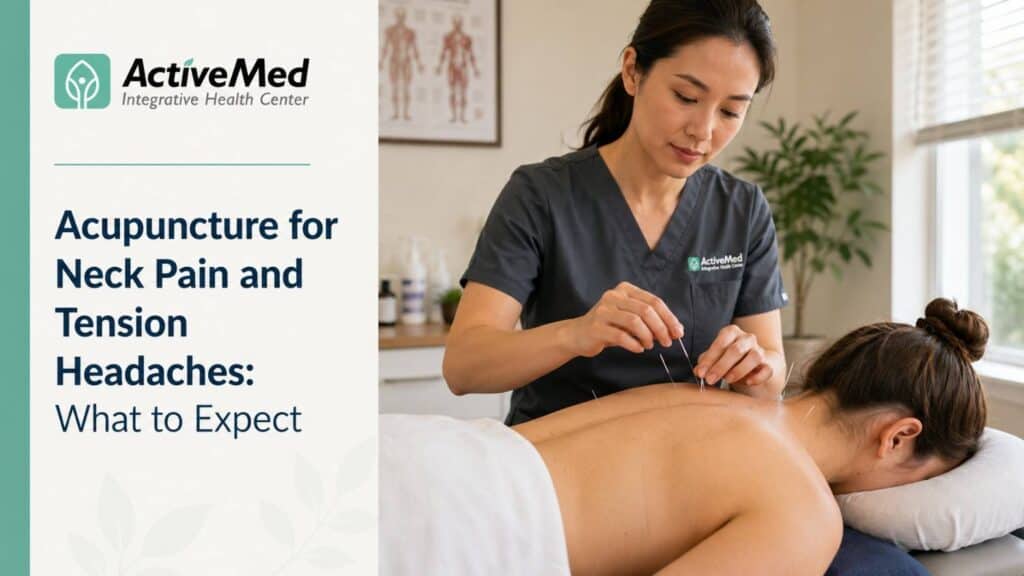
Acupuncture may help some people with neck pain and frequent tension headaches, but it should not be described as a guaranteed cure. Research summaries suggest acupuncture may help several pain conditions, including neck pain, and may reduce the frequency of tension headaches for some patients. The safest approach is to use acupuncture as part of an individualized care plan, track symptoms over time, and get medical evaluation first if headaches are sudden, severe, changing, or associated with neurologic symptoms.
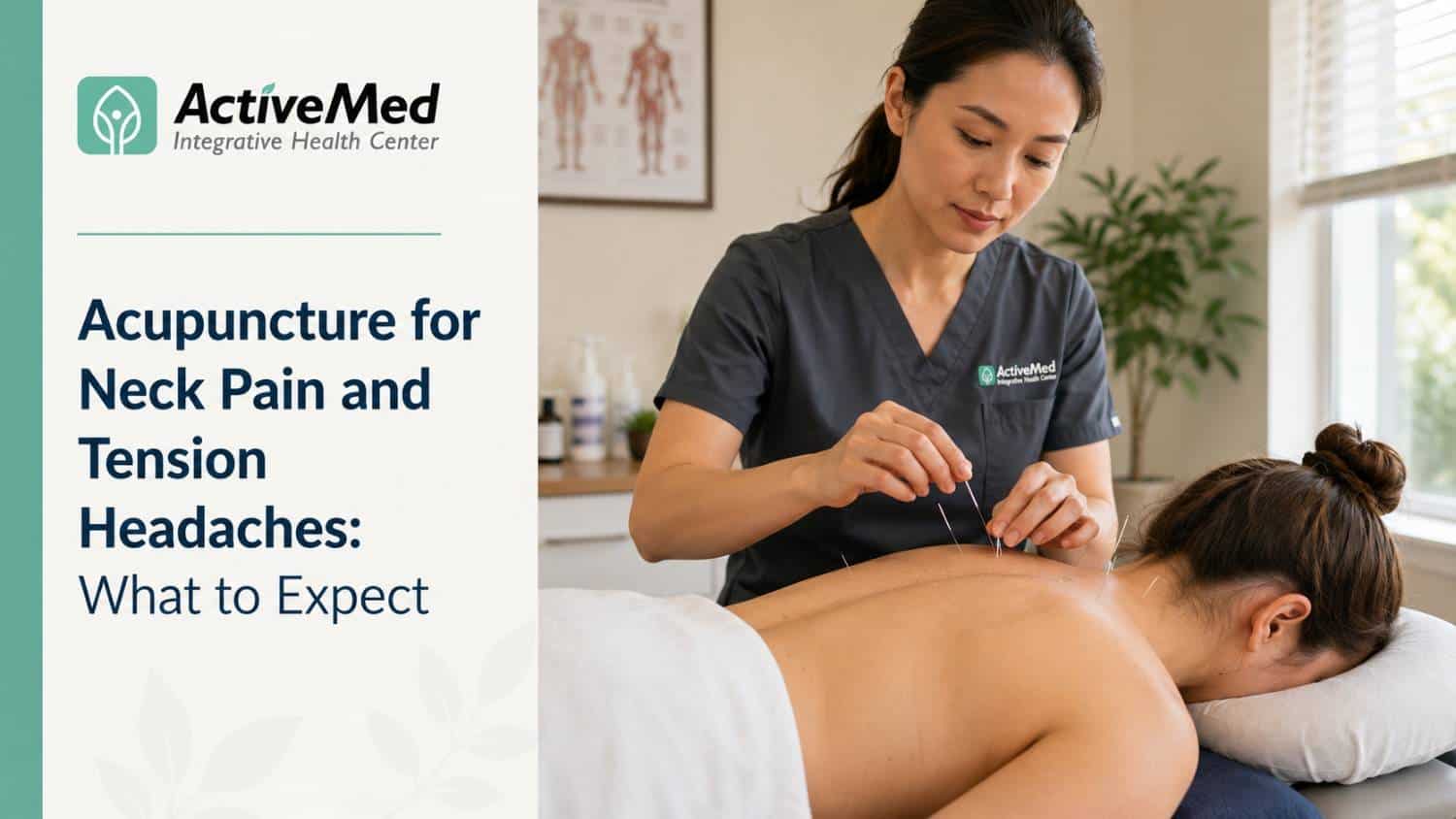
At ActiveMed Health, adults in Encinitas, Poway, and San Diego can explore Acupuncture as a non-drug care option for neck pain, muscle tension, and certain headache patterns.
Neck pain and tension headaches often overlap. Tightness in the neck, shoulders, scalp, or jaw can make daily life uncomfortable, especially when symptoms affect work, sleep, screen time, exercise, or focus. Acupuncture may be one option to discuss, but the right care plan depends on the headache pattern, neck symptoms, medical history, and whether any warning signs are present.
Acupuncture for Neck Pain and Tension Headaches
| Question | Evidence-Based Answer |
| Can acupuncture help neck pain? | It may help some people with neck pain, but results vary and it should not be described as a cure. |
| Can acupuncture help tension headaches? | It may reduce headache frequency for some people, especially those with frequent tension-type headaches. |
| Is acupuncture safe? | It is generally considered safe when performed by trained practitioners using sterile, single-use needles, but patient-specific risks should be reviewed. |
| Should acupuncture replace physical therapy? | No. Acupuncture may support pain modulation, while physical therapy addresses mobility, strength, posture, and movement function. |
| When should someone get evaluated first? | Sudden severe headache, fever, stiff neck, confusion, seizures, double vision, weakness, numbness, trouble speaking, head injury, worsening arm symptoms, or balance problems require prompt evaluation. |
| How should results be tracked? | Track headache days, neck pain intensity, sleep quality, medication use, neck movement, work tolerance, and daily function. |
According to NICE headache guidance, people with tension-type headaches on 15 days per month or more may be offered a course of up to 10 acupuncture sessions to help prevent future tension-type headaches.
Why Neck Pain and Tension Headaches Often Overlap
Tension headaches often feel like pressure, tightness, or a band-like sensation around the head. Some people feel pain in the forehead, temples, scalp, neck, or shoulders. Others notice the headache after a long workday, poor sleep, prolonged screen use, stress, jaw clenching, or sitting in one position for too long.
Neck pain can also contribute to headache discomfort. The neck, upper back, shoulders, jaw, and scalp muscles work together during posture, movement, and stress responses. When these areas become tense, irritated, or overloaded, some people experience both neck pain and headache symptoms.
According to MedlinePlus, tension headaches occur when neck and scalp muscles become tense or contract, and these muscle contractions can be related to stress, depression, head injury, or anxiety. MedlinePlus also notes that tension headaches are linked with tight muscles in the shoulders, neck, scalp, and jaw.
That does not mean every headache is a tension headache. Migraine, cervicogenic headache, medication-overuse headache, sinus-related headache, neurologic conditions, and other medical causes may also create head or neck pain. A new, severe, or changing headache pattern should be evaluated.
What Is Acupuncture?
Acupuncture is a treatment that involves placing very thin needles at selected points on the body. It is traditionally rooted in Chinese medicine. In modern pain-care discussions, acupuncture is often described in relation to nervous-system effects, pain modulation, muscle tension, relaxation response, and whole-person symptom management.
During an acupuncture visit, a practitioner may ask about your symptoms, health history, headache frequency, neck pain pattern, medications, stress, sleep, and prior treatment. Very thin needles are placed at selected points and usually remain in place for a period of time while the patient rests.
According to the National Center for Complementary and Integrative Health, acupuncture may affect nervous system function and may also have effects on tissues where needles are inserted. NCCIH also notes that nonspecific effects, such as patient expectations and the practitioner-patient relationship, may contribute to symptom improvement.
The important point is this: acupuncture should be framed as a possible supportive treatment, not a guaranteed fix.
What Does the Evidence Say?
The evidence for acupuncture is strongest when the claim is modest: it may help some people with certain pain conditions, including neck pain and frequent tension-type headaches. It should not be promoted as a universal solution.
| Condition or Concern | What the Evidence Suggests | How to Frame It |
| Neck pain | Acupuncture may help some people with neck pain; evidence suggests benefit compared with no treatment in some analyses. | Reasonable to discuss as a non-drug option, not a cure. |
| Tension headaches | Acupuncture may reduce headache frequency for some patients, especially with frequent tension-type headaches. | Best framed as a possible prevention/support strategy. |
| Migraine | Acupuncture has separate evidence for migraine prevention, but migraine is not the same as tension headache. | Mention only to clarify that different headache types need different care. |
| Chronic pain patterns | Acupuncture may fit as complementary care when paired with movement, sleep, stress, and lifestyle strategies. | Good fit for a broader integrative care plan. |
According to NCCIH, research has shown that acupuncture may be helpful for several pain conditions, including back or neck pain. NCCIH also states there is moderate- to low-quality evidence that acupuncture may reduce the frequency of tension headaches.
NICE also supports acupuncture for a specific headache pattern. According to NICE, people with tension-type headaches on 15 days per month or more may be offered up to 10 acupuncture sessions to help prevent future tension-type headaches.
This supports a balanced conclusion: acupuncture may be worth considering for selected patients with neck pain and frequent tension-type headaches, especially when symptoms are tracked and the care plan is reassessed.
When Acupuncture May Be Reasonable to Consider
Acupuncture may be reasonable to discuss when symptoms are persistent, recurring, or affecting quality of life, but do not involve urgent warning signs.
| Patient Situation | Why Acupuncture May Fit |
| Neck pain with muscle tension | May support pain modulation and relaxation for some patients |
| Frequent tension-type headaches | May help reduce headache frequency in selected patients |
| Stress-related neck and shoulder tightness | May support relaxation and symptom management |
| Desk-work or posture-related neck discomfort | May complement movement, ergonomic, and physical therapy strategies |
| Preference for non-drug care options | Acupuncture can be discussed as part of a broader plan |
| Chronic pain patterns | May be useful as complementary care when paired with movement, sleep, and stress support |
| Neck pain affecting sleep or focus | May be worth a short trial with measurable goals |
ActiveMed’s Acupuncture service can be positioned as a non-drug care option for selected patients with neck pain, muscle tension, and certain headache patterns. Patients looking for location-specific care can also explore acupuncture in Encinitas, acupuncture in Poway, or acupuncture in San Diego.
When Acupuncture Should Not Be the First Step
Acupuncture is not the right first step for every headache or neck-pain situation. Some symptoms require medical evaluation before acupuncture, massage, physical therapy, or other conservative care.
| Symptom or Situation | Why Evaluation Comes First |
| Sudden, very severe headache | May indicate a serious medical condition |
| Headache with fever or stiff neck | May indicate infection or another urgent issue |
| Confusion, seizures, double vision, weakness, numbness, or trouble speaking | Possible neurologic emergency |
| Headache after head injury | Needs medical evaluation, especially if worsening |
| New or changing headache pattern | Needs diagnosis before treatment |
| Worsening arm numbness, pins and needles, clumsiness, or weakness with neck pain | May indicate nerve or spinal cord involvement |
| Balance or walking problems after neck pain starts | Needs urgent assessment |
| Neck pain with severe headache | Needs prompt evaluation |
| Unexplained weight loss, cancer history, or systemic illness symptoms | Requires medical evaluation |
According to Mayo Clinic, emergency care is appropriate for a sudden, severe headache; headache with fever, stiff neck, confusion, seizures, double vision, weakness, numbness, trouble speaking; or headache after a head injury.
NHS Inform advises urgent GP contact if neck pain is accompanied by worsening hand clumsiness, numbness, pins and needles, weakness in one or both arms, balance or walking problems, or severe headache.
These symptoms should be evaluated first. Acupuncture can be considered later if appropriate.
What to Expect During an Acupuncture Visit
A visit for neck pain and tension headaches usually begins with a symptom and health-history review. The practitioner may ask about:
- Where the neck pain is located
- How often headaches occur
- Whether headaches feel like pressure, tightness, throbbing, or sharp pain
- Whether symptoms are one-sided or on both sides
- Triggers such as stress, sleep, posture, screen time, work, exercise, or jaw tension
- Whether there is nausea, light sensitivity, visual symptoms, numbness, weakness, dizziness, or balance changes
- Current medications and supplements
- Blood thinners, bleeding disorders, pregnancy, implanted devices, immune concerns, or recent injury
- Prior care, imaging, diagnoses, or treatment response
- Goals such as fewer headache days, less neck tension, better sleep, improved work tolerance, or reduced medication reliance when medically appropriate
During treatment, very thin needles are placed at selected points. Some patients feel little discomfort. Others may notice pressure, warmth, heaviness, tingling, dull ache, or a relaxation response. Needles may remain in place while the patient rests, depending on the treatment plan and clinic protocol.
A good care plan should also include reassessment. Acupuncture should not continue indefinitely without tracking whether symptoms and function are improving.
How Many Sessions Should Patients Try?
There is no universal number of sessions that works for every patient. A practical approach is to start with a short course, track symptoms, and reassess.
| What to Track | Why It Matters |
| Headache days per month | Shows whether frequency is changing |
| Neck pain intensity | Helps measure symptom change |
| Neck movement comfort | Shows whether mobility is improving |
| Sleep quality | Neck pain and headaches often affect sleep |
| Medication use | Helps identify whether symptoms are easier to manage |
| Work and screen tolerance | Important for desk workers and professionals |
| Exercise or daily activity tolerance | Shows whether symptoms are less limiting |
| Stress and muscle tension | Helps connect symptoms to lifestyle triggers |
A useful question after several visits is not only, “Do I feel better today?” but also:
- Are headaches less frequent?
- Are symptoms less intense?
- Am I sleeping better?
- Can I move my neck more comfortably?
- Can I work, drive, exercise, or complete daily tasks with less limitation?
- Is this care helping enough to continue?
If there is no meaningful improvement after a reasonable trial, the plan should be reassessed.
Acupuncture vs Physical Therapy for Neck Pain and Headaches
Acupuncture and physical therapy are different tools. One does not automatically replace the other.
| Option | May Help With | Limitation |
| Acupuncture | Pain modulation, muscle tension, relaxation, headache frequency for some patients | Does not directly retrain posture, strength, mobility, or work mechanics |
| Physical therapy | Neck mobility, shoulder strength, posture tolerance, movement function, ergonomic strategies | Requires active participation and home follow-through |
| Massage therapy | Short-term muscle-tension relief for some patients | May not address movement, strength, or recurring triggers alone |
| Pain management evaluation | Persistent, complex, or multi-factor pain | Should not be reduced to one treatment |
| Medical evaluation | Red flags, severe or changing headaches, neurologic symptoms | Comes before conservative care when warning signs exist |
If neck pain and headaches are connected to posture, shoulder mechanics, mobility limits, or movement patterns, Physical Therapy may be an important part of the care plan. If muscle tension is a major contributor, massage therapy may also be discussed as a supportive option.
For persistent or complex symptoms that are not improving, ActiveMed’s Pain Management services may also be discussed after evaluation.
Safety: Who Should Disclose Health Risks Before Acupuncture?
Acupuncture is generally considered safe when performed by trained practitioners using sterile, single-use needles. Still, patients should be screened before treatment.
Tell your practitioner if you:
- Take blood thinners
- Have a bleeding disorder
- Are pregnant or may be pregnant
- Have an implanted medical device
- Have a weakened immune system
- Have a history of fainting with needles
- Have skin infection or open wounds near treatment areas
- Have recent surgery, recent injury, or unexplained symptoms
- Have cancer history or systemic illness symptoms
- Have new weakness, numbness, tingling, balance issues, or neurologic symptoms
According to NCCIH, acupuncture is generally safe when performed by experienced, well-trained practitioners using sterile needles. The FDA’s product classification database lists single-use acupuncture needles as acupuncture needle devices.
Safety depends on practitioner training, clean technique, proper screening, and referral when symptoms suggest a problem that needs medical evaluation.
Related Reading From ActiveMed
Continue learning about acupuncture, pain care, and related support options:
- Acupuncture
- Acupuncture in Encinitas
- Acupuncture in Poway
- Acupuncture in San Diego
- Physical Therapy
- Massage Therapy
Frequently Asked Questions About Acupuncture for Neck Pain and Tension Headaches
Can acupuncture help neck pain?
- Acupuncture may help some people with neck pain, but results vary. It should be viewed as a non-drug symptom-support option, not a guaranteed cure or permanent fix.
Can acupuncture help tension headaches?
- Acupuncture may reduce tension headache frequency for some patients. NICE says people with tension-type headaches on 15 days per month or more may be offered up to 10 acupuncture sessions to help prevent future headaches.
How do I know if my headache is a tension headache?
- Tension headaches often feel like pressure, tightness, or a band-like sensation around the head and may involve neck, shoulder, scalp, or jaw tension. A healthcare provider should evaluate headaches that are new, severe, changing, or associated with neurologic symptoms.
Is acupuncture safe for neck pain and headaches?
- Acupuncture is generally considered safe when performed by trained practitioners using sterile, single-use needles. Patients should disclose blood thinners, bleeding disorders, pregnancy, implanted devices, immune concerns, recent injury, and relevant medical history.
How many sessions should I try?
- There is no single number for everyone. A practical approach is to try a short course, track headache days, pain intensity, sleep, neck movement, and medication use, then reassess whether acupuncture is helping.
Should I choose acupuncture or physical therapy?
- They serve different roles. Acupuncture may help with pain modulation and tension for some patients, while physical therapy addresses mobility, posture tolerance, strength, movement patterns, and activity function.
When should I get medical help before acupuncture?
- Get medical help first for sudden severe headache, fever, stiff neck, confusion, seizures, double vision, weakness, numbness, trouble speaking, head injury, worsening arm symptoms, balance problems, or severe headache with neck pain.
Can acupuncture help migraines too?
- Some evidence suggests acupuncture may help reduce migraine frequency, but migraine and tension headaches are different. Patients with migraine-like symptoms should discuss diagnosis and treatment options with a healthcare professional.
What happens during an acupuncture visit?
- A visit may include symptom review, health-history screening, discussion of goals, placement of thin sterile needles, a rest period, and reassessment after several sessions.
Where can I schedule acupuncture for neck pain or tension headaches?
- ActiveMed Health offers acupuncture services for patients in Encinitas, Poway, and San Diego. Patients can schedule a visit to discuss neck pain, tension headaches, and appropriate care options.
Conclusion
Acupuncture for neck pain and tension headaches may help some people, especially when symptoms involve muscle tension, recurring headaches, stress load, or chronic pain patterns. It should not be described as a cure, and it should not replace medical evaluation when symptoms are sudden, severe, changing, neurologic, or associated with injury or illness.
The strongest approach is to use acupuncture as part of an individualized plan, track measurable outcomes, and combine care with movement, posture, sleep, stress, and activity strategies when appropriate.
To discuss a personalized next step, explore Acupuncture, learn about acupuncture in Encinitas, acupuncture in Poway, or acupuncture in San Diego, or schedule a visit with ActiveMed Health.
Patients planning to use insurance can also verify insurance benefits before beginning care.